

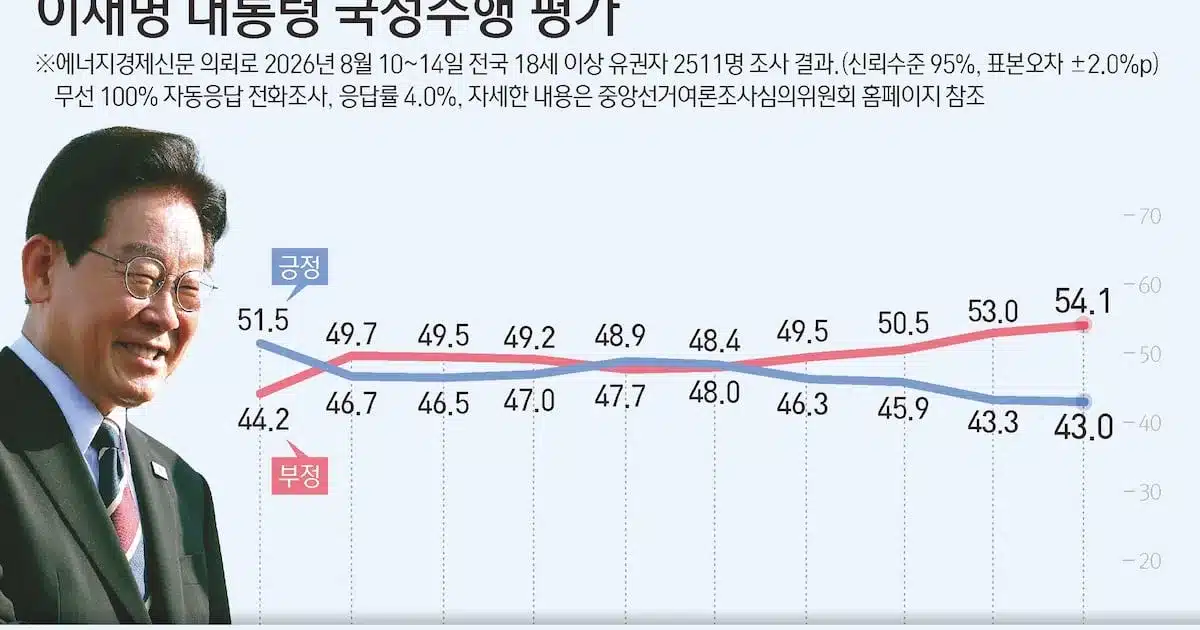
The approval rating for the current presidential administration has fallen to a new low, marking six consecutive weeks of decline. Recent polling data indicates a significant drop in public support, with the latest figures reflecting growing concerns among the electorate.
Presidential Approval Dips Below 41%
According to a survey conducted by Realmeter between October 18th and 21st, the president’s job performance received a positive evaluation from 40.2% of respondents. This represents a decrease of 2.8 percentage points from the previous week’s figures. Conversely, negative evaluations rose to 56.9%, an increase of 2.8 percentage points.
The gap between positive and negative assessments widened to 16.7 percentage points, a margin exceeding the survey’s margin of error. Approximately 3.0% of participants remained undecided or offered no opinion. This downward trend in approval began in early July, when the administration’s support stood at 48.9%. Since then, a consistent decline has been observed.
Factors Contributing to the Decline
Analysts suggest several key issues have contributed to the erosion of public confidence. The controversy surrounding the proposed relocation of the presidential office to Yongsan has fueled distrust in real estate policies. Additionally, the appointment of Cho Hee-dae as the new Supreme Court Chief Justice and ongoing debates about potential amnesty pronouncements have led to internal political friction. Concerns about national security, exacerbated by the suspension of joint military drills with the United States, have also played a role. These factors are believed to have alienated conservative voters and the demographic aged 70 and above.
Party Support Ratings Show Shifts
Beyond presidential approval, the survey also examined support for major political parties. The Democratic Party saw its support rating drop by 6.0 percentage points to 41.9%. In contrast, the People Power Party experienced a rise of 4.5 percentage points, reaching 37.6%.
Other parties registered lower support levels: the New Reform Party garnered 3.9%, the Progressive Party secured 2.3%, and the Innovation Party received 2.0%. Undecided voters accounted for 9.7%, with other parties collectively holding 2.5%.
Analysis of Party Support Trends
The decline in the Democratic Party’s support is attributed to several factors. The fading “convention effect” following the party leader’s national convention speech, coupled with the Yongsan presidential office relocation controversy and internal party disputes stemming from the appointment of Kim Min-seok to a top leadership position, are seen as significant contributors. These internal and external pressures appear to have weakened the party’s standing.
The People Power Party, meanwhile, has reportedly capitalized on the ruling party’s real estate policy controversies and the national security concerns arising from the suspended joint military drills. Observers suggest the conservative party has successfully consolidated its base and attracted voters disillusioned with the Democratic Party.
Methodology and Margin of Error
The Realmeter survey was conducted among 2,026 eligible voters nationwide, aged 18 and older. The survey employed a landline (40%) and mobile phone (60%) random dialing method. The sampling error for the survey is reported at a 95% confidence level with a margin of error of plus or minus 2.2 percentage points.
Conclusion
The latest polling data reveals a continued downward trajectory in presidential approval, reaching a new six-week low. A combination of domestic policy debates, political appointments, and national security concerns appears to be influencing public opinion. The shifts in party support ratings suggest a dynamic political landscape where voter sentiment is actively changing in response to these unfolding events.
