

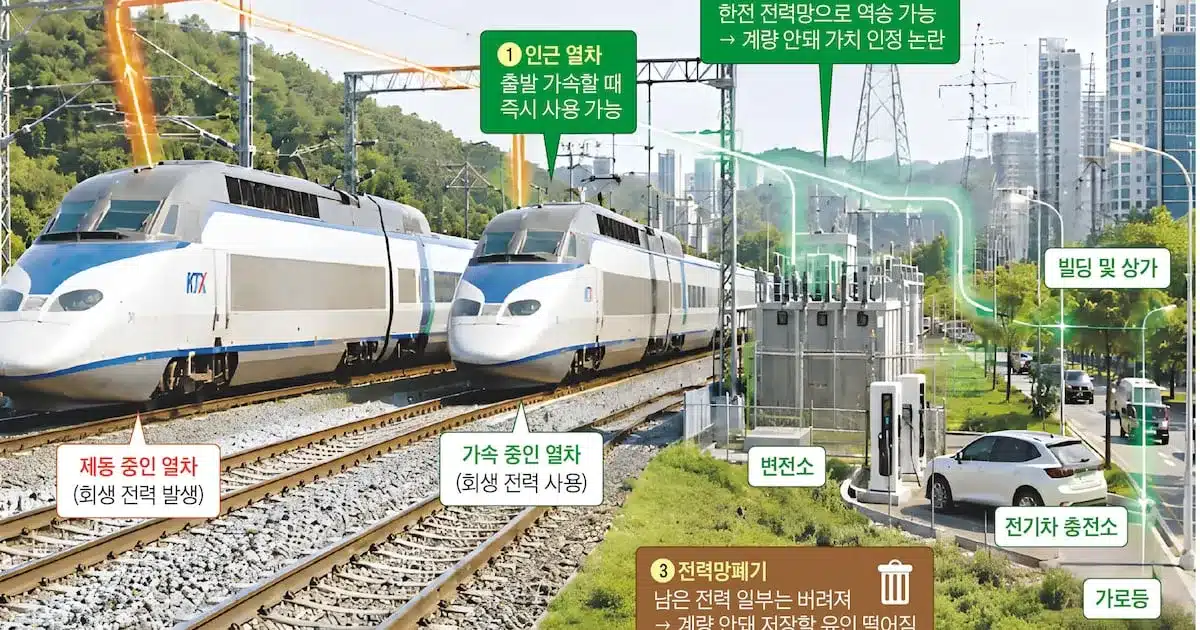
A significant amount of electricity, enough to power 30,000 households for an entire year, is being discarded annually due to a lack of systems and regulations for measuring and utilizing regenerative braking energy generated by electric trains like the KTX. While the technology to capture and store this energy exists, a legal definition for regenerative energy is absent, preventing its official measurement and accounting by the Korea Electric Power Corporation (KEPCO).
The Problem of Wasted Regenerative Energy
Electric trains, including the high-speed KTX, generate substantial amounts of electricity during deceleration. This phenomenon, known as regenerative braking, occurs when the train’s motor acts as a generator as the wheels continue to turn due to inertia while the train slows down. In 2024, these trains produced an estimated 1,185 GWh of regenerative energy, a figure projected to increase to 1,608 GWh by 2030. This amount is equivalent to the annual electricity consumption of 290,000 households.
While some of this generated electricity can be fed back into the power grid or used by other nearby trains via the overhead power lines, a portion is simply lost. Korea Railroad Corporation (KORAIL) estimates that approximately 115.5 GWh of regenerative energy is wasted each year. This wasted energy represents a considerable untapped resource, highlighting a critical inefficiency in the current railway system.
KORAIL Seeks Resolution and Reimbursement
In response to this ongoing issue, KORAIL has formally requested the Ministry of Environment’s Electricity Commission to establish the necessary infrastructure for measuring regenerative energy. Furthermore, KORAIL is seeking reimbursement for electricity charges it claims were overpaid due to the lack of measurement systems. This formal request is a preliminary step before potential legal action if the commission cannot resolve the dispute.
KORAIL’s argument is that since April of this year, it has been able to purchase some electricity directly from the electricity market, bypassing KEPCO. The electricity market, unlike KEPCO’s current system, measures regenerative energy according to international standards. KORAIL’s internal calculations suggest that from 2014 to the previous year, the financial loss due to unmeasured regenerative energy amounted to approximately 288.6 billion KRW.
Regulatory Hurdles and KEPCO’s Stance
KEPCO maintains that there is no legal basis within current domestic regulations to recognize or measure regenerative energy. The existing Electricity Business Act does not classify the equipment installed on trains that generates this energy as official electricity facilities. Consequently, electricity produced this way cannot be officially measured or settled in the electricity market.
From KEPCO’s perspective, implementing a measurement system would lead to a significant reduction in the electricity bills it receives from KORAIL. Therefore, the utility company sees little incentive to adopt such a system without a clear legal framework. KEPCO has stated that altering the billing system is difficult without the necessary legal foundation.
The Cost of Storage and Inter-Ministerial Disputes
Technologically, storing regenerative energy using systems like Energy Storage Systems (ESS) is feasible. However, the installation costs are substantial. KORAIL operates 67 substations, and equipping each with an ESS is estimated to cost 78 billion KRW per location. This prohibitive cost, coupled with the lack of official recognition for the energy, makes investment in ESS unviable for KORAIL.
The delay in addressing this issue for decades, with regenerative energy being consistently wasted, has only recently come to the forefront due to KORAIL’s direct electricity market participation. Some observers view the ongoing dispute as a conflict between the Ministry of Environment, which oversees KEPCO, and the Ministry of Land, Infrastructure and Transport, which oversees KORAIL. Despite the national importance of energy management, there are concerns that each ministry prioritizes the interests of its affiliated organizations.
International Precedents and Future Outlook
An industry expert emphasized the environmental benefits of regenerative energy, comparing its carbon emission reduction effect to planting 58 million pine trees. The expert urged for a focus on resource utilization rather than inter-agency disputes.
The Ministry of Environment has also raised concerns about the irregular, time-of-day generation patterns of regenerative energy. KORAIL counters this by pointing out that renewable sources like solar and wind power also do not generate electricity 24 hours a day.
Notably, many major countries, including Spain, the United Kingdom, Japan, France, the United States, and China, have established systems for measuring and settling regenerative energy. This international precedent underscores the need for South Korea to develop its own framework.
A KORAIL official stated, “The amount of wasted regenerative energy is expected to increase every year. It is problematic that we cannot properly utilize this energy, despite having the technology to store it, due to a lack of laws and systems.”
What is Regenerative Energy?
Regenerative energy is electricity produced by electric trains when they decelerate. The electric motor that propels the train forward acts as a generator when the train’s momentum causes the wheels to turn it during braking. This process generates electricity, which is known as regenerative energy.
