

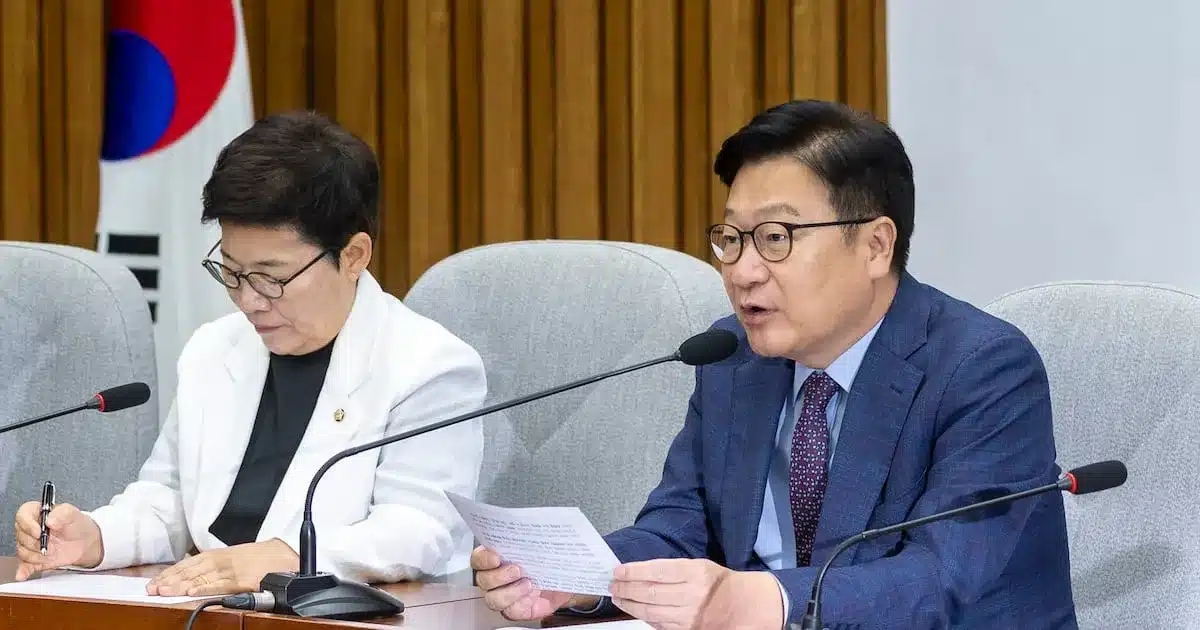
A prominent opposition figure has strongly criticized President Lee Jae-myung’s recent remarks regarding joint military exercises with the United States, questioning the president’s approach to national security in the face of North Korea’s advancing capabilities. Jung Jum-sik, the floor leader for the People Power Party, voiced his concerns on October 21st, stating, “When has any nation’s military commander ever been sidelined by an ally and then offered congratulations?”
Scrutiny Over Presidential Remarks
Jung’s statement was a direct response to President Lee’s comments made on the evening of October 19th. President Lee had expressed his “respect” to then-U.S. President Donald Trump for ordering the suspension of the combined military drills between South Korea and the U.S. This decision by President Trump, which led to a shortened exercise, has become a focal point of the opposition’s criticism.
During a party meeting at the National Assembly on October 21st, Jung elaborated on his position. “It is difficult to deny the reality that North Korea’s nuclear weapons capabilities have significantly advanced,” he stated. “Given this grave security situation, the president expressed his respect to President Trump for suspending the combined military drills, apparently in an attempt to establish a peace regime. This is truly perplexing.”
Criticism of Past Policies and Proposals
The opposition leader further pointed to other proposals and statements made by President Lee. “Furthermore, the president made proposals such as respect for North Korea and a ‘three-stage peaceful coexistence’ during the Liberation Day celebrations,” Jung recalled. He characterized these overtures as “utterly nonsensical grandstanding towards the North.”
Jung also took aim at what he described as decades of failed North Korea policy by the Democratic Party. “For the past 30 years, the Democratic Party’s administrations have been repeatedly taken advantage of by North Korea,” he asserted. “Whether it was the Sunshine Policy, the Peace and Prosperity Policy, or the current administration’s engagement policy, the Democratic Party’s approach to the North, which has merely changed its signboard over different presidencies, has ultimately been a deception of the public.”
He urged President Lee and the Democratic Party to acknowledge the errors of past North Korea policies and abandon their current strategic framework. “The Democratic Party and the Lee administration must admit the mistakes of past North Korea policies and dismantle the foundation of their North Korea strategy,” Jung demanded.
Calls for a Stronger Defense Posture
Jung emphasized the historical context of international relations, stating, “Historically, no nation has ever achieved peace by appeasing its adversaries.” He added, “Now that North Korea’s capabilities have become so advanced, we must build a strong defense capability that allows us to pursue peace from a position of strength against North Korea.”
Impact on Military Readiness
The controversy arises in the context of the Ulchi Freedom Shield (UFS) exercise, a major defensive computer-simulated command post drill between South Korea and the U.S. Following President Trump’s directive to reduce the scale of the drills, the exercise, originally scheduled for 11 days, was shortened to five days. The opposition’s critique suggests that such concessions undermine deterrence and embolden North Korea, particularly given its continued development of weapons of mass destruction.
The opposition’s stance underscores a fundamental disagreement on how to best ensure regional security. While President Lee’s administration has emphasized diplomatic engagement and de-escalation, the People Power Party advocates for a more robust military posture and a skeptical approach to North Korean overtures, arguing that genuine peace can only be achieved through overwhelming strength.
Conclusion
The debate highlights the complex geopolitical challenges facing South Korea and its alliance with the United States. As North Korea continues to modernize its military, the differing perspectives on how to manage the security environment and engage with Pyongyang are likely to remain a significant point of contention in domestic politics.
