

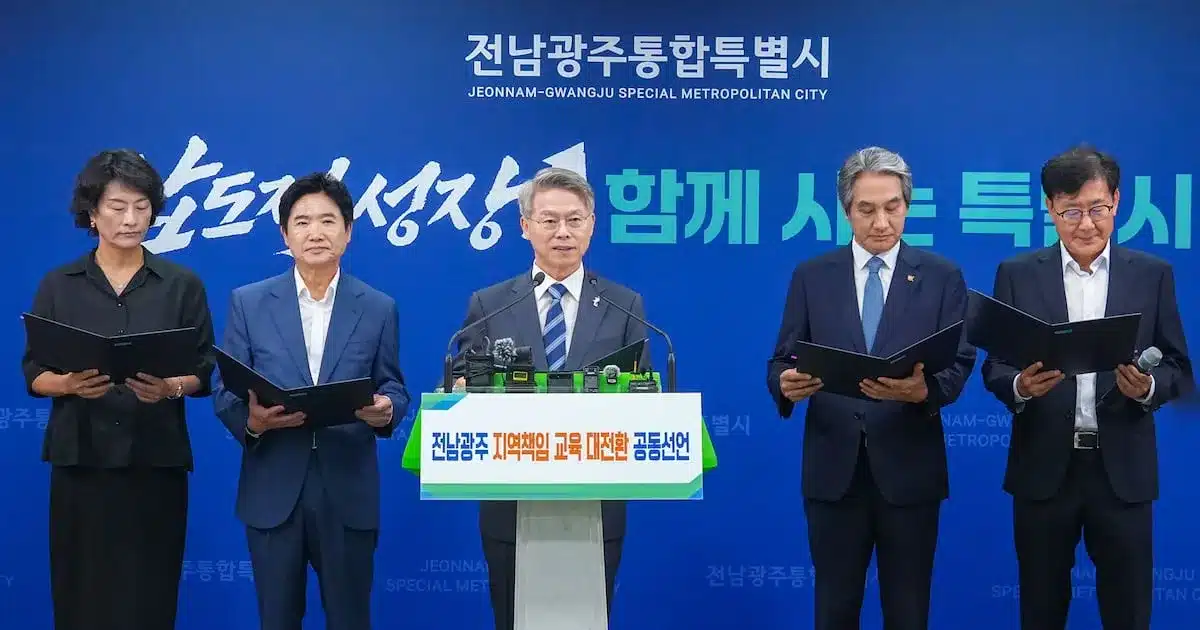
The Gwangju-Jeonnam Metropolitan City and its Metropolitan Office of Education have joined forces with regional universities to establish a comprehensive talent cultivation system. This initiative aims to create a seamless pathway from elementary and secondary education through university admissions, local industries, and ultimately, stable employment within the region.
Gwangju-Jeonnam Education Reform Initiative Launched
A joint press conference was held on the 19th at the Gwangju City Hall briefing room, where key figures announced the signing of a “Gwangju-Jeonnam Regional Responsible Education Joint Declaration.” Among the signatories were Min Hyung-bae, Mayor of Gwangju-Jeonnam Metropolitan City; Kim Dae-jung, Superintendent of the Gwangju-Jeonnam Metropolitan Office of Education; Lee Geun-bae, President of Chonnam National University; and Joo Hee Lee, President of Dongshin University and Chairperson of the Gwangju-Jeonnam Regional University Presidents’ Association. Also present was Ho-gyun Lee, Chairperson of the Junior College Presidents’ Association and President of Mokpo National University.
This declaration follows a directive from President Lee Jae-myung on the 5th, who, during a briefing on the Ministry of Education and the National Education Council’s work, cited Gwangju-Jeonnam Metropolitan City as an example and ordered a review of educational policies tailored to regional characteristics.
Establishing a Joint Development Body for Regional Education
The participating institutions have agreed to establish a “Joint Development Body.” This body will integrate the historically separated educational and industrial landscapes of Gwangju and South Jeolla Province into a single metropolitan living sphere. The initiative seeks to foster a collaborative environment involving the local government, the Ministry of Education, and universities.
A central aspect of this reform is the request for special provisions from the Ministry of Education and the National Education Council. These provisions would allow for the flexible operation of a “Gwangju-Jeonnam Type Education Process.” This process is intended to be based on subjective evaluations, including essay-based and qualitative assessments, rather than solely relying on absolute grading.
Key Objectives of the Reform
- Developing Regional Admission Systems: The initiative will jointly research and develop a “regional responsible admission system” and gradually expand the scope and proportion of regional talent selection.
- Strengthening Industry-Academia Links: Efforts will be made to increase the number of university programs related to strategic regional industries, particularly semiconductors. This aims to ensure a continuous supply of skilled talent.
- Requesting Regulatory Changes: The joint body will formally propose to the Ministry of Education, the National Education Council, and the Korean Council for University Education a relaxation of regulations concerning university admissions and quotas. This is crucial for nurturing talent in strategic sectors like semiconductors.
Focus on Subjective Evaluation for Talent Cultivation
Superintendent Kim Dae-jung emphasized the critical need for talent in future-oriented industries such as semiconductors within the Gwangju-Jeonnam region. “The core of this joint development body is the reflection of subjective, essay-based, and qualitative evaluations in university admissions,” he stated.
Kim further elaborated on the strategy: “By utilizing the current system, we will expand subjective evaluations and secure the necessary number of regional quotas and students for semiconductor talent selection.” This suggests a move towards a more nuanced approach in identifying and admitting students with potential in specialized fields.
Mayor Outlines Phased Implementation and Social Consensus
Mayor Min Hyung-bae highlighted the goal of creating admission plans suited to regional characteristics through the joint development body. “We will work together to consider the educational process,” he said. “We will proceed with policy implementation in phases, ensuring thorough and sufficient social discussion and verification, taking into account the regional and student-specific circumstances.”
This phased approach underscores a commitment to building consensus and ensuring that the reforms are both effective and equitable. The emphasis on subjective evaluation aims to move beyond standardized testing and embrace a more holistic assessment of student capabilities, fostering a more robust and responsive educational ecosystem within the Gwangju-Jeonnam region.
Future Outlook and Regional Development
The collaborative effort between the Gwangju-Jeonnam Metropolitan City, its Office of Education, and regional universities signals a significant shift in educational policy. By focusing on subjective evaluations and strengthening industry-academia ties, the region aims to cultivate a skilled workforce that can drive economic growth and innovation. The establishment of the Joint Development Body is expected to be a pivotal step in this direction, ensuring that educational strategies are aligned with the specific needs and future potential of the Gwangju-Jeonnam area.
The success of this initiative will likely depend on the effective collaboration between educational institutions, government bodies, and local industries, as well as the ability to secure necessary regulatory adjustments. The long-term vision is to create a self-sustaining talent pipeline that benefits both the students and the economic vitality of the region.
