

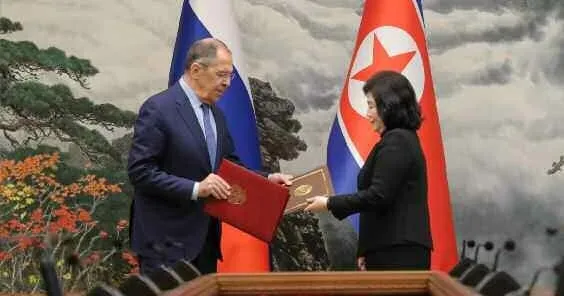
Russian Foreign Minister Sergey Lavrov has sent a congratulatory message to North Korean counterpart Choe Son Hui on the occasion of Korea’s Liberation Day, reaffirming both nations’ commitment to strengthening cooperation. The message, reported by North Korea’s Korean Central News Agency (KCNA) on August 18, underscores the deepening strategic alignment between Moscow and Pyongyang.
Lavrov’s Message and Historical Context
In his August 14th message, Lavrov highlighted the historical significance of the joint efforts of Soviet troops and Korean patriots in defeating Japanese militarism and liberating Korea from colonial rule. He stated that this victory, achieved at the end of World War II, hastened the war’s conclusion. Lavrov drew a parallel between historical struggles and contemporary conflicts, specifically referencing North Korean soldiers participating in what he termed “operations to drive out Nazi collaborators and foreign mercenaries from Ukrainian territory.” This statement aligns with Russia’s official narrative that the current Ukrainian government is Nazi-aligned and that its forces are engaged in a struggle against “foreign mercenaries” on Ukrainian soil.
Russia has been actively involved in Ukraine since February 2022, framing its actions as a denazification effort. North Korea has reportedly been providing military support to Russia since 2024, a development that has drawn international scrutiny and condemnation.
Shared Vision for a New World Order
Lavrov articulated a shared vision between Moscow and Pyongyang for establishing a new, just world order. He asserted that both capitals are united in their efforts to build a new global system based on multipolarity, genuine equality, and mutual interests. He further pledged to continue this path alongside Russian President Vladimir Putin and North Korean National Defence Commission Chairman Kim Jong Un, emphasizing the robust and multifaceted strengthening of Russia-North Korea cooperation.
The Russian Foreign Minister stressed that this collaboration serves the interests of both nations’ peoples and contributes to regional and international security. This sentiment echoes statements made by President Putin, who previously described the relationship between Moscow and Pyongyang as having reached an “unprecedentedly high level of comprehensive strategic partnership.” Putin expressed confidence in continued joint efforts to build a more just and democratic world order, addressing pressing global and international issues.
Reciprocal Communications and Strategic Partnership
KCNA reported that Kim Jong Un also sent a reply message to President Putin. In his response, Kim expressed pride in the enduring relationship between North Korea and Russia, which he described as a “noble tradition of comradeship” built on a “common struggle for justice.” He conveyed his optimism about further developing this relationship with Putin, anticipating a more brilliant future for bilateral ties.
The exchange of messages highlights a coordinated diplomatic effort to solidify their alliance. While Putin’s message was sent on August 14th, North Korea publicly disclosed it on August 15th, followed by the release of Lavrov’s message four days later. This timing suggests a deliberate strategy to amplify their joint messaging and reinforce their strategic partnership on the international stage.
Implications of Russia-North Korea Cooperation
The growing military and political ties between Russia and North Korea have significant implications for regional and global security. The alleged North Korean arms supplies to Russia have been a particular point of concern for the international community, potentially violating multiple UN Security Council resolutions. This cooperation could embolden both nations, further destabilizing existing geopolitical dynamics, particularly concerning the conflict in Ukraine and tensions on the Korean Peninsula.
The shared rhetoric about challenging the existing world order and establishing a new one based on multipolarity suggests a coordinated effort to counter Western influence. Both nations have faced international sanctions and diplomatic isolation, leading them to seek stronger alliances with like-minded states. The strengthening of the Russia-North Korea relationship represents a significant development in this trend, potentially reshaping international relations and alliances in the years to come.
Conclusion
The exchange of congratulatory messages between Russian and North Korean foreign ministers, coupled with reciprocal communications between their respective leaders, signals a deepening strategic alignment. This reinforced partnership, framed within a historical context of shared struggles and a future vision of a new world order, underscores the growing cooperation between Moscow and Pyongyang. As this alliance solidifies, its impact on regional stability and the broader international security landscape warrants close observation.
