

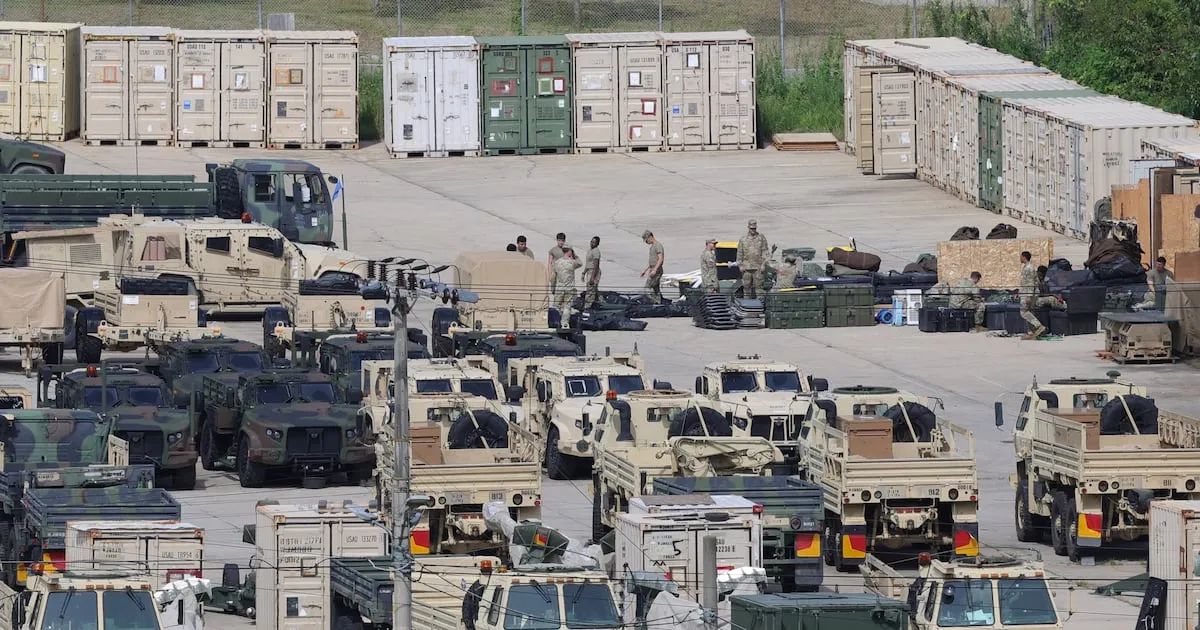
North Korea has issued a stern warning, stating that the joint US-South Korea military exercise, Ulchi Freedom Shield (UFS), is creating an unprecedented level of security instability. The reclusive nation declared that such provocations would inevitably lead to a response, hinting at actions that would constitute ‘just retaliation’.
Escalating Tensions Amid Ulchi Freedom Shield Drills
The warning came via a statement released through state media on the 14th. North Korea’s foreign affairs spokesperson detailed concerns that the current UFS exercise has escalated significantly compared to previous years. The spokesperson highlighted that the drills involve a vast array of military personnel and advanced combat technologies from both the United States and South Korea, including elements of the ‘UN Command sending countries’.
Specific training activities mentioned include large-scale field exercises, such as the ‘Warrior Shield’ component, alongside simulations of unmanned aerial warfare, electronic warfare, and cyber warfare. These advanced training scenarios are designed to prepare forces for modern conflict environments. The Ulchi Freedom Shield exercise itself is a computer-simulated command post exercise, traditionally conducted by the US and South Korea, scheduled to run from August 17th to 27th. In conjunction with the main exercise, 14 large-scale, division-level field training events are also planned.
North Korea’s Interpretation of US-South Korea Intentions
North Korea asserted that the United States has openly acknowledged that this joint military exercise differs markedly from those conducted over the past five years. According to Pyongyang’s interpretation, the US has emphasized a focus on honing wartime execution capabilities aligned with new offensive strategies. North Korea views this as a clear admission that the ultimate objective of these drills is to prepare for a potential military confrontation with North Korea.
Pyongyang argues that this stance effectively confirms that what the US and South Korea describe as ‘routine’ and ‘defensive’ exercises are, in essence, rehearsals for an invasion. The North Korean statement further contended that the ongoing large-scale war games between the US and South Korea are exacerbating security instability on the Korean Peninsula and beyond, creating a situation far more volatile than in previous years.
Concerns Over Regional Military Buildup
The statement specifically pointed to the escalating US military posture globally and the corresponding expansion of South Korean and Japanese military capabilities. It highlighted the intensification of the US-South Korea-Japan trilateral military cooperation, which North Korea views as a direct response to perceived threats. This trilateral alliance, coupled with the expansion of military power in Japan and South Korea, is seen by Pyongyang as increasing the risks associated with the UFS joint military exercise, especially given the comprehensive mobilization of military assets and operational methods available to the US and South Korea.
North Korea maintains that these ‘invasion war games’ by adversarial nations pose a significant threat to its national security and the regional security environment. The nation reiterated its long-standing principle of responding to new levels of threat with an equally strong level of deterrence.
Pledge of Decisive Retaliation
The statement concluded with a resolute declaration: “The will of the Democratic People’s Republic of Korea to resolutely defend the supreme interests of national security by applying the strongest and most overwhelming countermeasures against all sorts of hostile acts by outside forces is unshakable.” North Korea vowed that the escalating military confrontation being orchestrated by adversaries would not be tolerated. It promised that its position would be clearly demonstrated through “responsible and decisive acts of just retaliation” that would leave no room for the enemy’s provocations or challenges.
This strong rhetoric underscores the heightened tensions on the Korean Peninsula, as North Korea perceives the joint military exercises as a direct threat to its sovereignty and security, while the US and South Korea maintain the drills are defensive in nature and necessary for regional stability.
