

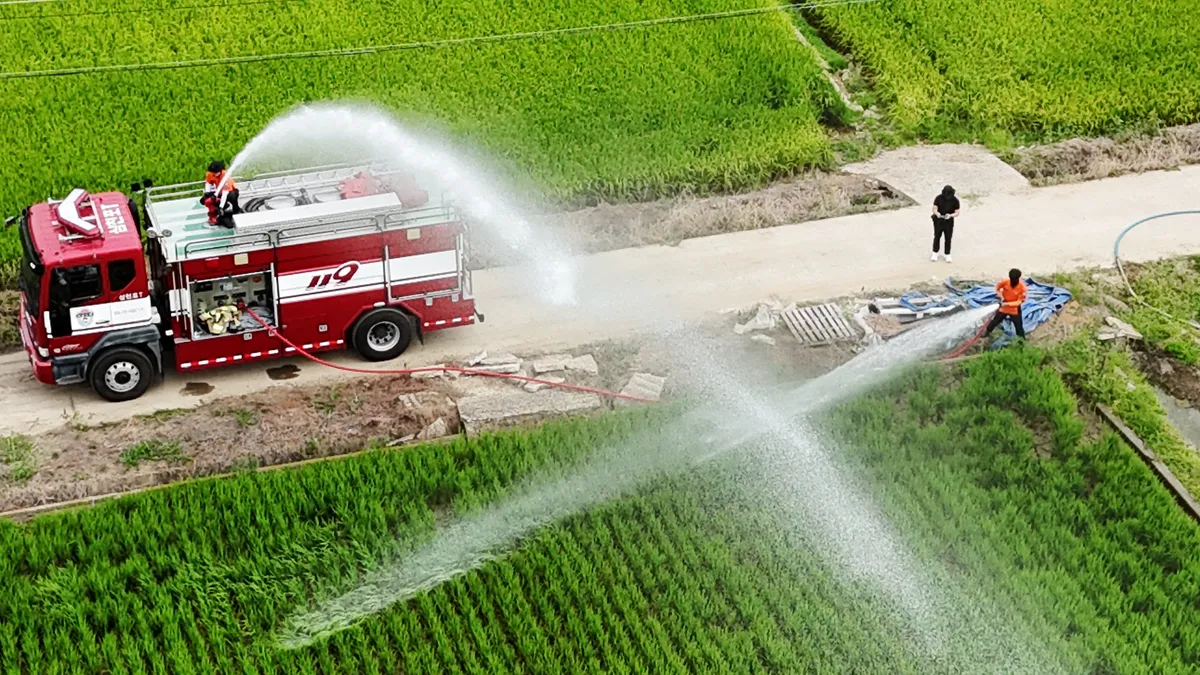
In response to an unprecedented and severe drought gripping Gyeongnam Province, approximately 200 fire trucks from across South Korea were deployed on July 12th to provide critical water support. These vehicles, some traveling over 300 kilometers from regions like Gyeonggi and Gangwon, worked tirelessly to spray water onto parched and cracked rice paddies. The mobilization followed the National Fire Agency’s declaration of a national disaster response, a measure allowing for the nationwide deployment of firefighting resources. This is the second time such a declaration has been made due to drought conditions, the previous instance being in August of the previous year in Gangneung, Gangwon Province.
Nationwide Firefighting Effort Addresses Critical Water Shortages
Firefighters expressed the emotional toll of witnessing the widespread crop damage. Lee Chang-hwan, a firefighter from Hoengseong Fire Station in Gangwon, described his arrival in Miryang, Gyeongnam, at 4 AM after a four-hour drive. “Seeing the cracked fields, it felt like this drought was happening to me, not someone else,” he shared, highlighting the personal impact of the crisis.
Data from the Gyeongnam Provincial Fire Headquarters indicates the scale of the operation. On July 12th, the deployed fire trucks participated in a total of 653 water-spraying missions, delivering 4,769 tons of agricultural water to affected areas. This significant effort underscores the severity of the water deficit impacting the region’s agricultural sector.
Record-Breaking Heat and Minimal Rainfall Exacerbate Drought Conditions
The current drought in Gyeongnam is a direct result of critically low rainfall combined with record-breaking heatwaves. In July, the province received only 73.4 millimeters of rain, a mere 23% of the annual average. This figure represents the lowest rainfall recorded for July since meteorological observations began in 1973. The situation was further compounded by extreme temperatures. On July 2nd, Yangsan, Gyeongnam, recorded a daytime high of 42.5 degrees Celsius, setting a new all-time temperature record for South Korea and the first instance of temperatures exceeding 42 degrees Celsius nationwide.
These extreme weather conditions have led to a rapid depletion of water resources essential for agriculture. According to the Korea Rural Community Corporation, the average water storage rate in Gyeongnam’s agricultural reservoirs stands at a mere 32.8%, less than half of the typical level for this time of year. Crop damage has been reported across 5,703 farms, affecting approximately 2,121 hectares of farmland.
Wider Regional Impact and Grim Forecast
The drought’s impact extends beyond Gyeongnam, with similar dire situations reported in the Honam region (comprising Gwangju, Jeollanam, and Jeollabuk provinces) and the Daegu and Gyeongbuk regions. In these areas, average agricultural water storage rates hover between 30% and 40%. Water levels in reservoirs supplying major cities like Daegu, Gyeongsan, and Yeongcheon have plummeted, with the Unmun Dam, a key water source, experiencing a storage rate as low as 24.7%.
The crisis is also affecting daily life. Water supply has been cut off in island villages and mountainous areas not connected to the main water systems. In Gyeongnam alone, 26 villages are currently under restricted water usage. This widespread water scarcity poses a significant threat to both agricultural output and the daily lives of residents across multiple provinces.
Limited Rainfall Expected to Offer Little Respite
Looking ahead, the Korea Meteorological Administration has forecast some rain for parts of the southern regions on July 13th and 14th. However, officials caution that the expected precipitation is unlikely to be sufficient to alleviate the severe drought conditions. The ongoing extreme weather patterns highlight the vulnerability of South Korea’s agricultural sector and water management systems to climate change, necessitating long-term strategies for drought resilience.
