

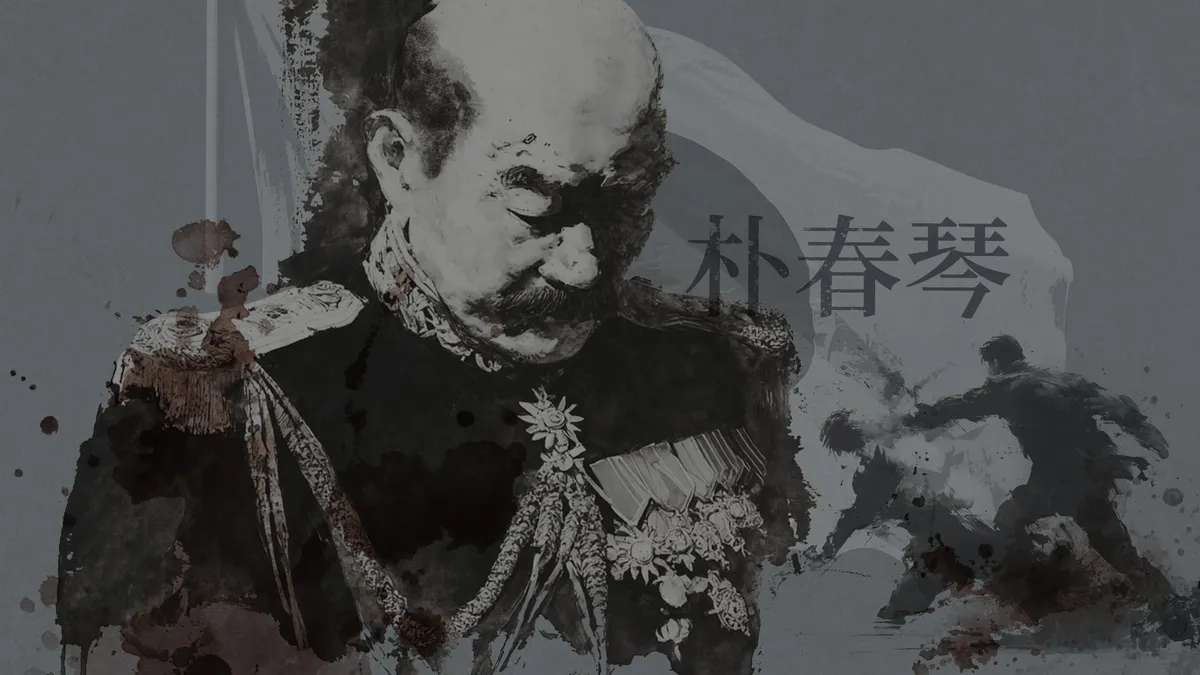
The life of Park Chun-geum (1891-1973) stands as a stark and disturbing chapter in Korean history, characterized by extreme pro-Japanese collaboration and violence. Born in Yangsan, Gyeongsangnam-do, and raised in Miryang, Park’s early life was marked by hardship and a lack of formal education. He learned Japanese while working as a military orderly for the Japanese army in Daegu in 1905 during the Russo-Japanese War. By 1907, he had moved to Japan, where he held various menial jobs, including a deliveryman, a tomok laborer, a bicycle repairman, and a coal mine worker, reflecting the difficult lives of many Koreans living abroad during the Japanese colonial period.
Rise to Infamy as a Pro-Japanese Agitator
Park Chun-geum’s trajectory shifted dramatically in the 1910s, as he began to emerge as a prominent figure within violent, pro-Japanese organizations among Koreans in Japan. By 1917, he had become the president of the Nagoya Korean Residents Association, a position that placed him at the center of a network deeply intertwined with Japanese ultranationalist circles. He received tutelage from Ryoichi Uchiyama, a key figure behind the ultranationalist group Kokuryukai (Black Dragon Society) and a spiritual mentor to Japanese extremist factions.
In the 1920s, Park founded the Sang-aehoe (Mutual Aid Society) in Tokyo, ostensibly promoting harmony and coexistence between Koreans and Japanese. The organization later evolved into the Sang-aehoe in 1921. Publicly, its stated goals included providing job placement, counseling, and communal lodging for Korean laborers. However, the reality was far more sinister. The Sang-aehoe, under Park’s leadership, functioned as a tool for the Japanese authorities and employers to oppress and exploit Korean laborers. It was, in essence, a forced labor recruitment organization and a gang that used intimidation and violence.
The Sang-aehoe was reportedly established by the Japanese to control the influx of Korean laborers following the March 1st Movement in 1919. Park willingly became its front man. The organization engaged in acts of terror against Korean labor activists in Japan. Reports suggest that the Sang-aehoe extorted 20-30% of the wages from young female entertainers under the guise of various fees. They also committed sexual violence and physical assault. Members of the Sang-aehoe, armed with clubs, Japanese swords, and martial arts, frequently attacked those who refused to join, incidents that likely would not have occurred without the tacit approval of the Japanese police. Park’s organization also collected funds from Japanese companies, ostensibly for disaster relief, further solidifying his role as an exploiter of Korean labor and an agent of the Japanese government.
Escalation of Violence and Political Ambitions
Park Chun-geum’s activities intensified following the Great Kanto Earthquake in September 1923. He organized a “Labor Volunteer Corps” of 300 Korean laborers. Rather than assisting Koreans, this group was involved in the “disposal of bodies” and the “removal and use of deceased Korean laborers,” allegedly to cover up the mass killings of Koreans that occurred in the aftermath of the earthquake. This collaboration with Japanese officials, including former Governor-General of Korea Akashi Nao, aimed to conceal the truth about the massacre of thousands of Koreans.
In 1928, when the Sang-aehoe was reorganized as a stock company, the former Governor-General of Korea, Maruyama Tsurukichi, became its president. Park continued to consolidate his power, establishing the “Labor Commerce Association” in Seoul in 1924 and participating in the pro-Japanese organization “Kakpa Yujeonmaeng” (League of Friends of the Fatherland). When the Sang-aehoe headquarters moved to Gyeongseong (Seoul) in January 1924, Park received 40,000 won in funding from the Government-General of Korea, a sum equivalent to over 800 million won today.
Park’s violent tendencies were not limited to labor disputes. In April 1924, after the Dong-A Ilbo newspaper criticized the League of Friends of the Fatherland, Park lured the newspaper’s owner, Kim Seong-su, and editor, Song Jin-u, to a restaurant and assaulted them. In 1928, dissatisfied with the Ilbo newspaper’s reporting, he physically attacked its editor, Han Ki-ak, with a club. His reign of terror extended to rural areas as well. In July 1928, upon hearing of a dispute over land ownership in Haenam, Jeollanam-do, Park led a group of gangsters to the island, raided a youth association, and forced the residents to sign land sale contracts under duress. However, his luck ran out in 1928 when he visited Haenam again; this time, residents fought back, beating him and stripping him of his belongings.
Entry into Japanese Politics and Continued Collaboration
Park’s pro-Japanese activities continued unabated. He compelled Koreans traveling to Japan to purchase a “Sang-aehoe Travel Permit,” a policy that was eventually abolished by the Japanese government after independence activist Ahn Chang-ho publicly denounced it. Despite these setbacks, Park’s fervent pro-Japanese stance remained unwavering.
In the 1930s, Park publicly declared his loyalty to Japan, stating in the newspaper “Our Country, Imperial Japan” that Koreans should embrace the Japanese Empire with love and loyalty, considering it their duty and a calling of their hearts. His unwavering commitment to collaboration earned him a seat in the Japanese House of Representatives. In 1932, he was elected to the 18th general election in Tokyo, representing the 4th district of Tokyo. Despite facing accusations of election law violations, including receiving political funds, he managed to evade punishment. After a period out of office, he was re-elected to the House of Representatives in 1940 and served until 1942. He holds the distinction of being the first person of Korean descent to serve in the Japanese Diet, a feat achieved with the support of Japanese elites who sought to portray Japanese colonial rule as successful.
During his tenure as a Diet member, Park advocated for the “equal rights of Koreans and Japanese” and the “recovery of suffrage and self-governance.” However, given his past actions, these pronouncements are widely believed to have lacked sincerity. He later became involved in lucrative business ventures in Korea, such as the Chunman Gwangsan mine. Following the outbreak of the Sino-Japanese War, he delivered speeches promoting wartime mobilization, echoing the Japanese government’s propaganda for national assimilation.
In the final stages of the Pacific War, Park organized the “Yamato Dōmei” (Great Harmony Alliance) to promote the “perpetual existence of the Japanese nation and the unity of the homeland and colony.” In January 1944, at a “Student Soldier Mobilization Lecture” organized by the Mainichi Shimbun, Park delivered a chilling speech: “If 4,000 or 5,000 student soldiers die, leading to the well-being of 25 million people, what better thing could there be? Now, the 100 million people must unite their hearts and minds to complete this holy war, distinguishing neither between the homeland and the colonies… Students, guide the homeland and colonies onto the correct and bright path. Shed your blood to open the way for 25 million people. Our only path is national assimilation.”
The Final Days and Lingering Controversy
Just 50 days before Korea’s liberation, on June 24, 1945, Park became the leader of the “Great Righteous Party,” advocating slogans like “Defeat the US Military,” “Unite Homeland and Colonies,” and “Victory in the Final Battle.” At this time, Japan’s defeat was imminent, and the question was only when it would surrender.
On July 24, 1945, the Great Righteous Party held the “Asian Peoples’ Segregation Conference” at Bumin-gwan, which ended in failure due to a bomb attack by three young men: Kang Yun-gu, Yu Man-su, and Jo Mun-gi. There are also accounts suggesting that Park Chun-geum had planned to round up 300,000 anti-Japanese Koreans nationwide and execute them. It is believed that the Great Righteous Party may have been tasked with “handling” the 3,000 individuals arrested by the Japanese police from early July to August 15, 1945.
After liberation, Park Chun-geum attempted to secure a position within the Preparatory Committee for National Establishment but was rejected. He then fled to Japan. In 1948, after the establishment of the Republic of Korea, the Committee for the Prosecution of Anti-National Acts designated Park as a Class 1 perpetrator of anti-national activities and sought his extradition, but this was never realized. He continued to exert influence within the Korean diaspora in Tokyo, serving as an advisor to the Tokyo branch of the Mindan (Korean Residents Association in Japan). He organized the “Association for the Promotion of National Unification” in 1955 and founded the “Japan-Korea Cultural Association” in 1957, serving as its president. In 1962, he became the president of the Asia Sangsa Company in Tokyo.
During a brief return to Korea in 1963, he remarked, “I have returned to my homeland, which has become an independent nation, with pride.” His death occurred in Tokyo on March 31, 1973, at the age of 81. While Park’s actions during his lifetime were egregious, his post-mortem legacy proved equally controversial. His body was secretly buried in an unmarked grave in Gyodong, Miryang. In 1992, the Japan-Korea Cultural Association erected a “Songdeokbi” (Monument to Virtuous Deeds) at his re-interred gravesite. However, upon learning of this, Miryang citizens protested, leading to the removal of the tomb in 2002 and the dismantling of the monument. While this represented a form of justice, it was a limited one.
Park Chun-geum genuinely believed in Japan’s “Pan-Asianism” and the “Five Races Harmony” ideology, which underpinned Manchukuo’s rule. Some accounts suggest he did not consider Japan’s defeat inevitable even during the Bumin-gwan conference. Regardless of his personal beliefs, his actions—betraying and trampling on his own people to achieve wealth and fame—mark him as an exceptionally malicious and wicked individual. He has been described as a “representative figure of a violent, extreme pro-Japanese collaborator,” whose shameless audacity seemed to amplify the evil of his deeds.
