

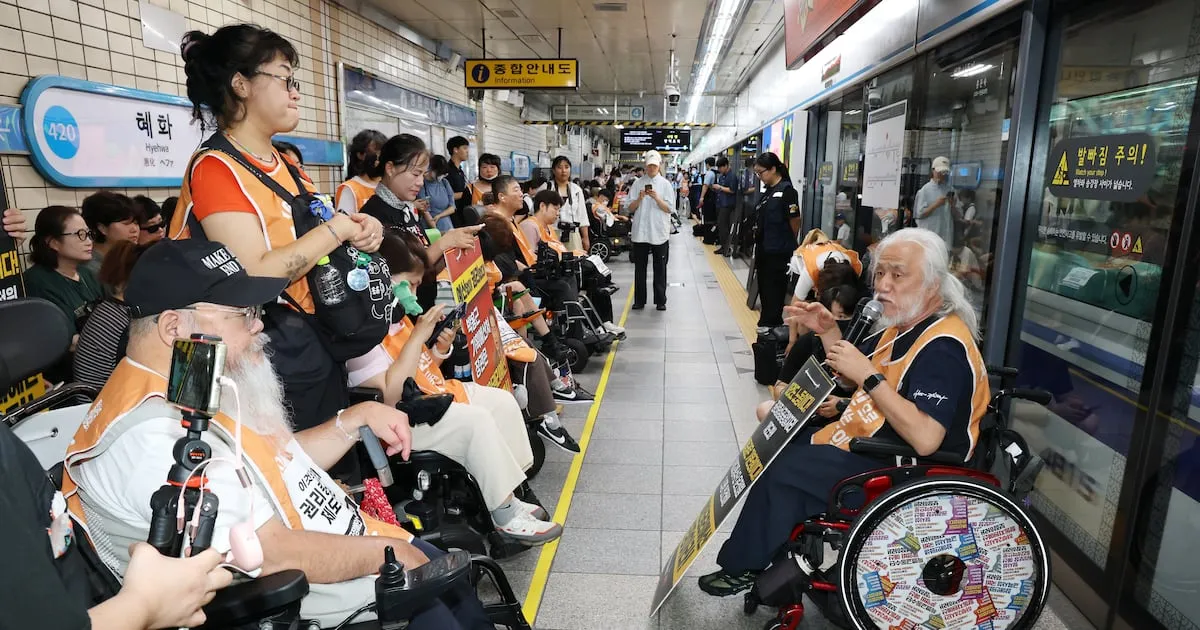
Commuters faced significant disruptions on the morning of November 10th as members of the National Federation of Disabled Persons’ Organizations (Jeonjangyeon) staged a subway boarding protest. The action, which took place at Yongsan Station on Seoul Subway Line 1, caused trains heading towards Cheongnyangni Station to bypass the platform for approximately two hours. The disruption began around 8:10 AM and concluded shortly after 10:00 AM, with normal operations resuming thereafter.
Protest Details and Impact
Jeonjangyeon activists initiated their protest around 8:00 AM at Yongsan Station, targeting the northbound platform of Line 1. The group’s strategy involved boarding trains and refusing to disembark, effectively preventing them from departing the station. This tactic led to trains on the affected line passing through Yongsan Station without stopping to allow passengers to board or alight.
The Korean Railroad Corporation (Korail) issued safety advisories via text message to inform the public about the situation. At approximately 10:14 AM, Korail announced that the non-stop passage at Yongsan Station had concluded and that services were returning to normal. The protest action at this specific location lasted for about two hours, from 8:10 AM to 10:06 AM.
Simultaneously, another group of Jeonjangyeon members conducted a similar boarding protest at Hyehwa Station on Line 4. However, the transit authority at Hyehwa Station implemented a policy of allowing trains to pass through without stopping, which led to the activists concluding their demonstration there by around 9:00 AM. This difference in response between stations highlights the varied approaches taken to manage such protest actions.
Jeonjangyeon’s Demands and Future Actions
Following the subway protests, Jeonjangyeon members relocated to a demonstration in front of the Ministry of Economy and Finance in Seoul, commencing at 11:00 AM. This larger gathering was organized to publicly announce their decision regarding the protest. The core demand of Jeonjangyeon is the inclusion of budget allocations for the rights and welfare of disabled individuals in the government’s upcoming budget proposal.
The organization has committed to a sustained campaign to achieve its objectives. They announced plans to continue their subway boarding protests every Monday morning at Hyehwa Station until November 24th. Furthermore, Jeonjangyeon indicated that similar guerrilla-style boarding protests would be carried out concurrently at other stations to amplify their message and pressure the government.
Background of the Movement
Jeonjangyeon, representing disabled individuals, has been advocating for increased government support and the establishment of a dedicated budget to ensure the rights and welfare of its constituents. The group argues that current budget proposals do not adequately address the needs of disabled persons, particularly concerning access to services, employment, and social inclusion.
The boarding protest tactic, while disruptive, is intended to draw public attention to the urgency of their demands. By directly impacting the daily commutes of thousands of citizens, Jeonjangyeon aims to compel policymakers to engage more seriously with their concerns. The organization has previously employed various forms of protest, including sit-ins and rallies, to advocate for policy changes and budget allocations.
The specific budget items in question include funding for accessible transportation, employment support programs, independent living services, and educational opportunities for disabled individuals. Jeonjangyeon asserts that these are not merely welfare measures but essential components of ensuring equal rights and opportunities within society.
Government Response and Public Reaction
While the immediate response from Korail was to manage the disruption by allowing trains to bypass affected stations, the broader governmental response to Jeonjangyeon’s demands is still unfolding. The Ministry of Economy and Finance is the key ministry responsible for budget allocation, and the protests are directly aimed at influencing its decisions.
Public reaction to the protests has been mixed. While some commuters expressed frustration over the delays and inconvenience, others have shown understanding or support for the cause, acknowledging the importance of disability rights. Social media platforms and online forums saw discussions reflecting both empathy and criticism regarding the protest methods.
The government has previously stated its commitment to improving the lives of disabled citizens but has also cited fiscal constraints as a limiting factor in budget increases. Negotiations and discussions between disability advocacy groups and government bodies are ongoing, with the upcoming budget deliberations serving as a critical juncture.
Looking Ahead
Jeonjangyeon’s planned continued protests indicate a determination to keep the issue of disability budget allocations at the forefront of public and governmental attention. The success of their campaign will likely depend on their ability to maintain public support, sustain their protest actions, and effectively negotiate with the Ministry of Economy and Finance.
The situation at Yongsan Station serves as a stark reminder of the ongoing challenges faced by disabled individuals in South Korea and the lengths to which advocacy groups will go to secure necessary resources and policy changes. The coming weeks will be crucial in determining whether the government will meet Jeonjangyeon’s demands for increased budget provisions for disability rights and welfare.
