

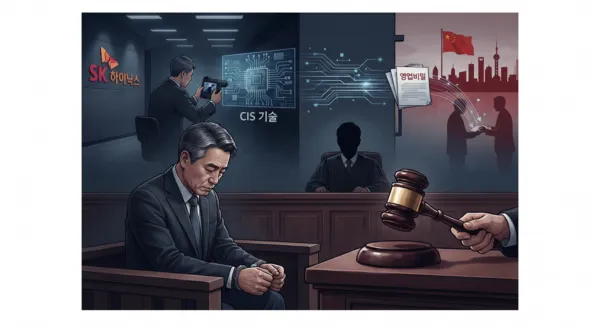
An appeals court has upheld an 18-month prison sentence for a former SK Hynix employee accused of leaking the company’s trade secrets to Chinese firms. The individual, identified as Mr. Kim, was found guilty of violating the Act on Prevention of Divulgence and Protection of Industrial Technology and the Unfair Competition Prevention Act, along with charges of business betrayal.
Trade Secret Leak Details Emerge
The case centers on allegations that Mr. Kim, while employed at SK Hynix’s China division in 2022, illicitly printed and photographed confidential documents related to the company’s advanced CIS (CMOS Image Sensor) technology. These materials were reportedly accessed and copied from the company’s internal document management system.
CIS technology is crucial in converting light captured by lenses into electrical video signals. Its applications are widespread, ranging from smartphones and autonomous vehicles to sophisticated medical equipment, highlighting its significant commercial value.
Allegations of Job Application Misuse
Investigators believe Mr. Kim utilized the leaked SK Hynix data during the resume writing process after receiving job offers from Chinese companies, including HiSilicon, a subsidiary of Huawei. Evidence suggests that some of this information was subsequently included in his resume and transmitted to Chinese businesses.
Initial Ruling and Appeal
The initial ruling by the Seoul Central District Court found Mr. Kim guilty of leaking trade secrets, imposing an 18-month prison sentence. However, the court acquitted him on charges related to the leakage of data concerning hybrid bonding technology, a key component of HBM (High Bandwidth Memory). This decision was based on the reasoning that the HBM-related materials did not meet the government’s definition of “advanced technology” under the relevant industrial technology protection guidelines.
The prosecution appealed this specific acquittal, arguing that there were factual and legal errors in the initial judgment. However, the appellate court, reviewing the case, affirmed the first court’s decision, dismissing the prosecution’s appeal.
Appellate Court’s Rationale
In its ruling, the appellate court emphasized the severity of Mr. Kim’s actions. The court stated, “The defendant’s act of leaking a large volume of results obtained through the victim company’s years of investment and utilizing this information in a resume submitted to Chinese companies is grave.”
The court further elaborated on the potential consequences of leniency, warning, “If such crimes are treated lightly, it could weaken the incentive for corporate technological development and lead to a situation where overseas competitors can easily steal domestic technology under the guise of hiring.”
Mitigating Factors Considered
Despite the firm stance on the severity of the crime, the court acknowledged certain factors that were considered in favor of Mr. Kim. These included his admission of the offenses and the recovery of a significant portion of the leaked materials.
The court’s decision underscores the critical importance of protecting industrial technology and trade secrets in a competitive global market. The penalties aim to deter similar actions that could undermine a company’s innovation and competitive edge.
Broader Implications for the Semiconductor Industry
This case highlights the ongoing challenges faced by technology companies, particularly in the highly competitive semiconductor sector, in safeguarding their intellectual property. The rapid pace of innovation in areas like memory technology and image sensors necessitates robust security measures and strict enforcement of intellectual property laws.
The involvement of Chinese companies in such alleged leaks also points to the geopolitical dimensions of technological competition. Nations and corporations alike are increasingly focused on securing their technological advantages, leading to heightened scrutiny of cross-border technology transfers and potential espionage.
The Role of Industrial Technology Protection
The legal framework surrounding industrial technology protection is designed to prevent the unauthorized disclosure of proprietary information that could harm a company’s competitive position or national technological capabilities. The definition of what constitutes “industrial technology” or “trade secret” can be complex and is often a point of contention in legal proceedings, as seen in the HBM-related data aspect of this case.
The court’s decision to uphold the sentence, while acknowledging mitigating factors, sends a strong message about the legal consequences of betraying corporate trust and compromising valuable technological assets. The focus remains on ensuring that companies can continue to invest in research and development with the assurance that their innovations will be protected.
Conclusion
The appellate court’s decision reinforces the legal penalties for individuals who betray the trust of their employers by leaking sensitive company information. The 18-month prison sentence for the former SK Hynix employee serves as a stark reminder of the legal ramifications and the significant efforts required to protect vital trade secrets in the global technology landscape.
