

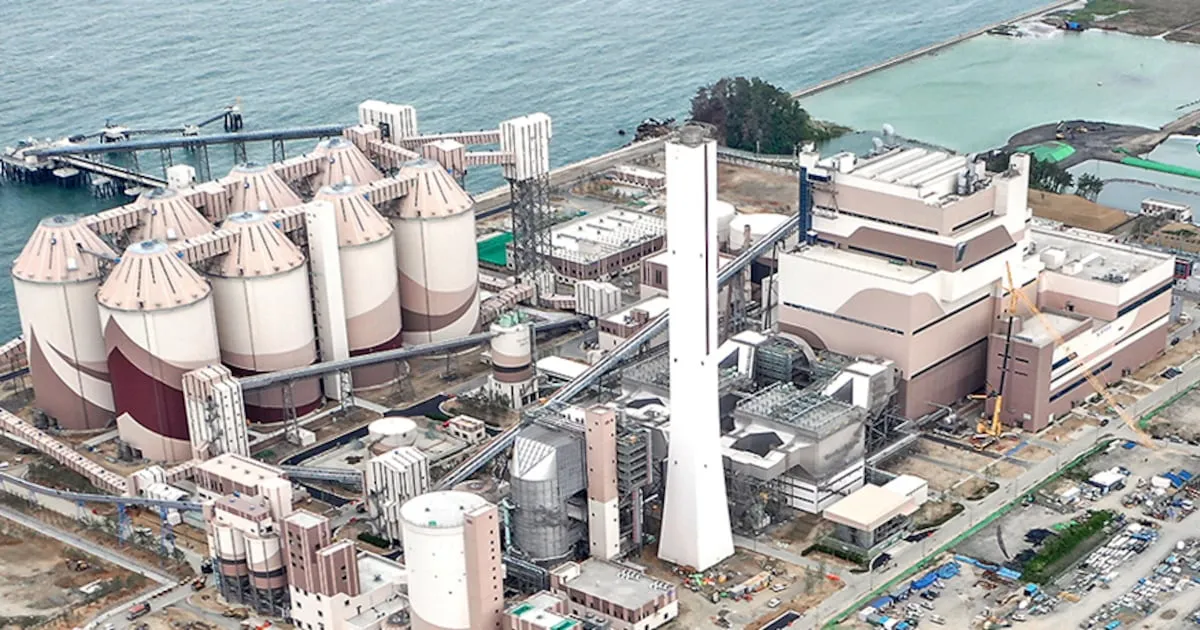
The Supreme Court of South Korea has ruled that a construction company, not the power plant operator, bears responsibility for industrial safety management in cases of fatal accidents occurring during construction at a power plant site. This landmark decision shifts the legal accountability for workplace safety during such projects.
Supreme Court Decision on Power Plant Construction Safety
The Supreme Court’s First Division, led by Justice Seo Kyung-hwan, announced on September 9th that the operation and construction of a power plant are distinct business activities. Consequently, the court overturned a lower court’s acquittal of Jungbu Power Development, which had been indicted for violating the Occupational Safety and Health Act. The case has been remanded to the Daejeon High Court for further proceedings.
In contrast, Kumho Engineering & Construction, the company that undertook the construction work, had its conviction upheld. The lower court had found Kumho Engineering guilty, imposing a fine of 50 million won (approximately $38,000 USD) and recognizing its culpability, which was affirmed by the Supreme Court. This distinction in rulings highlights the court’s view on the differing roles and responsibilities of the plant operator versus the construction contractor.
Background of the Accident and Construction Project
Jungbu Power Development began construction on the new Shinseocheon Power Plant in 2016. This project was initiated to replace the existing Seocheon Power Plant, which ceased operations in 2017. The new facility was completed in 2021 and subsequently commenced commercial operations.
The fatal accident occurred on April 10, 2020, around 3:00 PM, while construction was still underway. The incident involved an electrical explosion during the installation of a desulfurization facility. Tragically, a worker in his 40s sustained severe third-degree burns across his entire body and later succumbed to his injuries despite being transported to the hospital. Three other workers also suffered second and third-degree burns in the same incident.
Legal Proceedings and Lower Court Rulings
Following the accident, investigations extended beyond the site contractor, Kumho Engineering, to include the client company, Jungbu Power Development, and the supervising engineer. Prosecutors argued that all parties, as ‘importers’ under the Occupational Safety and Health Act, had failed to fulfill their safety obligations.
The initial trial court acquitted Jungbu Power Development, stating that the construction of the power plant was a temporary undertaking, not its core business. The court also noted that Jungbu Power Development lacked the necessary specialized technical certifications required for general construction, thus absolving it of the duty to implement safety measures as an ‘importer’ in relation to the construction work.
However, the second trial court found Jungbu Power Development guilty, imposing a fine of 50 million won. This court reasoned that despite Jungbu Power Development’s claims of not being an ‘importer’ with safety duties, its extensive control and management over the construction of power plants across 27 sites nationwide indicated a level of responsibility. The court concluded that Jungbu Power Development had a duty of care and safety obligations, including those related to the installation work.
Supreme Court’s Rationale for Reversing the Acquittal
The Supreme Court’s decision hinges on the classification of Jungbu Power Development’s role in the incident. The court determined that Jungbu Power Development acted as the client commissioning the construction work, rather than an ‘importer’ with direct industrial safety management responsibilities under the law.
The court stated, “It is difficult to conclude that Jungbu Power Development, as a highly specialized ‘importer’ business for the desulfurization facility construction, exercised effective influence over the subcontractor (Kumho Engineering).” Consequently, the Supreme Court found that the elements required to establish a violation of the Occupational Safety and Health Act by Jungbu Power Development in relation to this accident were not met.
Under the Occupational Safety and Health Act, ‘importers’ are mandated to implement safety and health measures. However, the client who commissions construction work is typically only subject to obligations related to the prevention of industrial disasters, a separate category of responsibility. By ruling that Jungbu Power Development was a client commissioning the work and not an ‘importer’ in this specific context, the Supreme Court effectively shifted the primary industrial safety management responsibility to the construction contractor, Kumho Engineering.
Implications for Industrial Safety and Construction Projects
This ruling clarifies the lines of accountability in complex construction projects involving specialized facilities like power plants. It emphasizes that the entity directly undertaking the construction, even as a subcontractor, bears the primary responsibility for ensuring workplace safety during the execution of the project.
The decision underscores the importance of clear contractual agreements and diligent oversight by both the client and the contractor to prevent accidents. While the client has a general duty to prevent industrial disasters, the direct management and implementation of safety protocols on-site fall under the purview of the construction company performing the work. This distinction is crucial for future cases involving similar industrial accidents and aims to enhance safety standards across the construction sector.
The case serves as a critical reminder that while power plant operators are responsible for the overall plant’s safety during operation, the responsibility for safety during the construction phase rests firmly with the construction firms involved. This legal precedent is expected to influence how safety regulations are interpreted and enforced in large-scale industrial construction projects throughout South Korea.
