

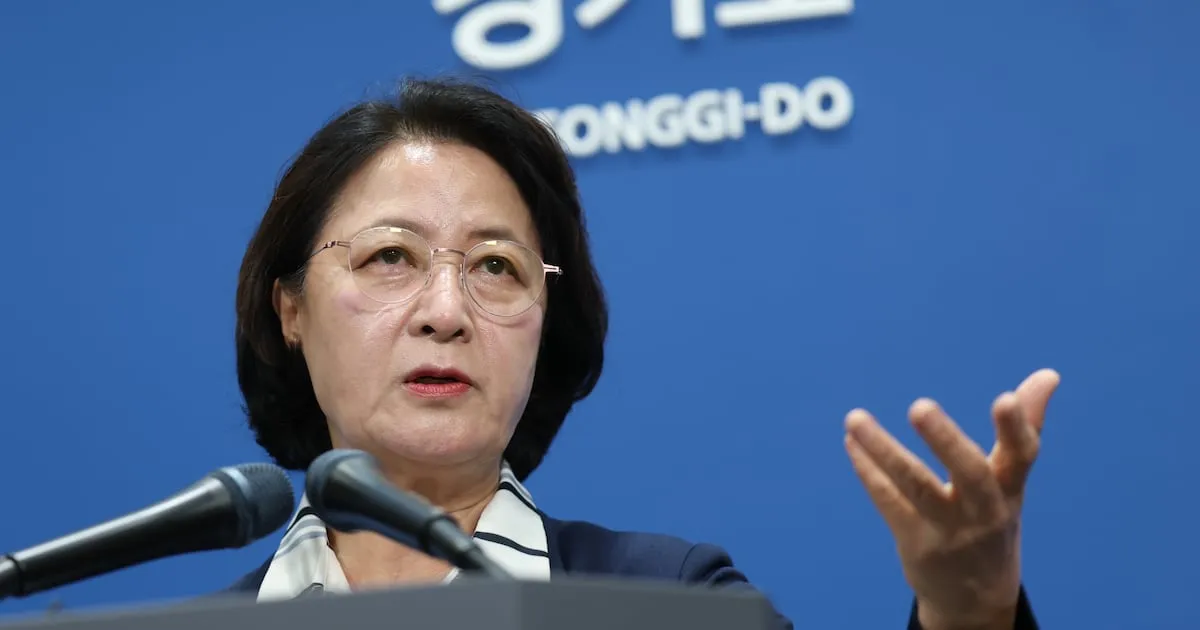
Gyeonggi Province Governor Choo Mi-ae has called for a significant overhaul of the funding structure for national firefighters, asserting that the province is disproportionately shouldering the financial burden. In a statement released via her Facebook page on the 8th, Governor Choo highlighted that Gyeonggi Province is currently responsible for the majority of the personnel costs associated with national firefighters, a responsibility she argues should primarily fall under central government purview.
Governor Choo’s Concerns Over Funding Disparity
Governor Choo emphasized that while the personnel expenses for national firefighters are fundamentally a central government matter, the current reality presents a stark contrast. She argued that fiscal reforms are urgently needed to support provincial growth and development. The governor pointed to the decade-long process of nationalizing firefighter services, during which Gyeonggi Province has seen a 1.4-fold increase in the number of firefighters and a 1.8-fold rise in personnel costs. Despite these increases, the province has been covering the bulk of these expenses.
Specifically, Governor Choo stated that out of approximately 1.1 trillion won (roughly $800 million USD) in annual personnel costs for national firefighters, the central government’s contribution amounts to only 80 billion won (roughly $60 million USD). This leaves Gyeonggi Province to cover the remaining substantial portion.
The “Nationalization” Paradox
The governor reiterated her stance that the costs for national public servants, including firefighters, should be borne by the national government. “The costs for national public servants are the central government’s responsibility, but the reality is the complete opposite,” she stated. She further asserted that the current system, where Gyeonggi Province is effectively footing the bill for over 1 trillion won in national firefighter personnel costs, is unsustainable and requires immediate reform.
Governor Choo linked this funding issue to the province’s recent declaration of a “fiscal emergency situation.” She explained that Gyeonggi Province faces severe financial constraints, partly because the central government’s support is insufficient. The governor elaborated that Gyeonggi Province has been structured in such a way that even if it were to face a budget deficit, it cannot receive equalization funds from the central government. This regulatory framework, she argued, prevents the province from replenishing its coffers, even when facing significant financial strain.
Urgent Need for Fiscal and Structural Reform
The governor stressed the critical need for both fiscal reform and a restructuring of the revenue-sharing mechanisms. She highlighted that the province’s financial difficulties have necessitated difficult decisions, including the proposed budget cuts of 770 billion won (approximately $580 million USD). This situation underscores the urgency of addressing the funding model for essential public services like firefighting, ensuring a more equitable distribution of costs between the central government and local authorities.
Governor Choo’s remarks signal a growing tension between provincial governments and the central administration regarding financial responsibilities for services that have been nationalized or are intended to be. The call for reform is not just about firefighters but also points to a broader debate on fiscal federalism and the allocation of resources across different levels of government in South Korea. The governor’s appeal suggests that without a revised funding model, provinces like Gyeonggi will continue to struggle under the weight of national responsibilities, potentially impacting their ability to provide other essential local services.
Background on Firefighter Services in Gyeonggi
Historically, fire services in South Korea have operated under a mixed system, with national, provincial, and municipal responsibilities. The trend towards nationalization aims to standardize services and ensure consistent response capabilities across the country. However, the financial implications of this centralization have become a significant point of contention. Gyeonggi Province, being the most populous and economically active region, often bears a larger share of such costs due to its scale.
The governor’s statement implies that the current financial framework does not adequately reflect the national scope of the firefighter service, placing an undue burden on the provincial budget. This situation could potentially affect future investments in emergency services, equipment, and personnel training if not addressed promptly. Governor Choo’s call for reform is therefore a critical step in advocating for a more sustainable and equitable financial arrangement for national public services.
