

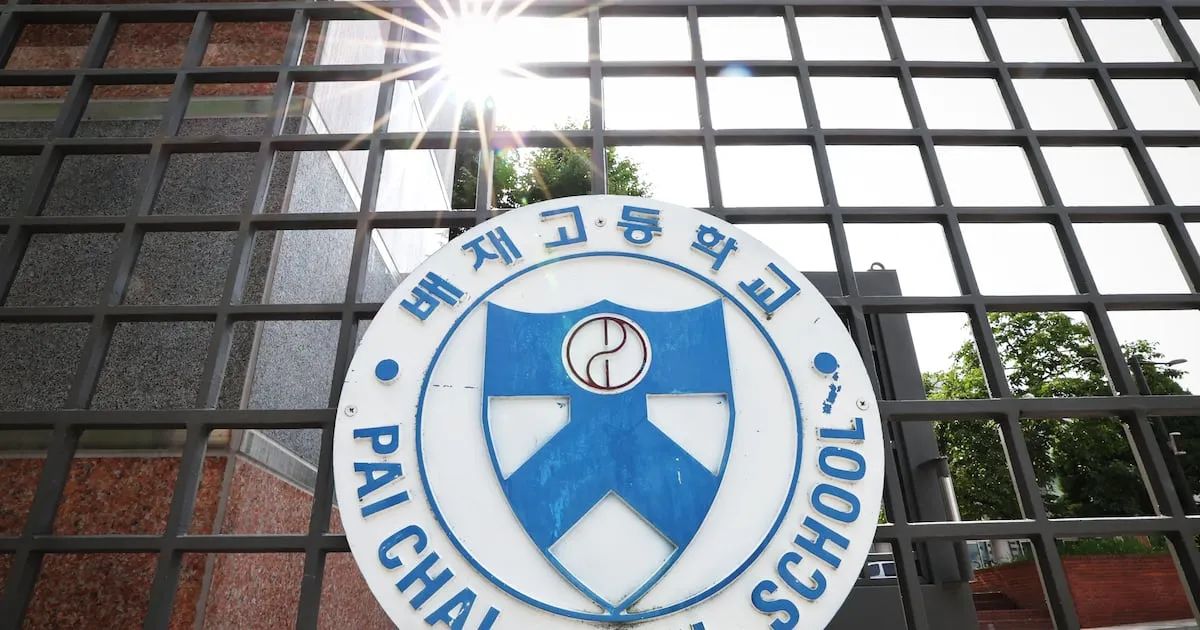
Two students from Baejaego High School’s baseball team have received disciplinary action from their school after shouting chants that trivialize the 5.18 Gwangju Uprising. The students were suspended from school activities following a review by the school’s student life committee.
Disciplinary Actions Taken Against Students
The disciplinary measures were decided upon by the Baejaego High School’s Student Life Committee, which convened recently to address the incident. The two students who initially led the offensive chants were given a suspension, the most severe form of school disciplinary action. Reports indicate that over ten other students who joined in the chants also faced lesser disciplinary measures, such as warnings or reprimands.
A representative from the Seoul Metropolitan Office of Education confirmed that the school had administered disciplinary actions and educational measures to the students involved. However, due to privacy concerns regarding individual students, specific details about the disciplinary outcomes could not be disclosed. The official statement emphasized that the school’s internal disciplinary process was deemed appropriate and sufficient.
Background of the Incident
The controversy erupted during a baseball game on June 25th at the Mokdong Baseball Stadium in Seoul. During the finals of the 81st Cheongryonggi National High School Baseball Championship, some players from Baejaego High School directed chants towards players from Gwangju Jeil High School. The chants, reportedly including “Starbucks, let’s go,” were interpreted by many as a derogatory reference to the 5.18 Gwangju Uprising, a pivotal event in South Korea’s modern democratic history. The phrase “Starbucks, let’s go” is a Korean slang phrase that can be used to mock or belittle events or people, and its use in this context was seen as deeply offensive and disrespectful to the victims and survivors of the uprising.
This incident gained significant public attention, particularly as it coincided with a separate controversy surrounding a Starbucks Korea event called ‘Tank Day,’ which also drew criticism for its insensitivity. The timing amplified public outrage and scrutiny over the use of potentially offensive language and references.
Baseball Association’s Response and Sanctions
The Korea Baseball Softball Association’s (KBSA) Sports Fairness Committee initially imposed a six-month ban on Baejaego High School from participating in all national competitions. This severe sanction reflected the gravity with which the association viewed the students’ actions.
Following the initial sanction, Baejaego High School officials visited Gwangju Jeil High School to offer an apology. Gwangju Jeil High School, in turn, requested a review of the sanctions. Subsequently, the KBSA Sports Fairness Committee reconsidered the case. On July 20th, the committee decided to reduce the ban to one month, citing the apology and the subsequent request for reconsideration.
Further Actions and Ongoing Scrutiny
In addition to the student’s school suspensions, Baejaego High School’s coaching staff also faced repercussions. Initially, four coaches, including the head coach, were suspended from their duties. However, reports suggest that currently, only the head coach remains suspended. The exact status of the other coaches’ sanctions is less clear, but the initial action indicated a broader accountability within the team’s leadership.
The incident has sparked a wider conversation about sportsmanship, historical awareness, and the responsibilities of young athletes. Educational institutions and sports organizations are under pressure to ensure that such insensitive and offensive behavior is not repeated. The focus remains on educating students about historical events and fostering a culture of respect and understanding within the sports community.
Conclusion
The disciplinary actions taken against the Baejaego High School baseball players serve as a stark reminder of the importance of historical sensitivity and respectful conduct. While the students have faced consequences from their school and the baseball association, the incident highlights the ongoing need for robust educational programs that instill a deep understanding and appreciation of South Korea’s history, particularly events like the 5.18 Gwangju Uprising. The reduction of the KBSA’s ban reflects a process of review and reconciliation, but the underlying issues of historical awareness and appropriate behavior in public spaces continue to be a critical concern for educational bodies and sports organizations alike.
