

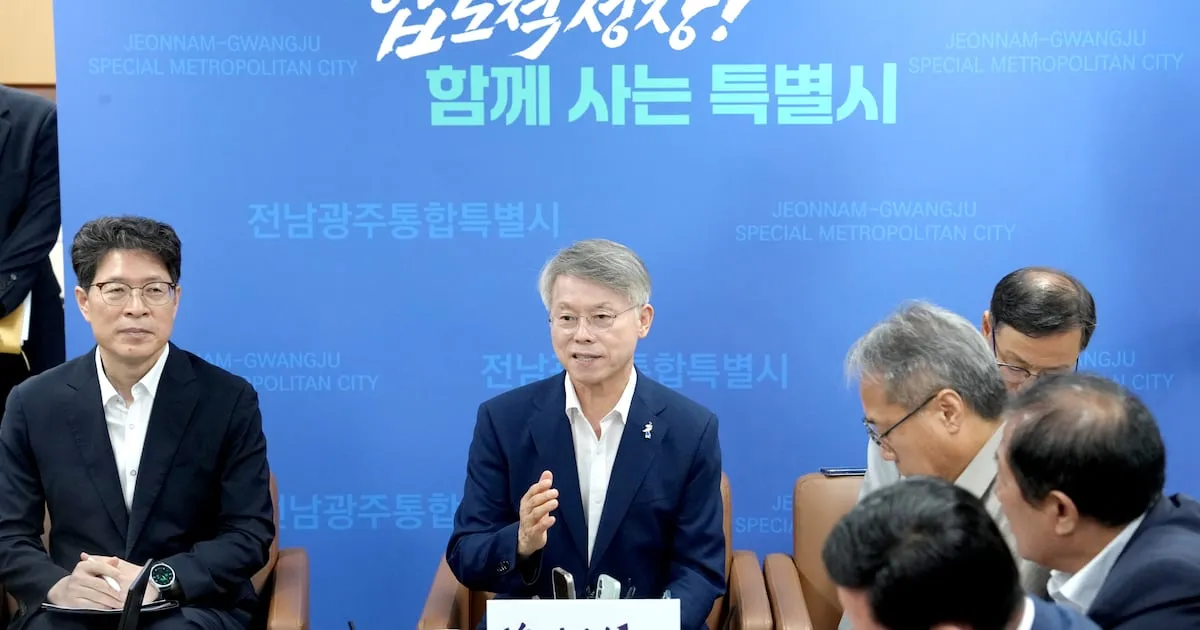
Min Hyung-bae, the newly inaugurated Mayor of JeonnamGwangju, has pledged to unveil a unified policy and welfare plan by early September, aiming to consolidate the distinct administrative systems of the former Jeollanam-do Province and Gwangju Metropolitan City. Speaking at a press conference held at the Muan County Office on August 3rd, Mayor Min articulated his vision for a “problem-solving mayor” rather than one focused solely on “emergency management,” emphasizing the need for proactive solutions and innovation to realize the region’s potential.
Forging a Unified Identity for JeonnamGwangju
The mayor highlighted the successful administrative integration on July 1st as a foundational step, stating, “If July 1st was about creating the grand blueprint of a ‘Unified Special City,’ now is the time to truly achieve unification by pooling the strengths of JeonnamGwangju.” He acknowledged the swift administrative merger as a success, achieved without significant public inconvenience within just six months. However, he stressed that a paradigm shift is urgently needed, moving from a governance model driven by administrative authority to one led by citizen power.
“We will thoroughly review all policies that have been operated differently for the past 40 years since the separation of cities and provinces in 1986, including welfare systems, and present a unified policy plan by early September,” Mayor Min announced. This initiative aims to address the disparities that have emerged over decades of separate governance and create a more cohesive and equitable system for all residents.
Addressing Key Regional Development Projects
Mayor Min also expressed a strong commitment to resolving critical regional issues, including the relocation of the Gwangju Military Airport from Muan County and the establishment of a National University Hospital. He asserted that the administration would not shy away from responsibilities, especially concerning issues directly impacting citizens’ lives.
Muan Airport Relocation and Funding
Regarding the Muan Airport relocation, Mayor Min stated, “We will proactively pursue this matter in consultation with the central government.” He revealed plans to secure approximately 1 trillion won in support, including the city’s own budget allocation of 790 billion won, to facilitate the airport’s relocation. This financial commitment underscores the administration’s determination to move forward with the project, which is a key condition for the airport’s selection as a successor to the current site.
National University Hospital Establishment
Concerning the establishment of the National University Hospital, Mayor Min emphasized its direct link to citizens’ well-being. “This is a matter directly related to the lives of our citizens, so we will not leave it solely to the university,” he declared. He plans to meet directly with the presidents of both universities involved to reach a final agreement on the hospital’s establishment by August 10th.
Honam Region Semiconductor Cluster
The mayor also spoke enthusiastically about the planned 800 billion won ‘Honam Region Semiconductor Cluster,’ which is expected to revitalize the region and potentially occupy the site of the former Gwangju Military Airport. He described this project as a “historic opportunity that will be remembered in the thousand-year history of JeonnamGwangju.” The development aims to create a significant industrial hub, fostering economic growth and technological advancement in the region.
Advocating for Regional Interests in the National Arena
Mayor Min highlighted his active participation in weekly National Assembly sessions, where he utilizes opportunities to speak and advocate for the region’s voice to be directly reflected in national policy. “We will relentlessly pave the way for infrastructure, including strategic supply chains and water supply, with the goal of breaking ground in 2027,” he stated, underscoring a commitment to tangible development.
Ensuring Fair Distribution of Public Institutions
Addressing the relocation of public institutions as the second metropolitan capital region, Mayor Min presented clear demands to the central government. He reminded the government of its promise to concentrate public institutions in the integrated administrative region. Citing the “non-detrimental clause” in the Unified Special Act, he insisted on retaining 45 key institutions, including the National Agricultural Cooperative Federation and the National Federation of Fisheries Cooperatives, which are currently located in the former Jeollanam-do and Gwangju cities.
Furthermore, regarding the proposed consolidation of 25 overlapping public institutions, Mayor Min stressed the need to move beyond mere integration. “We will focus on functional specialization to enhance service efficiency for citizens, completing personnel and organizational restructuring within the year,” he explained. This approach aims to optimize the performance of public services and ensure they meet the evolving needs of the populace.
Conclusion: Building a Self-Governing Future
Mayor Min concluded by emphasizing the democratic principle that “governance becomes stronger as power is shared and balance is achieved.” He expressed his commitment to realizing a true self-governing system where the successes of unification permeate the daily lives of citizens, built on a foundation of trust and participation. The administration’s forward-looking approach seeks to create a more prosperous, equitable, and responsive regional government for JeonnamGwangju.
