

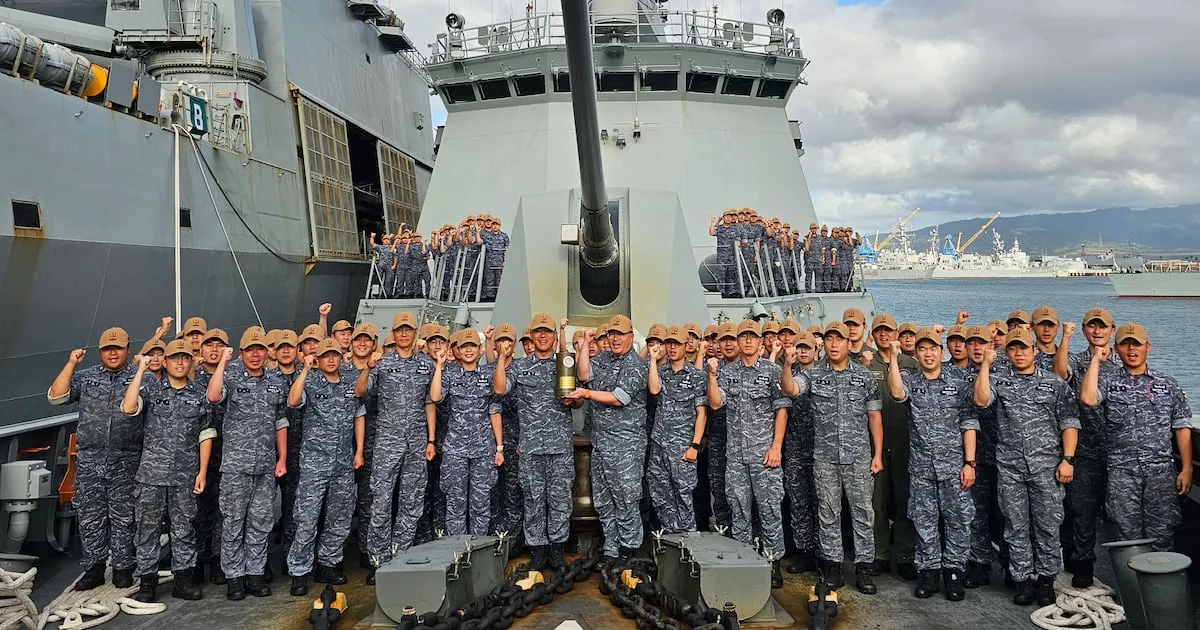
The South Korean Navy’s 3,100-ton guided-missile destroyer, DDG Daejeon, has earned the prestigious “Top Gun of the Sea” award at the 2026 Rim of the Pacific (RIMPAC) Exercise, the world’s largest multinational maritime drill. This commendation is bestowed upon the most outstanding warship participating in the exercise’s live-fire drills.
DDG Daejeon Achieves Top Honors at RIMPAC
According to the Navy, the DDG Daejeon secured the highest score among 13 competing vessels from 10 nations during the maritime firepower support exercise held near Hawaii on June 12th (local time). This victory marks a significant achievement, placing the South Korean vessel as the top performer in a highly competitive field.
The competition involved firing five rounds from a 5-inch naval gun at a target located 7.2 kilometers away. The winner is determined by the smallest combined miss distance from the target. The DDG Daejeon’s exceptional accuracy in this challenging scenario led to its selection as the top warship.
This marks the first time a South Korean warship has received this honor since the DDG Sejong the Great in 2010, an interval of 16 years. The results of the competition were kept confidential until they were officially announced at the RIMPAC closing ceremony on June 31st (local time).
Rigorous Preparation for Pacific Conditions
Ahead of the exercise, the crew of the DDG Daejeon underwent intensive preparation, including strategic discussions with former crew members and simulated firing drills. This was crucial given the exercise’s location in the vast Pacific Ocean, which presents different environmental conditions compared to the waters surrounding the Korean peninsula.
Commander Lee Jeong-soo, captain of the DDG Daejeon, expressed his pride in the crew’s accomplishment, stating, “This award is a direct result of our dedication to training.” He added, “We will continue to build our combat readiness through practical, realistic training.”
South Korea’s Expanding Role in RIMPAC
Beyond its performance in the live-fire exercise, the 2026 RIMPAC marked another milestone for the South Korean Navy. For the first time, a South Korean Navy officer was appointed as the commander of a multinational task force, overseeing joint naval operations. This appointment underscores South Korea’s growing leadership and capabilities within the international maritime community.
About the Rim of the Pacific Exercise (RIMPAC)
The Rim of the Pacific Exercise, often abbreviated as RIMPAC, is the world’s largest international maritime warfare exercise. It is conducted biennially by the U.S. Pacific Fleet, headquartered in Pearl Harbor, Hawaii. The primary objectives of RIMPAC include:
- Strengthening and enhancing interoperability among participating nations’ naval forces.
- Improving the ability to respond to crises in the Indo-Pacific region.
- Promoting maritime security and stability in a vital global waterway.
- Fostering goodwill and cooperation among diverse naval forces.
RIMPAC typically involves a wide range of naval, air, and ground forces from numerous countries, conducting complex training scenarios that simulate real-world operational environments. These exercises cover various aspects of naval warfare, including anti-submarine warfare, air defense, surface warfare, amphibious operations, and maritime interdiction operations.
Significance of the DDG Daejeon’s Achievement
The DDG Daejeon’s success at RIMPAC highlights the advanced capabilities and rigorous training standards of the South Korean Navy. Achieving the “Top Gun of the Sea” award signifies superior performance in naval gunnery, a critical component of naval combat effectiveness. This recognition not only boosts the morale of the crew and the Navy but also enhances South Korea’s reputation as a capable maritime power on the international stage.
The exercise provides a unique platform for navies worldwide to train together, share best practices, and build mutual trust. For the DDG Daejeon and its crew, participating in and excelling at RIMPAC demonstrates their readiness to contribute to regional and global maritime security efforts. The skills honed during such demanding exercises are vital for maintaining peace and stability in the Indo-Pacific and beyond.
The South Korean Navy’s increasing leadership roles within RIMPAC, such as commanding a multinational task force, further illustrate its evolving strategic importance and commitment to collaborative security operations. These developments are crucial in addressing the complex maritime challenges of the 21st century.
