

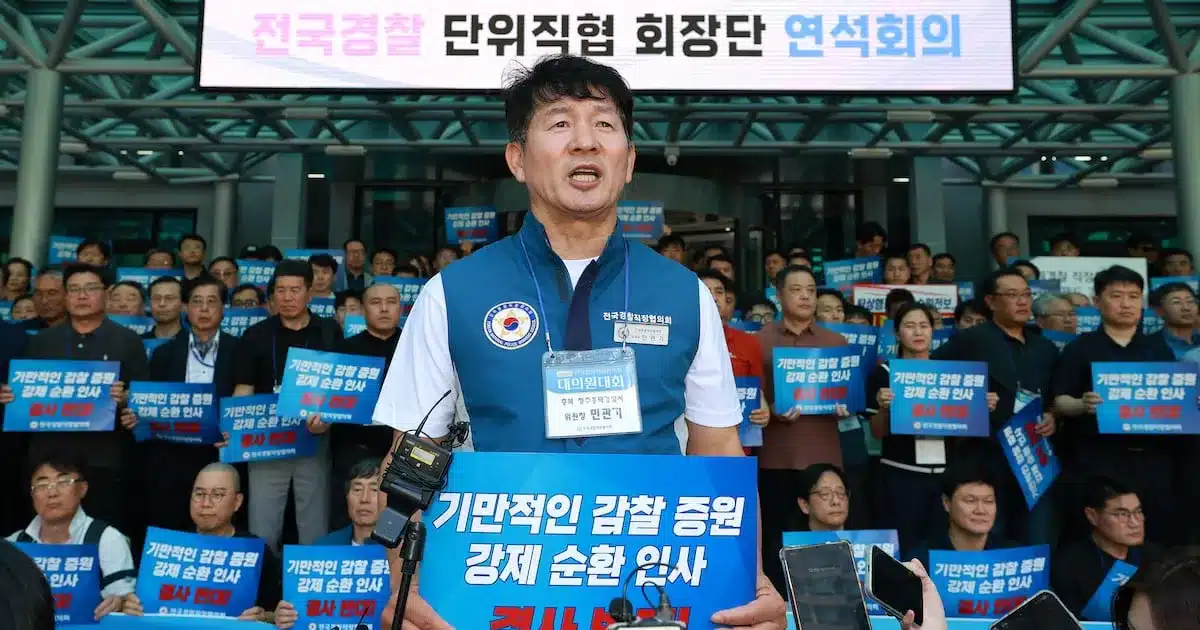
The National Police Officers Union (NPOU), a major labor organization representing police officers, has officially voiced its opposition to the government’s plan to expand rotational assignments. In a significant move, the union has also called for the resignation of high-ranking police officials, citing failures in investigations and organizational management.
Union’s Stance on Accountability
In a resolution adopted on March 30th, the NPOU stated that accountability for investigative failures and organizational mismanagement should rest with leadership, not frontline officers. The union specifically pointed to the Police Commissioner and the Director of the Gwangju Metropolitan Police Agency, Kim Young-geun, as individuals who should take responsibility.
The Chairperson of the NPOU’s Steering Committee explained that the resolution was amended to include the collective demand for the resignation of leadership following a general consensus among the union members. This decision stems from recent controversies, including the handling of the Jang Yoon-gi case, which raised questions about the police’s investigative diligence and potential cover-ups.
Background of the Dispute
The NPOU convened a meeting attended by 165 national chapter leaders at the Seoul Seodaemun Police Agency the previous day. During this meeting, the resolution was formally adopted. The union’s strong stance against the expansion of rotational assignments is a direct response to the proposed policy, which they view as a measure implemented without fully clarifying the facts of the Jang Yoon-gi case.
The union’s core demands, as outlined in their resolution, include:
- An immediate halt to the nationwide expansion of mandatory rotational assignments until the full truth of the Jang Yoon-gi case is clearly established.
- Opposition to the recently proposed policy of increasing police investigation personnel through rapid recruitment.
- Ensuring that police reforms are pursued through consultation with frontline representatives, including the NPOU, rather than being unilaterally imposed.
Formation of an Anti-Rotational Assignment Committee
To spearhead its campaign against the rotational assignment policy, the NPOU has announced the formation of a special committee. This “Anti-Rotational Assignment Struggle Committee” will operate under a co-chairperson system, with an executive body comprising 17 members. The executive committee held its first meeting on the day of the resolution’s adoption to discuss future activities and strategies for the campaign.
Concerns Over Investigative Practices
The union’s discontent appears to be rooted in a perceived lack of transparency and accountability within the police hierarchy. The Jang Yoon-gi incident, in particular, has become a focal point, with allegations that the police mishandled the investigation, leading to public distrust. The proposed expansion of rotational assignments is seen by the NPOU not as a solution to systemic issues, but rather as a superficial measure that fails to address the underlying problems of investigative integrity and leadership accountability.
By demanding the resignation of senior officials, the NPOU is signaling a desire for a significant shift in how the police force is managed and how investigations are conducted. They argue that true reform must begin with leadership taking responsibility for past failures and demonstrating a commitment to improving investigative processes and organizational culture.
Implications for Police Reform
The NPOU’s actions highlight a growing tension between the rank-and-file officers and the police leadership. The union’s insistence on consulting with frontline representatives underscores a desire for greater input in policy decisions that directly affect their work and the public they serve. The proposed reforms, including the controversial rotational assignments and changes to investigative personnel, are viewed by the union as potentially detrimental if not implemented with careful consideration and collaboration.
The formation of the struggle committee indicates that the NPOU is prepared for a sustained campaign to achieve its objectives. The success of this campaign will likely depend on the union’s ability to mobilize its members, garner public support, and effectively pressure the relevant authorities to address their concerns regarding accountability and investigative practices within the police force.
Future Outlook
The coming weeks and months will be crucial in determining the outcome of this dispute. The government and the police leadership will face pressure to respond to the NPOU’s demands. Whether this leads to a genuine reform of investigative practices, a reassessment of leadership accountability, or a compromise on the rotational assignment policy remains to be seen. The union’s firm stance, however, suggests that they are prepared to escalate their efforts if their concerns are not adequately addressed, potentially leading to further disruptions within the police organization.
