

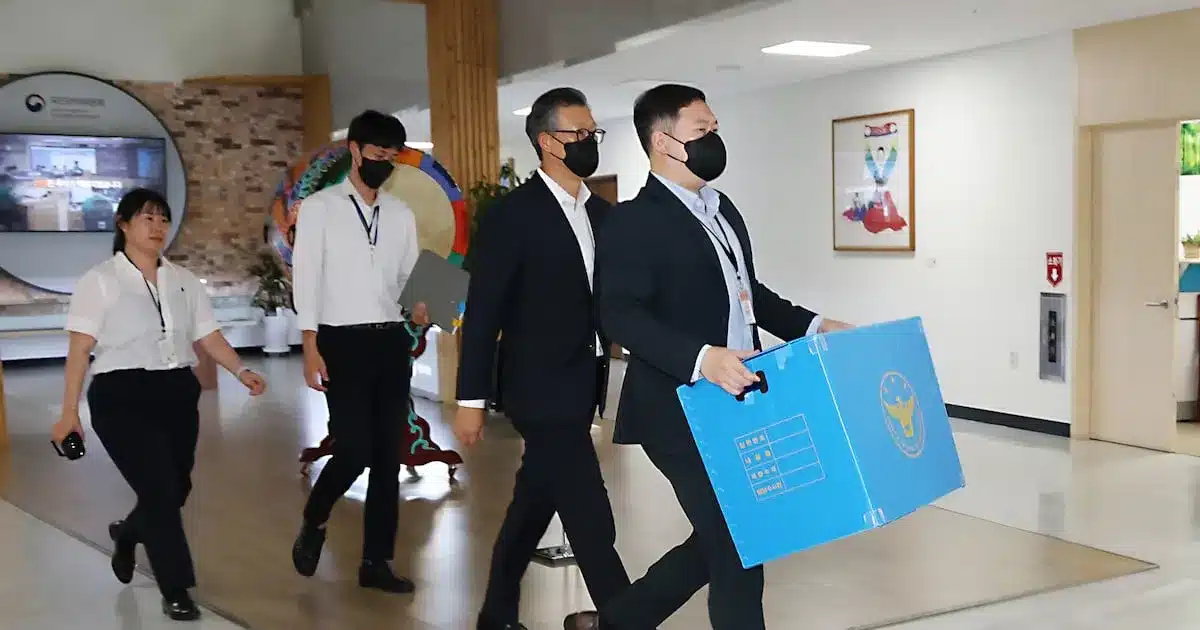
A special investigative unit within the Korean National Police Agency, tasked with examining sensitive cases, has concluded its operations after approximately eight months. The unit, known as the ‘Police Agency 3rd Special Task Force for Inherited Cases,’ officially ceased its activities on November 28th. Its responsibilities will now transition to a standing investigative team.
Unit Established to Tackle High-Profile Investigations
The special task force was established on December 1st of the previous year with a mandate to investigate several high-profile cases. These included allegations related to the ‘Sunjik Conscription Incident,’ the ‘Nae-ran Incident,’ and the ‘Kim Keon-hee Special Task Force’ cases. The unit aimed to provide a focused and thorough examination of complex matters that required dedicated resources.
Operational Statistics and Case Dispositions
During its eight-month operational period, the special task force conducted extensive investigations. According to official figures, the unit investigated 46 individuals a total of 62 times and interviewed 209 witnesses on 220 occasions. Furthermore, 16 search and seizure operations were executed. Of the 137 cases initially assigned, the unit successfully concluded 121 cases. This involved forwarding 16 cases for prosecution, transferring 54 cases to other relevant agencies, and classifying 51 cases as non-prosecution or unprosecution matters.
Key Cases and Notable Dispositions
The special task force achieved several notable outcomes during its tenure. In the ‘Nae-ran Incident,’ the unit investigated allegations of institutional cover-ups. This led to the referral of former Presidential Secretary Jeong Jin-seok and former Presidential Security Office Chief of Protocol Yoon Jae-seon for charges of abuse of power and obstruction of justice. The unit also referred former First Division Chief Kang Eui-gu for similar charges.
A significant aspect of the ‘Nae-ran Incident’ investigation involved the alleged abuse of power by former Ministry of Justice Vice Minister Shin Hyun-soo. The special task force investigated his directive to secure space for individuals who violated reporting regulations. Notably, this case was the first to be handled by the judicial authorities concerning a civilian official’s involvement in an emergency situation, rather than a military context.
In connection with the ‘Kim Keon-hee Special Task Force’ cases, the unit investigated allegations related to the leak of a preliminary election report for the 21st National Assembly (Seocho-gap, Seoul) involving a member of the People Power Party. This resulted in the referral of Representative Jo Eun-hee and Mr. Myung Tae-gyun for alleged violations of the Personal Information Protection Act.
The task force also conducted a comprehensive reinvestigation into the ‘Jeodo Military Parade’ incident, which had been previously deemed unclear and uninvestigated. Following a signed statement from then-Gyeongho Chief Kim Yong-hyeon, the special task force referred Mr. Kim and then-Gyeongho Planning and Coordination Office Director Kim Seong-hoon for alleged abuse of power under the Presidential Security Act.
Additionally, the unit investigated allegations of attempted coercion against former National Human Rights Commission Standing Member Kim Yong-won, a case inherited from the ‘Sunjik Conscription Task Force.’ This investigation also resulted in a referral.
Further investigations into the ‘Kim Keon-hee’ cases uncovered that Lee Jong-ho, former CEO of Black Pearl and an associate of Ms. Kim, had embezzled approximately 116 million KRW in legal fees and 167 million KRW in lawyer’s fees. These findings led to referrals for charges of fraud and violation of the Attorneys-at-Law Act.
Transition to Standing Investigative Teams
With the disbandment of the special task force, its remaining cases will be handled by designated investigative bodies. For the 16 cases requiring focused investigation, a standing investigative team comprising 23 members from the National Police Agency’s Investigation Bureau will take over. Kang Il-gu, a Superintendent General, has been appointed to lead this team. The remaining cases will be managed by the National Police Agency’s Security Investigation Division.
Conclusion
The ‘Police Agency 3rd Special Task Force for Inherited Cases’ has successfully concluded its mandate, having addressed a range of complex and sensitive investigations over eight months. The transition to standing investigative teams ensures that the ongoing work will continue with dedicated resources, maintaining the momentum established by the special unit.
