

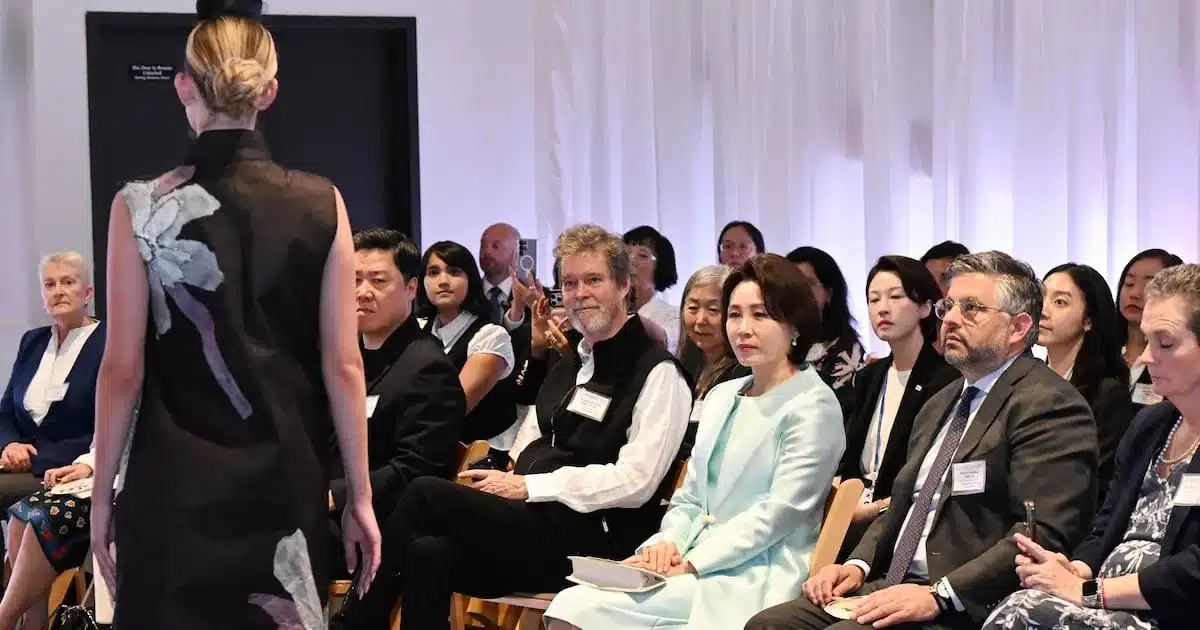
Kim Hye-kyung, the spouse of South Korean presidential candidate Lee Jae-myung, recently participated in a Hanji (traditional Korean paper) exhibition and fashion show in San Francisco, USA. The event aimed to highlight the cultural significance and diverse applications of Hanji, a craft deeply rooted in Korean heritage. This appearance by Kim Hye-kyung occurred during a period when both she and her husband were undertaking overseas visits, with Lee Jae-myung embarking on a tour of the United States, South America, and Germany.
Hanji Exhibition Highlights Timeless Craftsmanship
The event, titled ‘The Time and Future of Hanji,’ was held at The Pearl in San Francisco’s cultural district and was organized by the Korean Cultural Center of Los Angeles. Kim Hye-kyung attended the exhibition and fashion show, observing firsthand the artistry and innovation associated with Hanji. She was notably seen carrying a handbag made from Hanji leather, a product created by a South Korean youth startup, underscoring the material’s modern relevance and potential for commercial success.
The exhibition served as a platform to introduce the contemporary and future prospects of Hanji, showcasing its evolution beyond traditional uses. This initiative aligns with broader efforts to promote Korean cultural assets on an international stage. The event’s organizers emphasized the goal of raising awareness about Hanji’s rich cultural value and its expanding applications across various industries.
The Global Ambition for Hanji Recognition
South Korea’s Cultural Heritage Administration is actively pursuing the inscription of ‘Jiseung-mul, Hanji’ (Hanji, the craft of making paper) onto the UNESCO Intangible Cultural Heritage of Humanity list. This nomination recognizes the traditional knowledge, skills, and cultural practices involved in Hanji production. The ongoing efforts aim to secure global recognition for Hanji as a significant cultural heritage, reflecting its historical importance and artistic merit.
The San Francisco event was specifically curated to support this global recognition bid by demonstrating Hanji’s enduring appeal and its adaptability to contemporary design and industry. By showcasing its versatility, from artistic displays to fashion accessories, the event sought to build international appreciation for this unique Korean paper.
Kim Hye-kyung’s Endorsement and Vision for Hanji
During the event, Kim Hye-kyung expressed her deep admiration for Hanji, stating, “A single sheet of Hanji holds the breath of nature, the long-honed skill of artisans, and the complete record of our lives.” Her words emphasized the profound connection between the paper, its natural origins, the human craftsmanship involved, and its role in documenting history and culture.
She further conveyed her hopes for the material’s future: “I hope that this December, Hanji will be inscribed as UNESCO Intangible Cultural Heritage of Humanity and shine even brighter as a precious asset for all of humanity.” This statement reflects a strong desire to see Hanji elevated to a global cultural status, recognized for its universal value and contribution to human civilization. The timing of her statement, referencing an upcoming December decision, suggests a critical juncture in the UNESCO inscription process.
Understanding Hanji: History, Production, and Significance
Hanji is a traditional Korean paper made from the inner bark of the mulberry tree, specifically the paper mulberry (Broussonetia papyrifera). The production process is labor-intensive and requires specialized knowledge passed down through generations. The fibers are harvested, soaked, pounded into a pulp, and then carefully spread using a fine screen onto a frame. The unique method of papermaking results in a durable, flexible, and long-lasting paper that has been used for centuries in Korea for various purposes.
Historically, Hanji has been integral to Korean life. It was used for writing, painting, calligraphy, and bookbinding. Its strength and longevity made it suitable for architectural purposes, such as covering doors and windows (known as changhoji), providing insulation and a soft, diffused light. It was also used for creating various crafts, including fans, lanterns, and even armor.
The resilience of Hanji is remarkable; some ancient documents and artworks made on Hanji have survived for over a thousand years, attesting to its exceptional quality and durability. This enduring nature is a key factor in its nomination for UNESCO recognition.
Modern Innovations and Future Prospects
In recent years, there has been a resurgence of interest in Hanji, driven by contemporary artists, designers, and entrepreneurs who are exploring its potential in modern applications. Beyond its traditional uses, Hanji is now being incorporated into:
- Fashion and Accessories: As seen with the handbag showcased at the San Francisco event, Hanji leather offers a unique, eco-friendly alternative for bags, wallets, and even clothing.
- Interior Design: Hanji is used in contemporary furniture, lighting fixtures, and wall coverings, adding a touch of natural elegance and texture.
- Art and Craft: Artists continue to utilize Hanji for painting and drawing, while crafters create intricate decorative items, stationery, and packaging.
- Technology: Researchers are exploring the potential of Hanji’s unique fiber structure for applications in fields like electronics and biomaterials.
The efforts to promote Hanji internationally, including events like the one in San Francisco, are crucial for its continued preservation and development. By showcasing its versatility and cultural depth, proponents aim to ensure that Hanji not only survives but thrives as a globally recognized cultural treasure.
Conclusion: A Cultural Heritage for the World
Kim Hye-kyung’s participation in the Hanji exhibition and fashion show in San Francisco underscores the growing international attention on traditional Korean crafts. The event served as a vital platform to advocate for Hanji’s recognition as a UNESCO Intangible Cultural Heritage, highlighting its historical significance, artisanal skill, and modern-day relevance. As South Korea continues its push for this prestigious designation, the global community watches with interest, recognizing the potential for Hanji to enrich the world’s shared cultural tapestry.
