

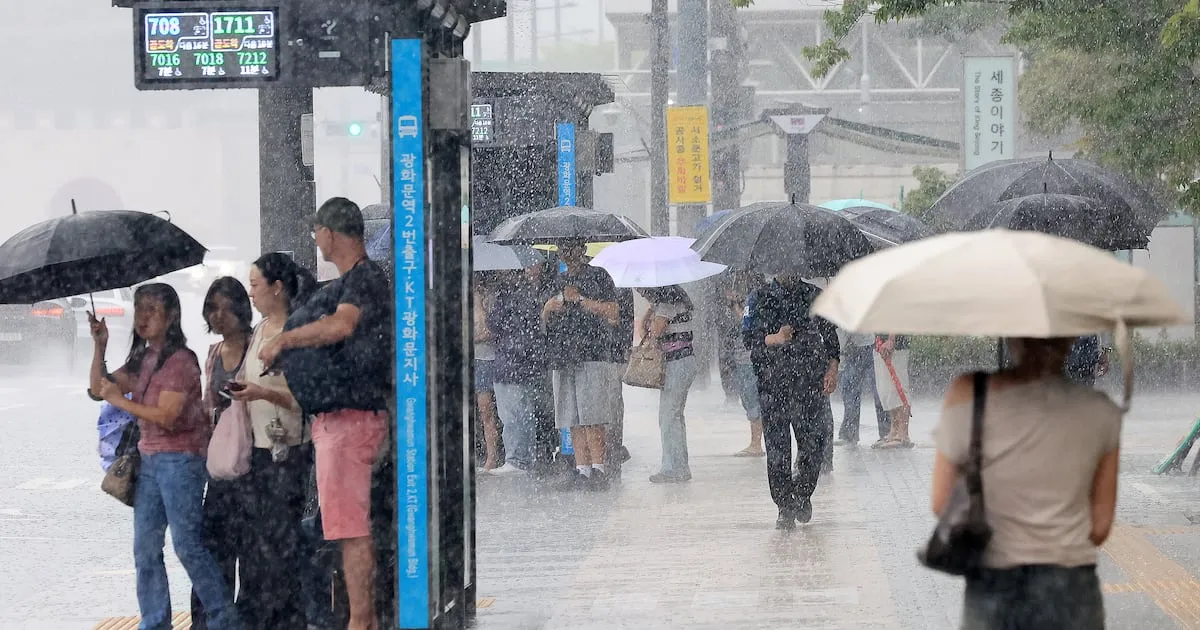
South Korea is set to experience widespread rain beginning Monday, the 20th, with the Korea Meteorological Administration (KMA) forecasting significant precipitation across the nation. This rainfall is expected to bring some relief from the ongoing heat in certain regions, while other areas brace for continued high temperatures and potential storm activity.
National Rainfall Forecast
The KMA has issued detailed rainfall predictions for various regions. The capital area, including Seoul and surrounding Gyeonggi Province, is expected to receive between 20 to 60 millimeters (mm) of rain on the 20th. Other areas will see varying amounts:
- Gangwon Province: Inland and mountainous areas are forecast to receive 5 to 40 mm, while the eastern coastal regions anticipate 5 to 20 mm.
- Chungcheong Provinces: These central regions are predicted to experience the heaviest rainfall, with amounts ranging from 20 to 80 mm.
- Jeolla Provinces: Southern regions are expected to receive 5 to 40 mm of rain.
- Gyeongsang Provinces: Northern Gyeongsang Province anticipates 20 to 60 mm, while Daegu and southern Gyeongsang Province are projected to get 5 to 40 mm. Inland areas of South Gyeongsang Province are expected to receive 5 to 20 mm.
- Jeju Island: The southern island is forecast to receive 5 to 20 mm of rain.
The rain is expected to continue through Tuesday, the 21st, primarily affecting the central and northern parts of the country. The KMA has cautioned residents about potential hazards due to the accumulation of rain in areas that have already experienced significant precipitation recently. These risks include sudden rises in river levels, soil erosion, and landslides. Therefore, vigilance is advised, especially in low-lying areas and near riverbanks.
Heatwaves Persist in Unaffected Areas
While rain is expected in many parts of the country, areas not receiving significant precipitation are likely to endure continued heatwaves. Heatwave advisories are currently in effect for parts of the Chungcheong and southern regions, as well as Jeju Island. Temperatures are expected to climb, with daytime highs in many areas reaching around 31 degrees Celsius (°C) or higher.
On the 20th, morning low temperatures are predicted to be between 22°C and 26°C, with afternoon highs ranging from 26°C to a sweltering 33°C. The KMA also noted that nighttime temperatures may not drop sufficiently in many areas, particularly in the southern regions, leading to tropical nights (where nighttime temperatures remain above 25°C) in some locations.
Maritime and Mountainous Warnings
Beyond the immediate concerns of rain and heat, the KMA has issued warnings for maritime and mountainous regions. Strong winds, accompanied by thunder and lightning, are anticipated along the western and eastern coasts, as well as the southern coast and around Jeju Island. Mariners are urged to exercise extreme caution to prevent accidents at sea.
Dense fog is also a concern. Fog is expected along the western and southern coasts, and the southern coast of Jeju Island, potentially reducing visibility. Furthermore, the mountainous areas of Gangwon Province may experience extremely dense fog with visibility as low as 200 meters until the morning of the 20th. This poses a significant risk for drivers and hikers in these areas.
Preparedness and Safety Advice
Given the varied weather conditions, the KMA is urging the public to stay informed about the latest weather updates. Residents in areas prone to heavy rainfall should take precautions against flooding and landslides. Those in regions experiencing heatwaves are advised to stay hydrated, limit outdoor activities during peak heat hours, and take measures to prevent heat-related illnesses.
For those near coastal or mountainous areas, awareness of potential fog, strong winds, and thunderstorms is crucial. Maritime activities should be carefully considered, and travel in mountainous regions should be undertaken with caution, especially during periods of reduced visibility. The combination of heavy rain in some areas and intense heat in others highlights the dynamic and potentially hazardous weather patterns currently affecting South Korea.
