

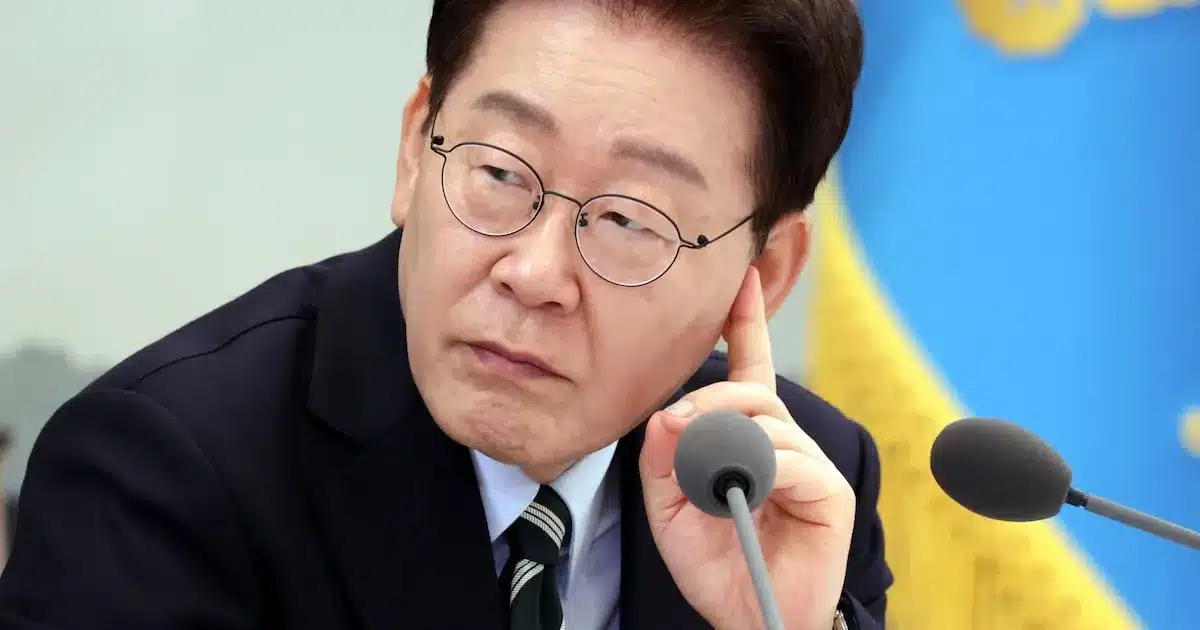
President Lee has directly refuted claims that his actions constitute a violation of election law by rejoining a political party while in office. Speaking ahead of the Democratic Party’s August 17th convention, Lee stated that the President’s right to participate in ordinary political activities, distinct from official election-related duties, is recognized under laws and the Democratic Party’s charter. He asserted that this participation, including expressing opinions on matters like campaign finance, is permissible.
Clarifying the Definition of Party Rejoining
President Lee addressed the controversy on August 19th via an X (formerly Twitter) post, where he shared an article discussing the impeachment of former President Roh Moo-hyun. The article highlighted that Roh’s rejoining a political party, which is typically prohibited during an election period, was cited as a reason for his impeachment.
Lee clarified that the prohibition on party rejoining specifically applies to violations of election laws, such as engaging in public elections or participating in election campaigns. He emphasized that expressing opinions on general party matters, even if critical, does not fall under this legal restriction.
Context of the Controversy
Recent discussions within the Democratic Party have centered on President Lee’s perceived involvement in party affairs. Specifically, allegations have surfaced that he has been actively supporting candidates for the June 3rd Seoul mayoral election and the National Assembly Speaker election, as well as endorsing ‘named’ candidates for the party convention. These claims primarily originate from factions supporting established political figures.
Writer Yoo Si-min also commented on a recent YouTube broadcast, suggesting that President Lee has been openly rejoining the party. The debate intensified when President Lee, on the same day as the party convention, commented that the contribution limit for party events was too high, suggesting a return to previous levels. This remark reignited the discussion about his party affiliation.
The X post shared by President Lee detailed the case of former President Park Geun-hye, who faced imprisonment for two years, and contrasted it with former President Roh Moo-hyun, who reportedly faced impeachment proceedings for simply asking for favorable consideration from his party, even without formally rejoining. The post urged recipients to remember these historical precedents.
President Lee’s Stance on Political Engagement
Responding to these points, President Lee reiterated that the issue with former President Park Geun-hye stemmed from her direct involvement in election campaigns and donations, not from expressing opinions on party matters. He stated that while expressing personal preferences for specific candidates in party elections is not explicitly forbidden by law or the party charter, it is a matter of exercising restraint and respecting freedom of expression.
Critique of ‘Ruling Party’s Burden’
President Lee also addressed the concept of the ‘ruling party’s burden,’ arguing that unlike opposition parties, the ruling party must demonstrate tangible results through action and implementation to meet public expectations. He stressed that the legitimacy of a ruling party lies in its ability to achieve these results, gain public trust, and thus secure a mandate for continued governance.
He further elaborated on the youth issue, identifying it as the most significant social problem facing society. President Lee suggested that the current debate surrounding youth contribution limits could serve as a catalyst for a fundamental re-evaluation of how the ruling establishment, including the Democratic Party and the government, perceives and addresses the concerns of young people. This re-evaluation, he posited, is crucial for fostering a more responsive and effective approach to youth-related policies.
Conclusion
President Lee’s statements aim to draw a clear distinction between permissible political engagement and illegal election interference. By referencing historical cases and clarifying legal definitions, he seeks to defend his right to participate in political discourse while adhering to the spirit and letter of election laws and party regulations. The ongoing debate highlights the complexities of presidential involvement in party politics and the fine line between advocacy and undue influence.
