

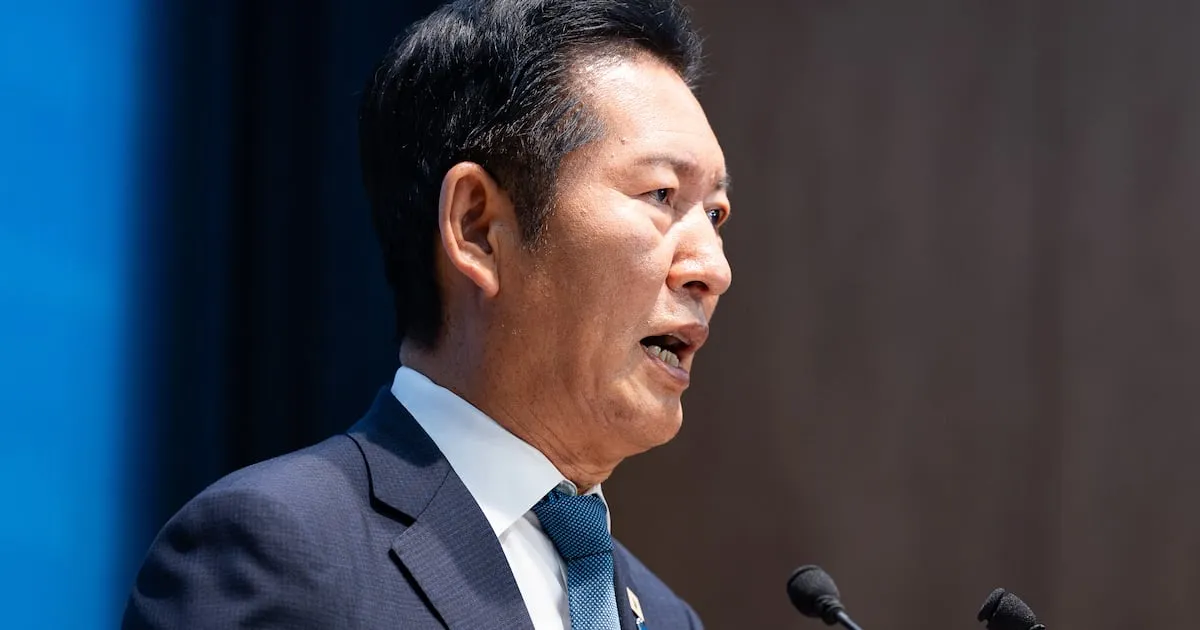
Jeong Cheong-rae, a former leader of the Democratic Party of Korea, has officially announced his candidacy for the party’s top leadership position, aiming to secure the chairmanship at the upcoming national convention in August. In a press conference held at the National Assembly, Jeong declared his intention to run, stating, “I will only rely on the will of the people and the party members for my candidacy.” He further emphasized his commitment, vowing, “I will not use the party leadership position for a proxy run,” and pledged to dedicate his life to the “re-establishment of the government.”
Jeong Cheong-rae’s Candidacy Announcement
The announcement event on the afternoon of the 13th saw a significant turnout of supporters, many holding yellow and blue balloons, chanting slogans like “I’ll vote for Jeong!” in response to his declaration. Prominent figures within the party, including lawmakers Kim Young-hwan and Lee Sung-yoon, who are considered part of the “pro-Jeong” faction, along with Lee Eun, the Mapo-gap district party chairwoman, were present to show their support.
Jeong Cheong-rae stressed his close working relationship with President Lee Jae-myung, stating, “We will work together in perfect harmony to support the stable governance of the Lee Jae-myung administration.” He added, “As has been the case, I will continue to stand by President Lee’s side as a unified ‘one team, one voice’ within the party.” He reiterated his commitment to ethical leadership, saying, “I will not fill my own pockets,” and reaffirmed his stance against leveraging the party leadership for electoral advantage: “I have no intention of running for office by proxy using the party leadership.” He concluded his remarks by stating, “I will be the architect of victory for the party” and promised to “operate the party with public integrity.”
Commitment to the Democratic Party
A key theme of Jeong’s announcement was his unwavering loyalty to the Democratic Party. He asserted his identity as a steadfast member, stating, “Since joining the Democratic Party, I have never left the party.” He highlighted his consistent adherence to party directives, noting, “I have always done as the party asked.” He drew a parallel to a past electoral situation in 2016, recalling his withdrawal from a contested nomination in Gyeonggi Province. “It was an unfair cut-off, but I accepted it with the resolve that it would contribute to the party’s victory,” he explained.
Policy Stances and Future Vision
Jeong Cheong-rae outlined his vision for the party and the nation, focusing on supporting the Lee administration’s economic and peace policies. He also expressed his intention to foster unity and solidarity among the progressive political forces. His key campaign pledges include strengthening party unity, reinforcing the authority of party members in decision-making, and ensuring active participation in party affairs, such as live broadcasts of National Assembly sessions and the implementation of a one-person, one-vote system in internal party disputes.
Relationship with President Lee Jae-myung
Addressing questions about his relationship with President Lee Jae-myung following his announcement, Jeong stated, “During President Lee’s previous term, we met and communicated through various channels.” He acknowledged that rumors of their lack of direct contact had circulated, saying, “There were even fake news reports claiming Jeong Cheong-rae had never met President Lee one-on-one, but we have met privately many times. We simply did not publicize these meetings.”
Prosecutorial Reform Stance
Jeong Cheong-rae also took a firm stance on prosecutorial reform, advocating for the abolition of the prosecution’s supplementary investigation powers. Responding to recent discussions on the necessity of these powers, highlighted by the Jang Kyung-tae incident, Jeong stated, “Prosecutorial reform is the cornerstone of the Democratic Party’s reform agenda, and we will not back down from it.” He reiterated, “The separation of investigation and indictment is the fundamental principle of prosecutorial reform.” He further suggested alternative mechanisms for oversight, proposing, “Instead of supplementary investigation powers, we can address many issues through investigations by other institutions like the Corruption Investigation Office for High-ranking Officials (CIO), allowing the prosecution’s confirmation and interrogation rights within defined investigative boundaries.”
