

The anticipation for the latest Balenciaga couture collection, helmed by Creative Director Pierpaolo Piccioli, reached its zenith with a striking reveal that merged traditional artistry with cutting-edge technology. Ahead of the official presentation, Balenciaga shared a poignant image on Instagram: 39 individuals, each clad in a crisp white lab coat, their faces a testament to the human element at the heart of haute couture. A powerful caption accompanied the image, stating, “The creators of couture are, after all, human. It is they who must pour in time, dedication, love, and soul to complete it. All of them created the collection with me. Their faces, and all of their souls. This is the essence of Balenciaga couture.” This statement encapsulates Piccioli’s vision for ‘digital age couture,’ a concept he has explored throughout his nearly decade-long tenure crafting couture collections, first at Valentino and now at Balenciaga.
The Essence of Digital Age Couture
The recent show, Balenciaga’s 55th couture presentation, unfolded at the historic Paris City-University. Following the runway spectacle, Piccioli and the Balenciaga couture team were seen greeting guests, underscoring the collaborative spirit behind the collection. Piccioli described the collection as an ode to the ‘feeling of being dressed,’ aiming to capture the emotional resonance of attire. His design philosophy for this collection involved stripping away superfluous elements – the ‘extra’ that constitutes clothing – to reveal the silhouette as a sculptural form. He sought to imbue heavy materials with a sense of lightness, transforming them into delicate, almost ethereal creations.
Sculpture and Haute Couture: A Fusion
Piccioli revealed that the core idea driving the collection’s design was the ‘union of sculpture and haute couture.’ His mood boards offered a glimpse into this inspiration, featuring works by diverse sculptors such as Alberto Giacometti, Barbara Hepworth, Henri Moore, Constantin Brancusi, and Isamu Noguchi. These artists, known for their distinct approaches to form and material, provided a rich visual language for Piccioli’s exploration.
However, the artistic influences extended beyond sculpture. Another mood board showcased the dramatic and intense works of Spanish Baroque painters like Francisco de Zurbarán, Diego Velázquez, El Greco, Bartolomé Esteban Murillo, and Francisco Goya. The raw emotion and powerful compositions of these masters clearly informed the collection’s aesthetic, adding a layer of historical gravitas and emotional depth.
Technological Integration in Craftsmanship
The initial phase in creating the Balenciaga Fall 2026 couture collection involved a sophisticated technological process: 3D scanning of the models’ bodies. This step marked a pivotal moment where the meticulous craftsmanship of couture met advanced technology. Piccioli explained with enthusiasm that clients purchasing pieces from future collections would also undergo a 3D body scanning process. Despite this embrace of cutting-edge technology, he emphasized that its presence should remain imperceptible on the runway. The ultimate goal was for the garments, particularly the dresses, to appear almost magical on the models, with no visible trace of the digital intervention.
Balancing Lightness and Form
Piccioli detailed his technical approach, noting the combination of ‘flou techniques’ – methods used to create fluid, ethereal silhouettes with fabrics like chiffon or silk – and tailoring. For pieces like cashmere coats, which embody the very idea of couture, the aim was to maintain a sculptural feel while avoiding a sense of being overly dressed. The fabrics were chosen and manipulated to drape softly around the body, achieving a delicate balance between structure and fluidity.
Throughout the collection, Piccioli highlighted the extensive effort dedicated to infusing garments with a sense of lightness and refinement. This involved meticulous attention to material selection, fabric manipulation, and construction techniques to ensure that even the most substantial pieces felt airy and graceful.
Artisanal Details and Historical Echoes
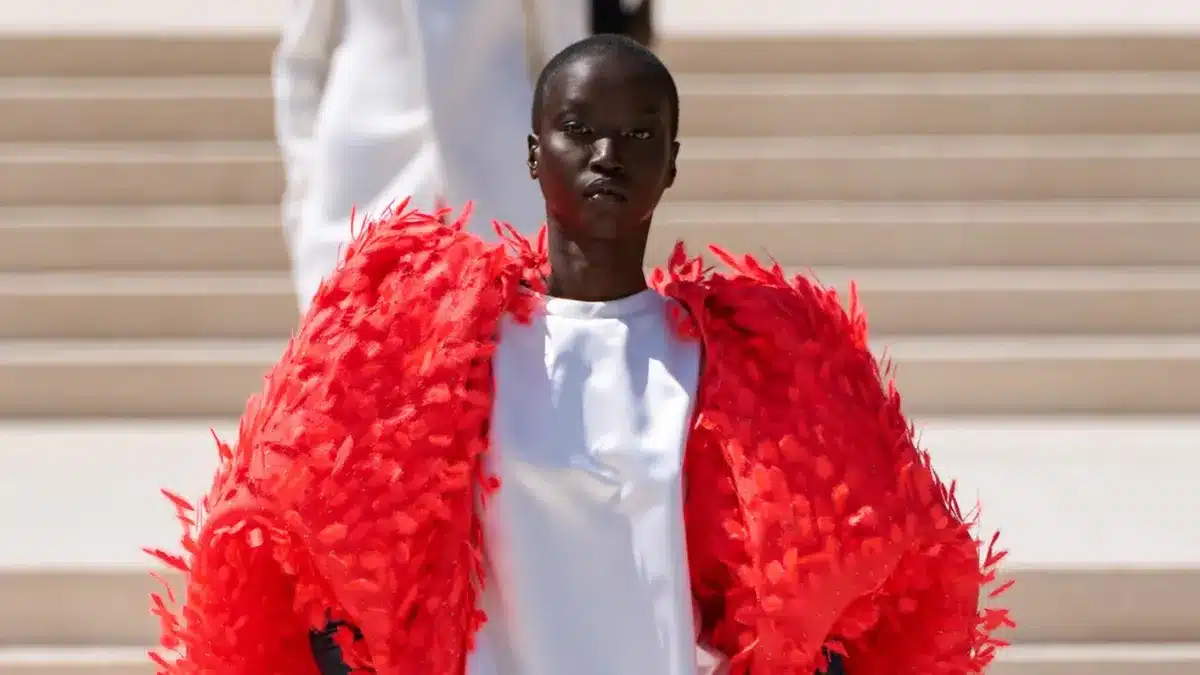
The Balenciaga couture ateliers demonstrated exceptional craftsmanship throughout the show. Intricately embroidered looks evoked a sense of dramatic elegance, while a dress adorned with 8,000 hand-painted petals stood as a true testament to the meaning of ‘couture.’ Another standout piece featured 24,150 satin stitches meticulously applied to a sheer organza base, showcasing the painstaking detail and artistry involved.
The opening and closing looks of the show were presented by model Anok Yai. The final white dress, which closed the presentation, drew inspiration from a 1967 creation by Cristóbal Balenciaga himself – the same year Pierpaolo Piccioli was born. Piccioli expressed a long-standing admiration for this particular dress, stating that his work was not about revering the past or adhering to historical precedent, but rather a sincere expression of his love for the Balenciaga legacy.
The Human Touch in a Digital World
Piccioli’s vision for Balenciaga couture in the digital age is one that honors the profound human effort, skill, and emotion inherent in the creation of each garment. By integrating advanced technology with time-honored artisanal techniques, he aims to redefine the boundaries of haute couture, ensuring its continued relevance and allure. The collection serves as a powerful reminder that even as technology advances, the soul and dedication of the human hand remain indispensable to true artistry. The faces of the 39 individuals featured in the pre-show imagery are a testament to this philosophy, embodying the spirit and dedication that breathe life into the exquisite creations of Balenciaga.
