

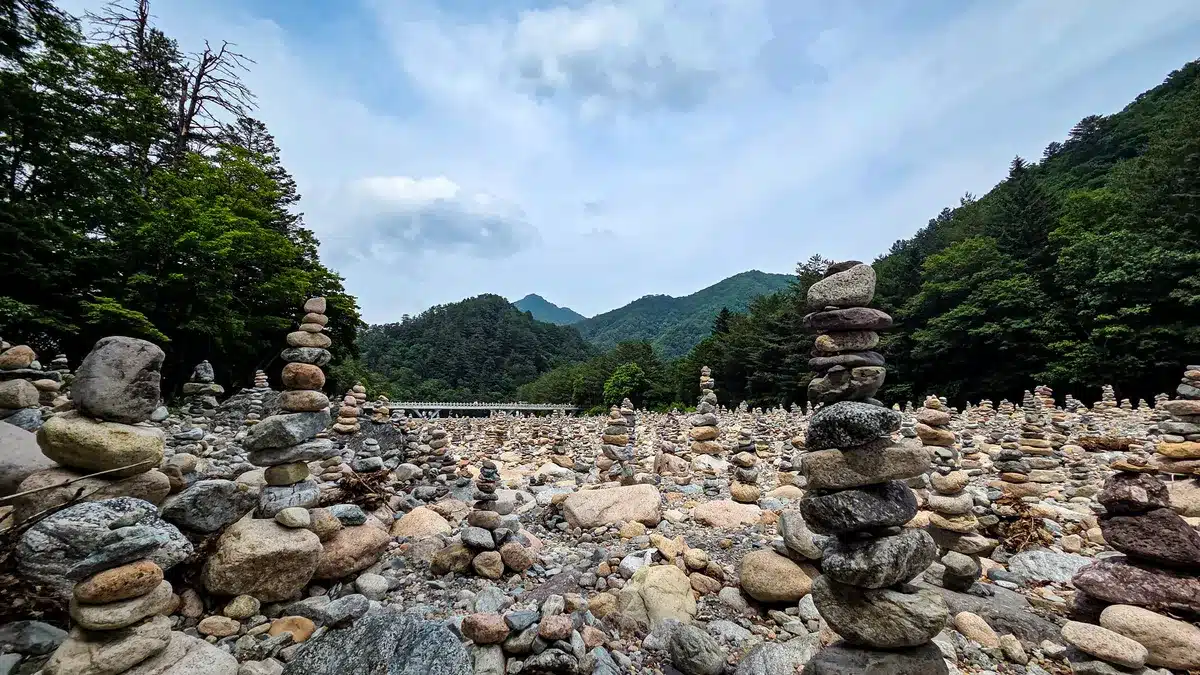
Nestled in the picturesque Seoraksan National Park, Baekdamsa Temple is renowned for a unique and poignant sight: countless stone towers meticulously stacked along the stream banks leading to the temple. These towers, a signature feature of the landscape, have become a symbol of the hopes, wishes, and resilience of the many visitors who have built them.
The path to Baekdamsa, approximately 7 kilometers from the former ticket booth, winds through the mountains. While accessible by car, some sections are narrow, making two-way traffic challenging. The journey takes about 15-20 minutes by vehicle or around two hours on foot. Along the way, the stream is dotted with white granite boulders, creating a serene natural setting. It is only as the path nears its end, revealing the temple buildings nestled at the foot of the mountain, that the full panorama of the stone towers unfolds.
The ‘Stone Towers of Hope’ Beginnings
The tradition of building these stone towers at Baekdamsa began in earnest around 2007. It was initiated by monk Baekgeo, who was in charge of the temple’s Temple Stay program. As part of the program, participants were invited to join in the ‘Hope Stone Tower Building’ activity.
This practice tapped into a deeply ingrained Korean sentiment – the spontaneous act of gathering stones and building small towers when out in nature. For participants, constructing a stone tower became a moment for introspection, a time to reflect on the meaning of life. Interestingly, towers built only with the most aesthetically pleasing stones tended to collapse quickly. It was discovered that smaller, less remarkable stones were crucial for providing stability, acting as foundational elements for the larger ones.
Monk Baekgeo observed, “As you build the stone towers, you realize that even the unsightly stones, the small ones that no one pays attention to, are essential as supporting stones.” This realization often led to emotional breakthroughs, with many participants shedding tears as they built.
One notable instance involved a gifted young student, who, despite receiving widespread praise for his academic achievements, broke down in tears while building a tower. The experience of carefully selecting and placing stones, including the seemingly insignificant ones, prompted him to reflect on aspects of his life he had overlooked, leading to an outpouring of emotion.
As the stone towers built by Temple Stay participants gradually increased in number, hikers and visitors began to contribute their own, spontaneously adding to the growing collection. Over time, the stone towers became an iconic feature of the Baekdamsa stream, captivating visitors in spring, summer, and autumn, and offering a unique spectacle even under a blanket of winter snow.
“It’s Okay If They Collapse, We Can Rebuild Them”
What happens to these towers when typhoons or heavy rains pass through? Naturally, they are washed away by the water. Yet, the spirit behind them remains unbroken.
Temple stay participants often expressed concern about the towers being swept away. Seeing the towers crumble would bring a sense of sadness. In such moments, the monk’s consistent response was, “It’s okay if they collapse.”
He explained this through the Buddhist principle of ‘Sa-Seong-Hoe-Kong’ (成住壞空), which describes the cycle of formation, existence, decay, and emptiness that all things undergo. The hopes and dreams of a twenty-year-old differ from those of a thirty or forty-year-old. The point, he emphasized, is not to cling to a collapsed tower but to rebuild today’s tower of hope.</n
Thus, the Baekdamsa stream continues to be a place where thousands of dreams and hopes are built, collapse, and are rebuilt, mirroring the transient yet persistent nature of life itself.
Monk Baekgeo, after serving as the head of Baekdamsa Temple’s Temple Stay program until 2024, now leads the temple stay program at Jeasa Temple in Gongju, Chungnam, where he continues the tradition of building hope stone towers with his participants.
Baekdamsa: A Sanctuary Steeped in History
Founded during the Silla Dynasty, Baekdamsa gained prominence in modern times, largely due to its association with the revered poet Manhae Han Yongun (1879-1944). Born in Hongseong, Chungnam, Han Yongun entered Baekdamsa in 1905, where he authored ‘The Philosophy of Korean Buddhism’ and his famous poetry collection, ‘The Silence of Love’.
As one of the 33 national representatives who led the March 1st Movement and endured imprisonment, Han Yongun frequently sought solace and inspiration at Baekdamsa during his periods of recovery and writing. Consequently, Baekdamsa is often referred to as Han Yongun’s spiritual home. This year marks the 100th anniversary of the publication of ‘The Silence of Love’.
Manhae Village and the Legacy of Han Yongun
In addition to the temple, the area around Baekdamsa honors Manhae Han Yongun’s legacy through various memorials. Crossing the stone bridge over the Baekdamsa stream leads to the temple’s main sanctuary. Within the grounds, a statue and calligraphy dedicated to Han Yongun greet visitors.
A stone inscription features Han Yongun’s poem ‘The Traveler and the Hometown’, beginning with “A man’s home is everywhere he goes.” The reverse side of the stone bears an ‘Odo Song’ (悟道頌), a verse of enlightenment, in Chinese characters:
男兒到處是故鄕 (A man’s home is everywhere he goes)
幾人長在客愁中 (How many wander, lost in sorrow?)
一聲喝破三千界 (A single shout shatters the three thousand realms)
雪裡桃花片片紅 (Peach blossoms in the snow, petal by petal red)
This poem was composed in 1917 by Han Yongun during a moment of profound awakening at Oseam Hermitage, near Baekdamsa. It vividly portrays the state of enlightenment through auditory and visual imagery.
Beyond the statue and poem, other structures like ‘Manhae Hall’ and the ‘Manhae Memorial Hall’ also bear his name. After publishing ‘The Silence of Love’ in 1926, Han Yongun moved to Seoul to continue his activities.
The Influence of Monk Musan and the Preservation of Manhae’s Spirit
About half a century after Han Yongun left Baekdamsa, another significant figure emerged in the late 1970s: Monk Musan (1932-2018), also known as ‘Mue Do-in’ (One Who Walks Unhindered). Monk Musan, whose lay name was Jo Ohyun, became the head monk of Sinheungsa Temple, which includes Baekdamsa, in 1977. He was also celebrated as a poet who expressed the world of Zen through his unique Korean free verse poetry, with collections like ‘Shimudo’ and ‘Distant Sage’ receiving widespread acclaim.
For Monk Musan, Han Yongun was both a senior poet and a fellow monk who had passed through Baekdamsa. Monk Musan dedicated his life to honoring Han Yongun’s memory and promoting his philosophy. In 1997, he established the Manhae Grand Prize. In 1999, he initiated the Manhae Village project, and in 2003, he opened ‘Manhae Village,’ a complex cultural facility at the entrance of Naerakseorak, in Bukmyeon, Inje.
The Manhae Grand Prize, awarded for three decades, recognizes individuals who have embodied Han Yongun’s life and ideals, transcending national borders, race, and religion. Through Monk Musan’s efforts, Baekdamsa became a sacred site for Han Yongun’s followers. Many temples now feature statues of Monk Musan in a seated meditation posture, accompanied by inscriptions of his poem ‘Emptiness’.
One such inscription reads:
“Others’ lives are all visible / But my own life is not visible // Others’ deaths are all visible / But my own death is not visible // Truly, others’ emptiness is all visible / But my own emptiness is not visible”
The serene smile on Monk Musan’s statue perfectly complements the profound message of his poetry.
Baekdamsa: A Hub of Zen Practice
Monk Musan also strived to transform Baekdamsa into a vibrant center for Zen Buddhism. Beyond the publicly accessible areas, the temple houses two secluded spaces: the Jogye Order’s Basic Training Center within the main sanctuary and Mumungwan (The Gateless Gate), located further up the stream.
The Basic Training Center serves as an educational institution for novice monks (samis) preparing for monastic life. Cultivating talented individuals requires significant time and resources. Monk Musan was instrumental in maintaining this center at Baekdamsa, providing essential support.
Mumungwan is a space for dedicated practitioners who isolate themselves for intensive meditation. Participants engage in strict training, confined to their rooms, with only one meal a day provided through a small opening. This rigorous environment is typically reserved for monks with established meditative experience.
In his later years, Monk Musan himself spent considerable time in Mumungwan, undertaking both the Ha-an-geo (summer retreat) and Dong-an-geo (winter retreat). Spending half the year in this austere setting demonstrates his deep commitment and pride in Mumungwan’s practice.
The entrance to Mumungwan is marked by a sign stating: “This is Mumungwan (Mu-geumseonwon), where monks reside for silent practice. Entry for laypeople is prohibited.” A wooden fence, taller than a person, surrounds the area, and the entrance is securely barred from the outside, preventing anyone from leaving prematurely.
A notice board displays the schedule for the Ha-an-geo retreat. This year, ten participants are undergoing the retreat. The gate was sealed on June 1st, and will only be reopened after the Dong-an-geo retreat concludes in July.
Inside Mumungwan, amidst the sounds of nature, no other noise can be heard. Imagining the practitioners within, one feels a sense of cool breeze, even on a hot day. It is in places like these, perhaps, that the strength of Korean Buddhism is forged.
Baekdamsa Temple, with its rich history and serene atmosphere, continues to be a place of spiritual significance, drawing visitors seeking peace, reflection, and a connection to the enduring legacy of its revered figures.
