

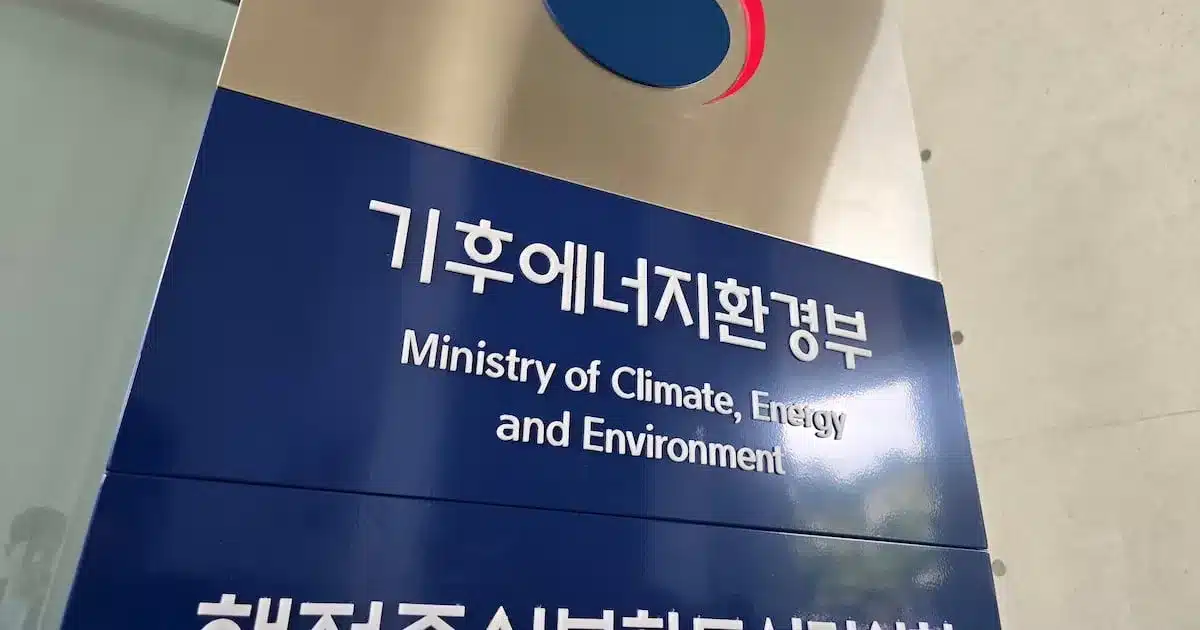
The South Korean government anticipates that the new semiconductor industrial complex in the Honam region will be able to secure a stable power supply without the need for new, dedicated transmission lines connecting different areas. This confidence stems from the anticipated abundance of renewable energy sources, such as solar and wind power, within the region, which are expected to meet the complex’s energy demands without strain. The Ministry of Environment and Energy announced that Vice Minister Lee Ho-hyeon met with Korea Electric Power Corporation (KEPCO) officials on the 8th to discuss and advance plans for an early, stable power supply to the new semiconductor cluster.
Following the confirmation of the industrial site’s location near Gwangju Airport on the 6th, the ministry aims to establish a stable power supply by 2030. During the meeting, Vice Minister Lee and KEPCO representatives explored immediate solutions for constructing new transmission lines to connect the industrial site to KEPCO’s public grid. They also discussed the necessary cooperation between local governments and relevant ministries, while KEPCO reviewed its response system.
KEPCO’s Commitment to Mega-Projects
KEPCO has formed a dedicated task force, the ‘Mega-Project Power Grid Construction Acceleration TF,’ led by Kim Jae-geun, former head of KEPCO’s Power System Department. This team is tasked with the rapid construction of power supply systems to meet the immediate needs of businesses establishing operations within the industrial complex. The plan involves accelerating construction and improving efficiency to ensure power is available precisely when and where companies require it.
The task force is also examining the current status and future plans for transmission lines to ensure a consistent 24-hour power supply to the semiconductor factories, even with the inherent variability of renewable energy sources. This proactive approach aims to guarantee uninterrupted operations for the critical semiconductor industry.
National Grid Interconnectivity and Future Energy Storage
A spokesperson for the Ministry of Environment and Energy explained the robustness of South Korea’s power infrastructure: “Our nation’s electricity grid is interconnected nationwide. This allows us to supplement power in areas with deficits by utilizing surplus power from other regions through inter-regional transmission lines.” The ministry is currently developing comprehensive national plans for electricity supply and transmission line construction.
To further bolster the stable power supply for the new complex, the government intends to confirm plans for new Energy Storage Systems (ESS) and pumped-storage hydroelectric power generation through the 12th Basic Plan for Electricity Supply and Demand. These measures are crucial for managing the intermittent nature of renewable energy and ensuring a reliable power flow to the high-demand semiconductor facilities.
Addressing Renewable Energy Variability
The semiconductor industry demands an exceptionally stable and continuous power supply, often requiring 24/7 operation. While renewable energy sources like solar and wind are environmentally beneficial and increasingly cost-effective, their output can fluctuate based on weather conditions. To mitigate this, the government and KEPCO are focusing on several key strategies:
- Grid Interconnectivity: Leveraging the existing national grid ensures that power can be rerouted from surplus regions to deficit regions
