

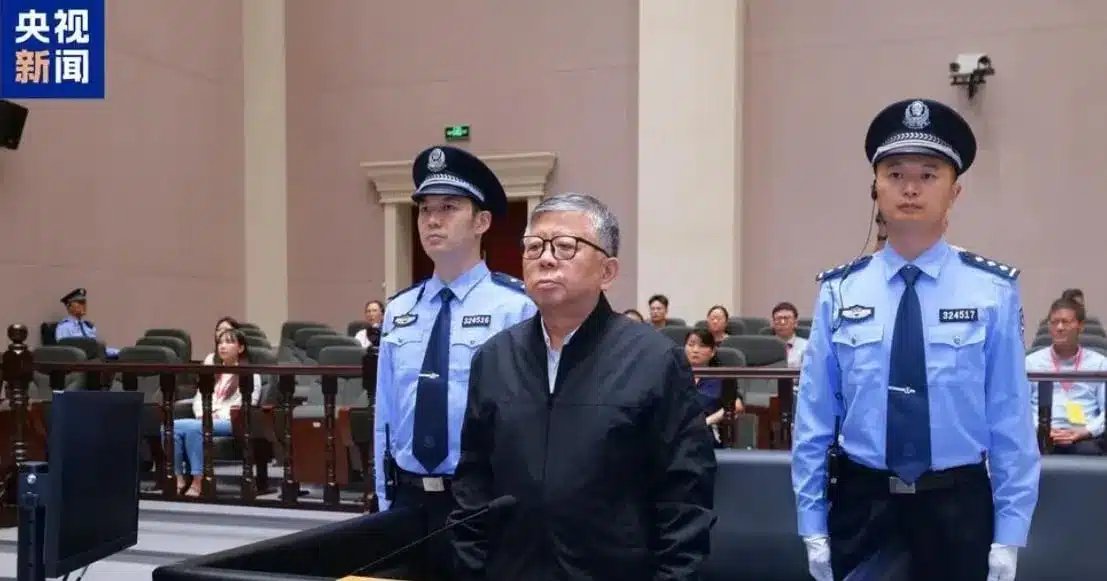
A former high-ranking official in China has been sentenced to death in his first trial for accepting bribes totaling over 2.21 billion yuan (approximately $500 million USD). The court also ordered the confiscation of all his personal assets. This case, involving what is being termed a ‘super-large’ bribery scheme, represents the largest single bribery amount ever publicly adjudicated in China.
Former Official Yang Yulin Convicted of Massive Bribery
Yang Yulin, 69, formerly served as the chairman of the Nanjiang Economic Development Group. He was found guilty by the Intermediate People’s Court of Changzhou City on July 6th. The charges against him included bribery, embezzlement, appropriation of public funds, abuse of power, and money laundering, among others.
According to court findings, Yang engaged in corrupt activities from 1993 to 2023. During this period, he held over ten positions in Nanjiang, where he leveraged his influence to provide preferential treatment to businesses and individuals in matters related to public bidding, company operations, land transfers, and fund circulation. In return, he received a staggering 2.214 billion yuan in illicit gains.
The court emphasized the exceptionally large scale of the bribery and the severity of the crimes, stating that Yang’s actions had a profoundly negative social impact and caused significant losses to national interests.
Yang Yulin’s Extensive Career in Public Service
Yang Yulin was a retired cadre who held significant positions, including deputy director of the Nanjiang Economic Development Zone Management Committee. While not the absolute highest rank, his positions were influential within the local government structure, equivalent to central ministry bureau chief or provincial department director levels.
Throughout his more than 40-year career in public service, Yang remained in his hometown of Nanjiang. He wielded considerable influence in regional development and administrative sectors.
Specific Allegations and Financial Misconduct
Further details of the charges include:
- From 2014 to 2016, while serving as deputy director of the Nanjiang Economic Development Zone Management Committee, Yang was accused of embezzling 12 million yuan in public funds in collusion with others.
- Between 2005 and 2023, he allegedly accepted over 25 million yuan in bribes from state functionaries to facilitate their work.
- From 2003 to 2009, while working in Nanjiang as the director of the Housing and Urban-Rural Development Bureau and deputy director of the Economic Development Zone Management Committee, he illegally approved land clearance and construction projects.
Context of High-Profile Corruption Cases in China
Yang Yulin is the fifth high-ranking official to be sentenced to death in the first instance since the 18th National Congress of the Communist Party of China in 2012. This sentencing reflects the ongoing stringent anti-corruption campaign within the country.
The amount involved in Yang’s case, while substantial, is second only to the 3.069 billion yuan case involving former secretary of the Huhhot Economic Development Zone, Li Zhenping. However, when considering the amount of a single bribery offense, Yang’s case stands as the largest publicly decided in China.
Professor Tang Linuo of the Beijing University of Posts and Telecommunications noted that the five officials sentenced to death in the first instance since the 18th Party Congress all had bribe amounts exceeding 1 billion yuan. He suggested that the 1 billion yuan mark has become an unofficial threshold for determining the likelihood of a death sentence in corruption cases.
Economic Development Zones as Corruption Hotspots
Experts view Yang Yulin’s case as emblematic of corruption within economic development zones. These zones, where control over land, finance, business attraction, and permits is concentrated, are particularly susceptible to long-term corruption if oversight is lax.
Chinese leadership has identified the operation, bidding, and distribution within economic development zones as key areas for anti-corruption efforts this year. This indicates that crackdowns in these sectors are expected to continue.
The court’s decision underscores the government’s commitment to combating corruption, particularly at high levels and involving significant financial misconduct.
