

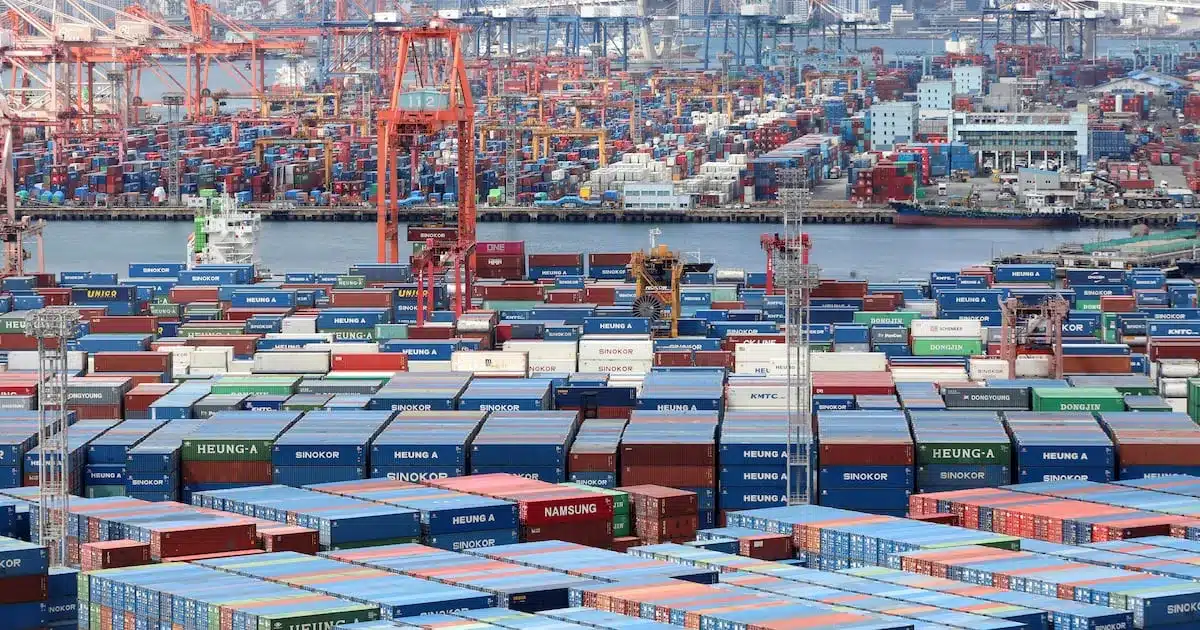
South Korea’s export value reached a historic milestone in June, exceeding $100 billion for the first time on a monthly basis. The surge is largely attributed to the booming demand for semiconductors, fueled by increased investments in artificial intelligence (AI) technologies. Official data released by the Ministry of Trade, Industry and Energy and the Korea Customs Service revealed that total exports in June amounted to $102.25 billion, marking a significant year-on-year increase of 70.9%.
Record-Breaking Export Performance
This remarkable achievement follows a period of robust export figures in the preceding months. In March, April, and May, monthly exports consistently hovered around the $80 billion mark, with figures of $87.2 billion, $85.9 billion, and $87.7 billion, respectively. The June performance represents a substantial leap forward, shattering previous records.
When considering the average daily exports, factoring in the number of working days, the figure for June rose by 59.5% to $4.54 billion. This marks the second consecutive month of record-breaking daily export performance, underscoring the sustained strength of the nation’s trade activities.
Semiconductor Sector Leads the Charge
The semiconductor industry emerged as the primary driver behind South Korea’s exceptional export results. In June, semiconductor exports alone soared to $44.82 billion, a staggering increase of 199.5% compared to the same month last year. This figure also represents a new monthly record for semiconductor exports, marking the first time this sector has surpassed $40 billion in a single month.
The AI Revolution’s Impact on Chip Demand
The exponential growth in semiconductor exports is intrinsically linked to the global surge in AI development and deployment. As companies worldwide accelerate their investments in AI infrastructure, the demand for high-performance chips, particularly advanced memory and processing units, has skyrocketed. South Korea, a global leader in semiconductor manufacturing, is strategically positioned to capitalize on this trend.
The nation’s major chip manufacturers have been investing heavily in research and development, focusing on next-generation technologies such as high-bandwidth memory (HBM) and advanced logic chips. These components are critical for powering AI applications, including large language models, sophisticated data analytics, and advanced robotics. The increased demand from global tech giants for these cutting-edge products has directly translated into higher export volumes and values.
Broader Economic Implications
The record-breaking export performance in June has significant implications for the broader South Korean economy. A strong export sector is a key engine for economic growth, contributing to job creation, foreign exchange earnings, and overall business confidence. The sustained momentum in exports, particularly in the high-value semiconductor sector, is expected to provide a significant boost to the nation’s Gross Domestic Product (GDP).
Furthermore, the success in exports highlights South Korea’s continued competitiveness in key global industries. The ability to meet the escalating demand for advanced technology components demonstrates the nation’s technological prowess and its integral role in global supply chains. This can attract further foreign investment and foster innovation across various sectors.
Looking Ahead: Sustaining Momentum
While the June figures are exceptionally positive, analysts are closely watching to see if this growth trajectory can be sustained. The global semiconductor market is dynamic, influenced by factors such as technological advancements, geopolitical developments, and shifts in consumer demand. However, the current strong demand driven by AI is widely expected to continue in the medium term.
South Korean policymakers and industry leaders are focused on maintaining this competitive edge. Strategies include continued investment in R&D, fostering a supportive regulatory environment, and strengthening international partnerships. The government has also been actively promoting diversification in export markets and products to mitigate risks associated with over-reliance on specific sectors or regions.
The Ministry of Trade, Industry and Energy has indicated its commitment to supporting the semiconductor industry’s growth, recognizing its pivotal role in the national economy. Efforts are underway to address potential supply chain bottlenecks, enhance workforce skills, and promote the development of related industries, such as advanced packaging and chip design services. The goal is to ensure that South Korea remains at the forefront of the global technology landscape.
Conclusion
The June export figures represent a landmark achievement for South Korea, underscoring the nation’s strength in the global technology market, particularly in semiconductors. Driven by the insatiable demand for AI-powered technologies, the export sector has demonstrated remarkable resilience and growth. This success not only bolsters the national economy but also reaffirms South Korea’s position as a critical player in the global supply chain for advanced technological components. The focus now shifts to sustaining this momentum through continued innovation and strategic industrial policies.
