

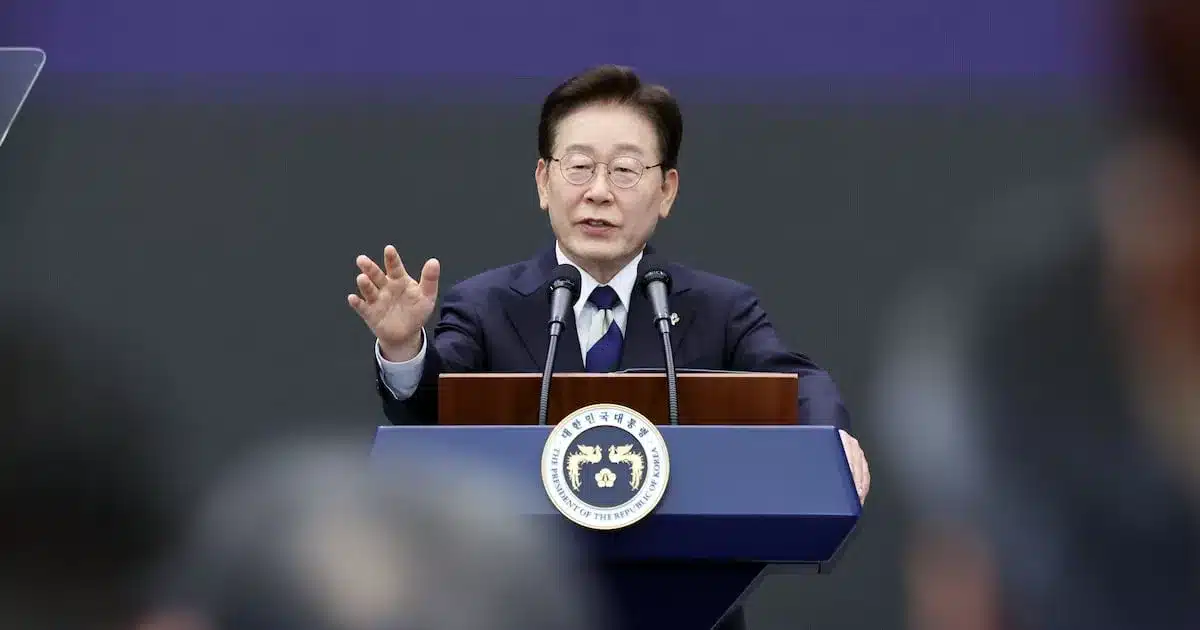
President Lee Jae-myung announced on the 30th that he secured commitments from Samsung Electronics Chairman Lee Jae-yong and SK Group Chairman Choi Tae-won to pursue the development of semiconductor clusters in both Yongin and the Honam region concurrently. This initiative is part of a broader 800 trillion won investment plan for the southwestern region of South Korea.
Dual Semiconductor Cluster Development
The president revealed these promises during a national convention in Gwangju, focused on developing advanced industries in the southwestern region. He explained that the initial plan was to complete the semiconductor cluster currently under construction in Yongin, Gyeonggi Province, before proceeding with investments in the Honam region. However, due to a surge in semiconductor demand, he urged both chairmen to advance the Honam project simultaneously.
“Given the explosive growth in semiconductor demand, I suggested proceeding with both the Yongin and Honam cluster developments at the same time,” President Lee stated. “The government will provide maximum support through financial aid, infrastructure development, education, and improvements to essential living conditions.”
He specifically highlighted that he had received prior assurances from Chairman Lee Jae-yong and Chairman Choi Tae-won regarding this parallel development. “With demand soaring, we agreed to push forward with both the Honam and Yongin cluster developments simultaneously, and both gentlemen consented to this,” he added.
To underscore the commitment, President Lee directly addressed Samsung Electronics Vice Chairman Jun Young-hyun and SK Hynix CEO Kwak Noh-jung, who were present at the convention, asking, “You agreed, didn’t you?” Both executives acknowledged with nods and applause.
President Lee pledged his personal involvement in overseeing the project’s execution, planning, and overall strategy. “As promised, I will personally oversee and ensure the execution, planning, and strategy are firmly in place,” he declared. “I will directly check and demonstrate how quickly this can be implemented.”
He further expressed his desire to prove the government’s commitment beyond political showmanship. “By pursuing both the Honam and Yongin developments simultaneously, I want to definitively show that this is not just political theater but a genuine effort by the politicians,” he stated.
Major Investment in Southwestern Region
The announcement follows a significant investment plan revealed on the 29th by Samsung Electronics and SK Hynix. The companies committed to investing 800 trillion won in the Jeonnam-Gwangju special self-governing city, starting next month, to build a fourth semiconductor fabrication plant (fab). Additionally, Amkor Technology Korea, a leader in semiconductor packaging, will invest 1 trillion won.
The total investment for the Honam region, as detailed by the presidential office, amounts to 896 trillion won. This includes the 800 trillion won for the fourth fab construction, 87 trillion won for an AI data center, and 8 trillion won for other smart factory and energy-related projects.
Economic Rationale for Honam Investment
Addressing claims of preferential treatment for the Honam region, President Lee emphasized the economic logic behind the decision. He explained that the Seoul metropolitan area is facing severe resource shortages, particularly in water and electricity, making further expansion nearly impossible.
“The Seoul metropolitan area is experiencing a shortage of all existing resources, and in particular, water and electricity sectors have reached an impasse where solutions are impossible,” President Lee explained. “The Gwangju and Jeonnam region has become the only area capable of resolving these critical issues.”
This strategic placement aims to leverage the region’s capacity to meet the escalating demand for semiconductors, ensuring the nation’s continued leadership in the global technology landscape. The simultaneous development of clusters in Yongin and Honam is expected to create a robust semiconductor ecosystem, fostering innovation and economic growth across the country.
Future Outlook and Government Support
The government’s commitment extends beyond mere financial backing. Plans include enhancing educational programs to cultivate a skilled workforce, improving infrastructure to support large-scale industrial operations, and ensuring a stable supply of essential utilities like power and water.
The dual-cluster strategy is designed not only to meet immediate demand but also to position South Korea for long-term dominance in the semiconductor industry. By diversifying production bases and investing heavily in advanced manufacturing capabilities, the nation aims to mitigate supply chain risks and enhance its competitive edge.
President Lee’s proactive engagement and direct oversight signal the high priority placed on this national project. The successful implementation of these semiconductor clusters is anticipated to generate significant economic benefits, including job creation and technological advancement, solidifying the southwestern region’s role as a key industrial hub.
The collaboration between the government and leading industry players like Samsung Electronics and SK Hynix is crucial for achieving these ambitious goals. The commitment to simultaneous development underscores a strategic approach to maximizing resources and accelerating progress in a rapidly evolving global market.
