

South Korea Mulls Basic Income Amidst AI Economic Boom
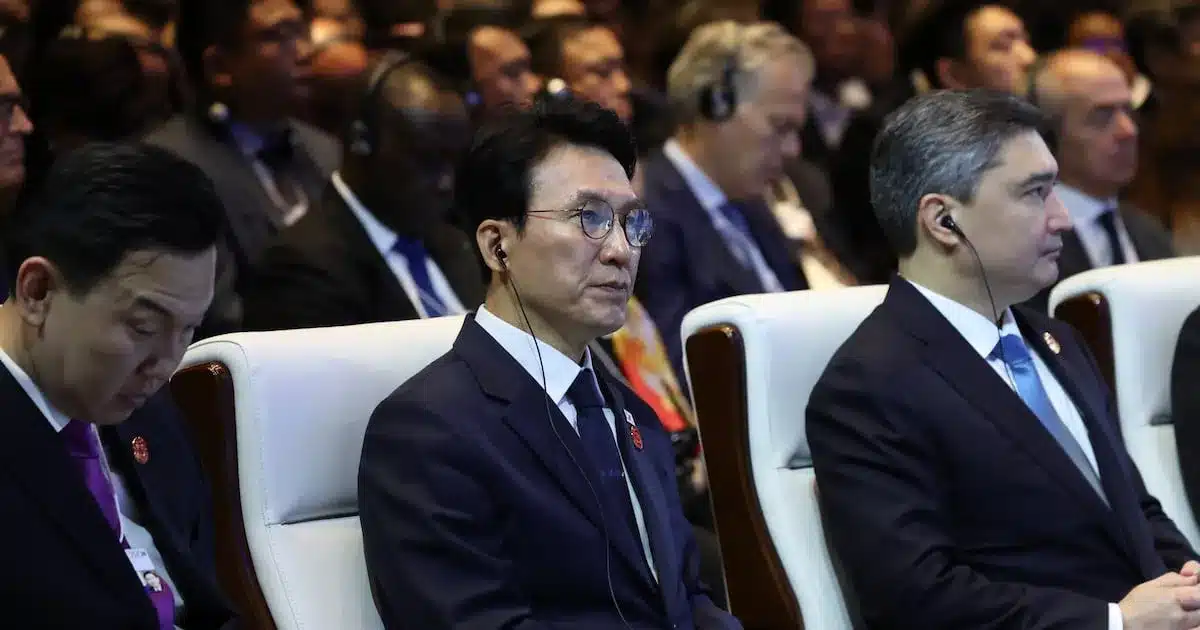
The potential economic benefits of artificial intelligence (AI) are prompting discussions about new distribution policies, including a possible link to basic income. This emerged during a special address at the 2026 Summer World Economic Forum (WEF), also known as the Summer Davos Forum, held in Dalian, Liaoning Province, China.
Addressing Societal Shifts from AI Advancement
When questioned about solutions to societal disparities arising from the widespread adoption of AI, the Prime Minister highlighted a new challenge emerging from the significant profits recently reported by South Korea’s semiconductor companies. “A new question has been raised: ‘How will these profits be distributed?'” he stated. “There is no definitive answer yet, and we are contemplating this.”
The Prime Minister further elaborated on potential strategies, suggesting that the immense wealth generated by the AI revolution could potentially be combined with concepts like basic income. “We are considering this as one idea,” he remarked. He added that it is a policy imperative for South Korea to conduct experiments linking AI transformation successes with basic income, providing insights on both the advantages and disadvantages to the international community.
South Korea’s Ambition in the AI Era
This participation in the Summer Davos Forum marked the Prime Minister’s first attendance in a decade. He outlined a vision for South Korea to leverage its deep manufacturing assets to achieve world-class competitiveness in what he termed ‘Physical AI’ – a fusion of hardware and AI. The nation aims to become a top three global player in the broader AI industry.
Emphasizing that AI is not solely defined by algorithms, the Prime Minister expressed confidence in the country’s technological foundation. “It requires comprehensive infrastructure, including semiconductors, data centers, telecommunication networks, power grids, and robust AI application and security systems,” he explained. “South Korea possesses unique strengths in this regard.” He further detailed these strengths as world-leading semiconductor manufacturing capabilities, advanced production capacity, stable high-quality power grids, robust ICT infrastructure, and a dynamic industrial ecosystem, collectively forming a ‘full-stack AI capability’.
Forging Ahead with Global Collaboration
Concluding his remarks, the Prime Minister invoked the idiom ‘Seungpung Parang’ (riding the wind and waves), signifying progress amidst challenges. He pledged collaboration with investors and researchers worldwide. “Humanity does not fear uncertainty; rather, it seizes the momentum of great change as an opportunity to navigate the tides of the era,” he stated. He reiterated his belief that South Korea’s traditional manufacturing prowess positions it to excel in the Physical AI sector.
Acknowledging the dual demands for AI and energy transformation driven by both domestic and international conditions, the Prime Minister reiterated the nation’s ambition: “We are targeting to become one of the global top three in AI across the board.”
