

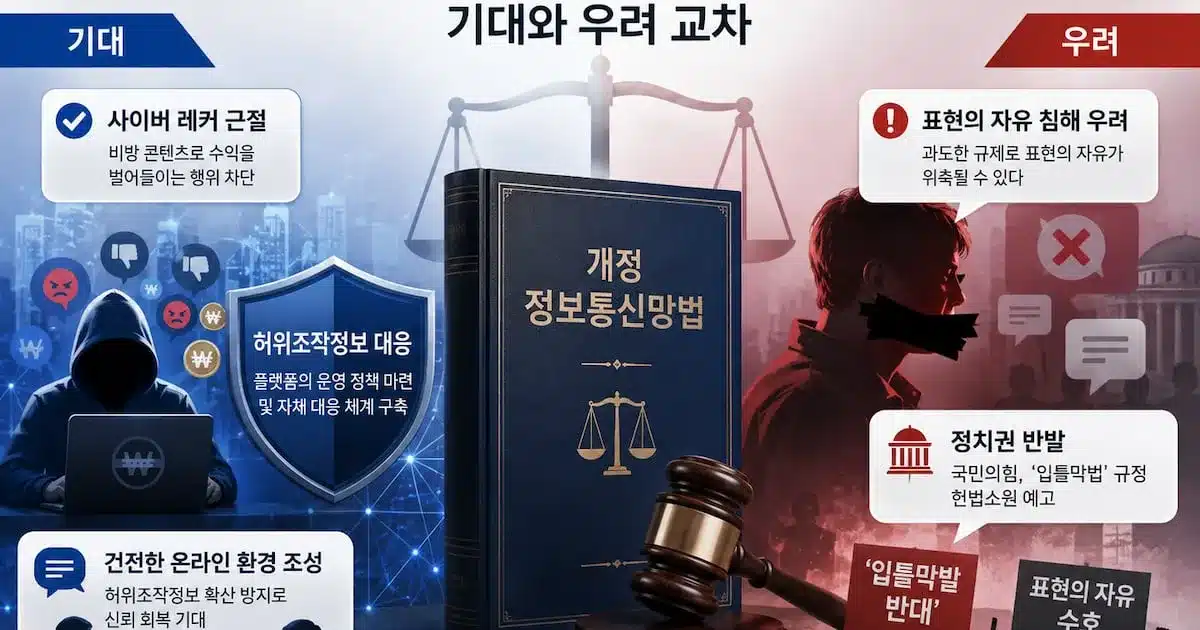
A recently enacted amendment to South Korea’s Information and Communications Network Act, effective from July 7th, is generating significant public discussion. The law aims to curb the spread of false and defamatory information online, with proponents anticipating a reduction in malicious content and a stronger stance against “cyber leeches” who profit from fabricated stories. However, critics express concerns that the vague definitions of what constitutes false or defamatory information could lead to excessive censorship and stifle freedom of expression. The opposition party has notably labeled the revised law the “mouth-gagging act” and signaled intentions to challenge it.
Key Provisions of the Amended Act
The core of the revised Information and Communications Network Act centers on imposing significant financial penalties for the repeated distribution of illegal or false information that causes harm to others. Individuals found to be repeatedly circulating such content, as confirmed by court rulings, could face damages claims up to five times the amount of the actual harm incurred. Furthermore, broadcasting and telecommunications review committees are empowered to levy administrative fines of up to 1 billion Korean Won (approximately $720,000 USD) on large-scale platform operators with over one million daily active users. These platforms are now obligated to establish their own content moderation policies. They must create manuals detailing procedures for reporting and handling instances of false or defamatory information. Additionally, these platforms are required to publish transparency reports every six months, outlining the number of reports received, actions taken, and other relevant details.
Under the new framework, the initial judgment on whether content is false or defamatory falls upon the platform operators themselves. They can remove content based on their operational policies and fact-checking results. In response to these new obligations, domestic tech companies, including Kakao and Naver, have reportedly been preparing relevant policies in line with guidelines from the Korea Internet & Security Agency (KISA), a self-regulatory body for internet freedom. Some international platforms, like Meta, are also collaborating with accredited organizations such as the International Fact-Checking Network (IFCN) to ensure compliance.
Divergent Views on Impact and Enforcement
Opinions are sharply divided regarding the anticipated effects of the amended law. Supporters believe it will effectively curtail the activities of “cyber leeches” and lead to a natural self-regulation within certain online communities that have historically hosted discriminatory or hateful content. They anticipate a positive impact on the online information ecosystem.
Conversely, a significant segment of the public and legal experts worry about the potential for overreach. Critics argue that the ambiguity surrounding the definitions of false and defamatory information could lead platforms to err on the side of caution, resulting in the excessive removal of content to avoid liability. While the government emphasizes that general opinions and political statements are not targets of regulation, there are fears that individuals might resort to self-censorship due to the perceived risks. Online discussions reflect this apprehension, with comments such as “I’m afraid to even speak” and “While the intention is good, there will likely be many cases of misuse” circulating on social media.
The debate is expected to continue until court rulings provide clearer interpretations of what constitutes false or defamatory information under the new law. Han Soo-yeon, a representative lawyer at K&D Law Firm, commented, “It can be seen as an expansion of legal responsibility and remedies to strengthen victim protection. However, the specific standards for genuinely false and defamatory information will be further refined through future court decisions.”
Political Reactions and Future Challenges
The political landscape is also reflecting the controversy surrounding the revised act. The People Power Party (PPP), the majority party, has indicated its intention to seek a constitutional appeal against the law and plans to push for a complete revision. During a party meeting, PPP floor leader Jung Jin-sik stated, “It will lead to a society where many citizens remain silent out of fear of strictness and defamation.” He added, “We will request a constitutional appeal and push for a comprehensive revision plan that includes the deletion of the defamation clause.”
In contrast, the Democratic Party of Korea (DPK), the main opposition party, has defended the amended law as a necessary institutional measure to prevent the spread of false information. Han Byung-do, a spokesperson for the DPK leader, emphasized, “This is a measure to significantly increase the social responsibility of large platform operators.” He asserted, “The terms ‘mouth-gagging’ and ‘poisonous content’ do not exist within the scope of the law.”
The differing stances highlight the ongoing tension between the need to protect individuals from online misinformation and the fundamental right to freedom of speech. The practical application and judicial interpretation of the revised Information and Communications Network Act will be closely watched in the coming months as South Korea navigates these complex issues.
