

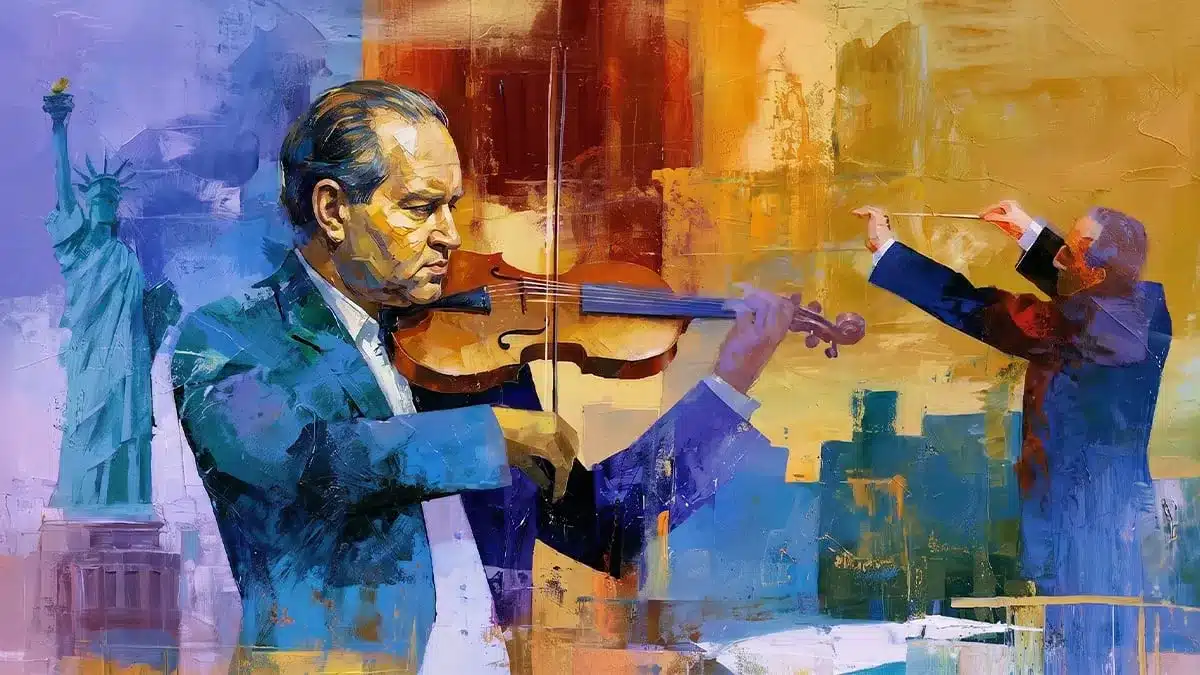
In the years following Joseph Stalin’s death, a thaw began to emerge in Soviet-American relations, marked by an increasing number of Soviet musicians undertaking tours in the United States. A particularly significant event was the debut recital of Soviet violinist David Oistrakh at New York’s Carnegie Hall on November 20, 1955. This engagement, however, was not without its challenges.
David Oistrakh’s Landmark Carnegie Hall Debut
Oistrakh’s entry into the U.S. faced initial hurdles, including opposition from Soviet authorities regarding his visa, which initially did not permit him to work. Furthermore, the planned performance was postponed due to the violinist’s sudden illness. Despite these complications, the concert generated immense public interest. Approximately 7,000 Americans lined up at the ticket office hours before sales began, and all tickets were sold out within two hours, setting a record.
Initially, Oistrakh was scheduled to perform with the Philadelphia Orchestra on December 21 of the same year before returning to the Soviet Union. However, the overwhelming demand for his performances led to an extension of his stay. He ultimately performed three concerts with the New York Philharmonic, conducted by Dimitri Mitropoulos, on December 29-30, 1955, and January 1, 1956. These concerts featured the premiere of Shostakovich’s Violin Concerto No. 1, a piece that had only recently been heard in the Soviet Union.
The Premiere of Shostakovich’s Violin Concerto No. 1 in America
The image of a Soviet violinist performing a contemporary Soviet composer’s work with an American orchestra in the heart of America was deeply symbolic. The recording of this historic collaboration was made on January 2, 1956, at Carnegie Hall, immediately following the concerts.
Remarkably, this concerto had never been publicly performed during Stalin’s lifetime. The composer, Dmitri Shostakovich, a renowned pianist himself, typically enjoyed performing works by Mozart and Beethoven, as well as his own violin sonatas. However, he began composing the Violin Concerto specifically for Oistrakh, completing the two-movement work in December 1947. Publicly, the concerto was first performed in its entirety in 1955, two years after Stalin’s death.
The concerto’s delayed premiere was due to political circumstances. In February 1948, while Shostakovich was still finishing the final movement, a resolution from the Central Committee of the Communist Party was issued. This resolution condemned Shostakovich, along with fellow composers Aram Khachaturian and Prokofiev, as formalists. This political pressure effectively suppressed the public performance of his more complex and potentially critical works.
Shostakovich’s Personal Motifs and Oistrakh’s Interpretation
Oistrakh, who had given the world premiere of the concerto in the Soviet Union on October 29, 1955, described the violin part as having a “Shakespearean role.” He characterized the first movement, ‘Nocturne: Moderato,’ as representing “oppressed emotions,” and the second movement, ‘Scherzo: Allegro,’ as “demonic.” Particularly striking in the second movement is the prominent use of the DSCH motif – a musical signature derived from the German spelling of Shostakovich’s name (D-S-C-H, corresponding to D, E-flat, C, B in German musical notation). This motif, which appears in many of Shostakovich’s later works, is often interpreted as a musical assertion of his identity and a questioning of his place amidst oppression and hardship.
Shostakovich’s Visit for Cello Concerto No. 1
Three years later, in November 1959, Shostakovich himself visited the United States, this time accompanying his Cello Concerto No. 1. This concerto had also received its world premiere in the Soviet Union just a month prior. The cellist who championed and premiered the work, Mstislav Rostropovich, recorded it with the Philadelphia Orchestra under the baton of Eugene Ormandy.
During this 1959 visit, Shostakovich became the first Soviet composer to witness the recording of his own work in America. His inscription in the guest book read, “To commemorate our wonderful meeting in Philadelphia.” Photographs from the time capture him with an unusually bright smile, a sight that led to varied interpretations. Some saw it as an expression of pride in Soviet cultural superiority, while others believed it reflected a sense of liberation felt by an artist often criticized by the Soviet system.
Cultural Exchange as a ‘Win-Win’
Regardless of the specific interpretation of Shostakovich’s demeanor, a more crucial point emerged: cultural exchange could transcend political and diplomatic tensions, creating a “win-win” scenario where neither side was solely a victor or loser. The recording of Shostakovich’s Violin Concerto No. 1, performed by Oistrakh with the New York Philharmonic, remains a historically significant artifact, capturing a moment when the worlds of Soviet and American music met, leaving an indelible mark on the cultural landscape.
