

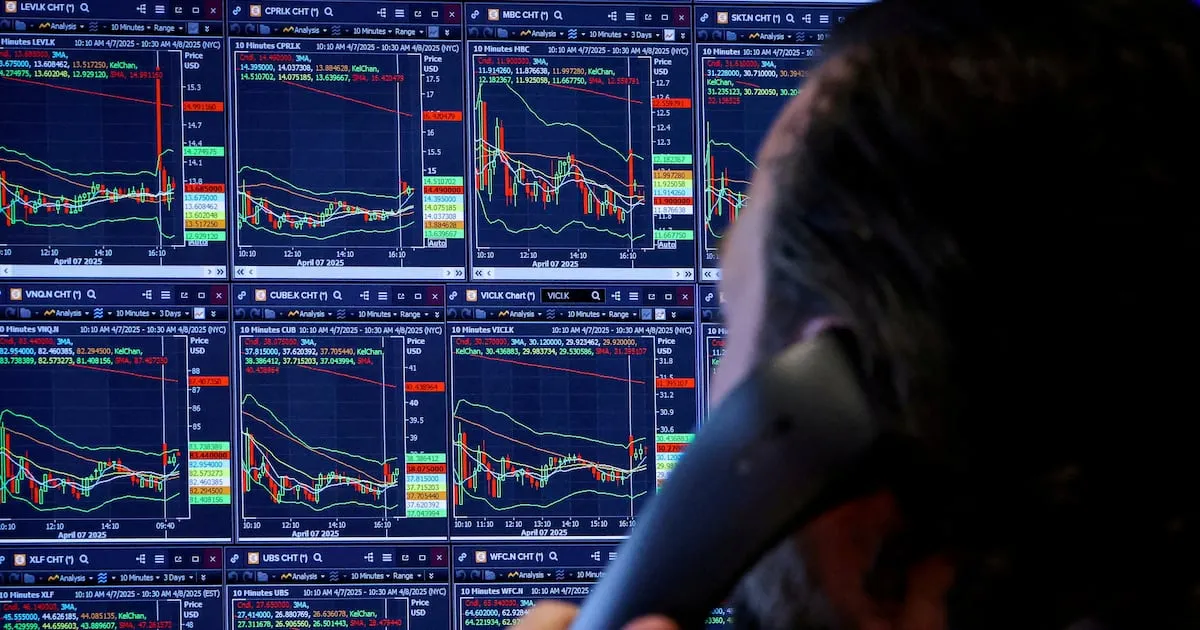
New York stock markets experienced a downturn, primarily driven by a significant sell-off in semiconductor stocks. Investor sentiment was further impacted by ongoing military tensions between the United States and Iran, contributing to the broad market decline. The Dow Jones Industrial Average, the S&P 500, and the Nasdaq Composite all opened lower on April 17th, reflecting the prevailing cautious mood among investors.
Semiconductor Sector Faces Pressure
The semiconductor industry, a key driver of recent market gains, found itself at the center of a strong selling wave. This pressure significantly weakened investor confidence in the sector. Nvidia, a leading chip manufacturer, saw its stock price fall by over 3% during intraday trading, briefly ceding its position as the most valuable company to Apple. As of mid-morning trading, Nvidia was down 1.2% to $204.82 per share. The Philadelphia Semiconductor Index also registered a notable decline, dropping 1.22%.
China’s AI Ambitions Fuel Concerns
Adding to the woes of AI-related stocks, concerns emerged regarding China’s potential to reduce demand for cutting-edge AI chips. This apprehension was triggered by the announcement from Chinese AI startup Moonshot AI, which unveiled its new “Kimi” model. The company claims this model can compete with the most powerful offerings from industry giants like OpenAI and Anthropic. This development echoes a similar situation in January when news of Chinese startup DeepSeek developing a high-performance, low-cost AI model led to a sharp decline in U.S. tech stocks. The perceived acceleration of China’s AI capabilities is creating unease among investors focused on the U.S. semiconductor market.
Geopolitical Tensions Escalate
The escalating military confrontation between the United States and Iran continued to cast a shadow over global markets. Iran reported conducting attacks on oil and gas facilities within Kuwait, resulting in damage and fires. Additionally, Iran’s Islamic Revolutionary Guard Corps (IRGC) reportedly carried out missile strikes on an Al-Wadeed military airbase in Qatar. These actions have heightened concerns about potential disruptions to the Strait of Hormuz, a critical global oil shipping lane. Earlier on April 16th, oil futures for the Strait of Hormuz had fallen to a three-week low, indicating a temporary easing of immediate supply fears. However, the renewed military escalation is now reigniting risk aversion among investors, leading to a surge in oil prices and a broader flight to safety.
Impact on Oil Prices and Risk Appetite
The geopolitical instability in the Middle East is a significant factor influencing oil prices and overall market sentiment. Any perceived threat to the Strait of Hormuz, through which a substantial portion of the world’s oil supply passes, typically leads to increased oil prices. This, in turn, can dampen economic activity and further fuel investor anxiety. The current situation suggests a renewed increase in risk aversion, prompting investors to move away from riskier assets like stocks and seek refuge in safer investments.
Corporate Earnings and Tech Stock Volatility
Beyond the semiconductor and geopolitical concerns, disappointing corporate earnings reports also contributed to the market’s downward trend. Netflix, a major streaming service, experienced a significant drop in its stock price, falling 8.84%. This decline followed the company’s second-quarter earnings report, which, while meeting earnings-per-share expectations, fell short of projections for its annual revenue guidance. Netflix projected annual revenue between $51 billion and $51.4 billion, representing a downward adjustment from its previous guidance range of $50.7 billion to $51.7 billion.
Alphabet and SpaceX Face Setbacks
Other technology giants also saw their stock prices decline. Alphabet, Google’s parent company, experienced a 2.02% drop in its stock value following reports that the launch of its “Gemini” AI model had been postponed. Furthermore, SpaceX, Elon Musk’s aerospace company, faced a setback when its Starship super heavy-lift rocket launch was temporarily halted. Elon Musk, CEO of SpaceX, explained that the delay was due to some engines not performing as expected during the automated launch sequence, but indicated that a re-attempt would be made within days. These events highlight the inherent volatility and challenges within the rapidly evolving technology sector.
Market Outlook
The confluence of a semiconductor sector downturn, escalating geopolitical risks in the Middle East, and mixed corporate earnings has created a challenging environment for the stock market. Investors will be closely monitoring developments in the U.S.-Iran relations, the competitive landscape of the AI chip market, and upcoming corporate earnings reports for further direction. The semiconductor sector, in particular, will be under scrutiny as market participants assess the sustainability of demand and the impact of international competition.
