

Director Na Hong-jin’s latest film, Hopeless, delves into the primal fear of unknown entities and pushes the boundaries of cinematic genres. The movie, set against the backdrop of a port city, follows police officer Park Bum-seok (played by Hwang Jung-min), detective Im Seon-ae (Jung Woo-sung), and a former boxer turned debt collector, Ryoo Seung-beom (Jo In-sung), as they confront an inexplicable presence. The film masterfully transitions through thriller, monster movie, and science fiction elements, progressively building suspense, dread, and terror.
The Thriller Foundation: Unveiling a Stranger’s Presence and the Chase
The initial act of Hopeless operates as a taut thriller, focusing on the unsettling presence of an unknown assailant and the ensuing pursuit. Thrillers are designed to evoke excitement, suspense, and tension in the audience. Suspense arises from a situation where the outcome is uncertain, even if the audience has some foreknowledge, while surprise stems from sudden, unexpected revelations. By manipulating the timing and delivery of information, thrillers create psychological pressure, making viewers experience both fear and fascination. Hopeless employs this strategy, weaving together suspense, surprise, psychological tension, pursuit, escape, and plot twists.
A pivotal early scene involves Park Bum-seok and Ryoo Seung-beom discovering the carcass of a bull on a village road. This moment immediately establishes psychological unease through a blend of predictability and impossibility. The discovery of the bull’s body, marked by three distinct, deep wounds, and the absence of any identifiable perpetrator, creates a sense of unease rooted in the unknown. The implication that such a fate could befall not only an animal but also a human being heightens the suspense. The camera work, moving from long shots to close-ups of the bull, offers an objective view of the scene while simultaneously capturing the protagonist’s mounting anxiety through intimate close-ups.
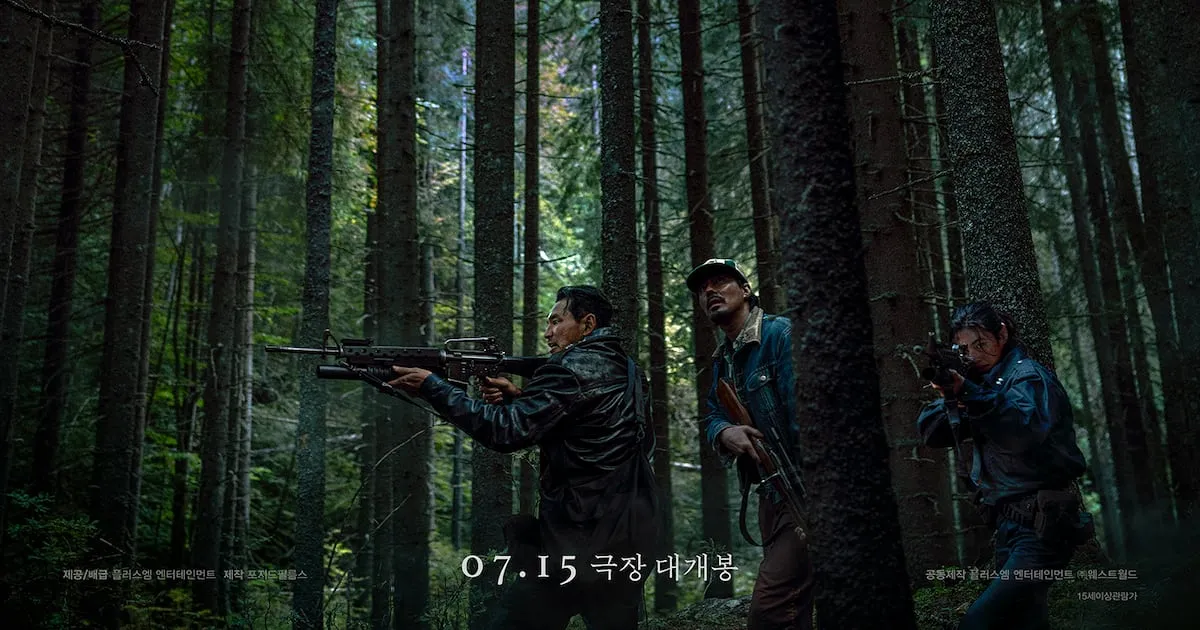
Later, in a dense forest, Ryoo Seung-beom and four other hunters find the remains of a cow, a human, and a dog. This sequence amplifies the tension and horror, blending realistic violence with the chilling suggestion of a supernatural presence. The graphic nature of the animal and human remains – a collapsed fence, a severely mutilated cow, a dismembered human torso, bloodstains, and a dog’s skull – points to the existence of an unimaginably powerful, unknown entity. Close-up shots of these gruesome discoveries intensify the feeling of dread. Ryoo Seung-beom’s gaze into the dark woods, captured in a close-up, underscores his fear and apprehension of this mysterious being.
The narrative then shifts to Park Bum-seok’s pursuit of the unidentified entity through the village. This segment highlights the dynamics of the chase, the objective of capturing the creature, and the role reversal between the pursuer and the pursued, injecting elements of black comedy. Park Bum-seok, initially driven by his duty as a police officer, becomes increasingly bewildered and fearful as he learns of the creature’s existence through the testimonies of villagers. While he is tasked with hunting the monster and protecting the residents, he finds himself outmatched and terrified by this unprecedented threat. The irony of the police officer needing help from the villagers, and the reversal of roles where the hunter becomes the hunted, generates dark humor.
The film further explores the incompetence of authority and the normalization of violence. The discovery of villagers’ bodies, including a hand protruding from a collapsed wall and a corpse crushed by a truck, leaves no trace of the creature, amplifying the fear of its unseen presence. The scene where Park Bum-seok fires his gun into a deserted convenience store, only to find the owner inside, reveals the escalating chaos and the police’s struggle to contain the situation. The owner’s dying words, laced with expletives and a strange sense of resignation, add a layer of dark comedy to the grim reality. This blend of gore and humor serves as a psychological defense mechanism, transforming horror into a form of catharsis against overwhelming dread and suffering.
The Monster Movie Middle: The Predator’s Rampage and Social Allegory
As Hopeless progresses into its middle section, it fully embraces the monster movie genre, depicting the predator’s brutal attacks and offering a profound social allegory. Monster movies typically chronicle humanity’s struggle for survival against unknown beings or mutated creatures. The narrative often intertwines elements of mystery, as characters try to identify the monster; thriller, as they are hunted; and action, as they fight back. Hopeless exemplifies this, showcasing the evolution of a female protagonist, the transition from mystery to action, the subversion of the predator trope, and underlying social commentary.
The film highlights the heroism of Im Seon-ae, a female police officer, in contrast to the initial fear displayed by Park Bum-seok. While Park Bum-seok hides behind a car, Im Seon-ae confronts the creature head-on, firing her weapon and injuring one of its legs. She then relentlessly pursues it in a police car, ultimately leading it to be crushed by a large truck. When Park Bum-seok questions where she got the gun, Im Seon-ae dismisses the question, emphasizing the creature’s reckless behavior and incredible speed. Her defiant words to the creature, “Don’t mess with me, you stinking thing,” and her sharp retort to Park Bum-seok, demanding he properly handle his ‘pig-like face,’ reveal her dual role as a capable officer and a protector of the marginalized.
Im Seon-ae embodies the archetype of the heroic female officer, demonstrating both strength and a complex social identity. Park Bum-seok, initially paralyzed by fear, finds courage after witnessing Im Seon-ae’s bravery and joins her in confronting the creature. The ensuing chase through the forest marks a shift in the film’s genre progression, moving from mystery to thriller to action. The hunters’ investigation into the creature’s identity, including the discovery of various animal and human remains and a subsequent autopsy revealing it to be a non-human biological entity, forms the mystery element. The pursuit and escape sequences create a sense of terror, while the final confrontation represents the action climax.
The narrative structure sees characters’ roles evolve: the police shift from pursuit to defense, villagers from victims to active participants, and hunters from observers to combatants. Initially fleeing the creature’s supernatural strength, they eventually rally, driven by the deaths of their companions and loved ones. The camera work mirrors this genre shift, transitioning from mystery to thriller to action, intensifying the characters’ emotions from suspense and fear to outright terror.
A particularly striking scene involves Park Bum-seok observing the creature through a shop window. The close-up on his face conveys the imminent danger and his palpable fear. Later, as the creature pursues a police car, Park Bum-seok shoots at it. The camera focuses on the creature shedding tears, raising questions about its nature and motivations. The forest chase and autopsy scenes further explore the creature’s identity and the fear it instills. The hunters’ attempt to capture and profit from the creature, only to be largely killed, highlights the dangers of greed and the disruption of ordinary life.
The autopsy reveals the creature has five fingers, facial features resembling human eyes, nose, and mouth, but also four toes, a three-meter height, tough skin, and no digestive system, confirming it as an alien life form. This revelation intensifies the fear of its formidable power and unknown capabilities.
The film critiques societal issues, including the failure of law enforcement and the brutalization of society. The creature’s existence is presented not merely as a threat but as a symbol of societal instability, exposing the government’s inability to maintain order. The hunters’ decision to capture and sell the creature, leading to their demise, underscores the theme of human greed leading to destruction. The forest, initially a place of peace, transforms into a site of terror and death.
The Sci-Fi Finale: Human-Alien Dynamics and the Essence of Humanity
The concluding part of Hopeless transitions into a science fiction epic, exploring the complex relationship between humans and extraterrestrials and questioning the fundamental nature of humanity. Science fiction films often use space, future societies, or advanced technology as a backdrop to explore profound philosophical questions. Common themes include the future of humanity, the definition of being human, and the nature of reality. Hopeless touches upon the ethical implications of advanced technology, the core of human identity, and the fusion of multiple genres.
The discovery of a spaceship in the forest marks the film’s shift from a monster movie to science fiction. The creature is revealed to be an alien. The appearance of the spaceship, along with other sci-fi elements like advanced weaponry and technology, signifies this genre transformation. The colossal spaceship serves as a visual representation of an advanced alien civilization. The alien invader, Mabe-yu, continuously shapeshifts, appearing as a four-legged beast, a winged alien, and a humanoid extraterrestrial. These transformations, along with the giant alien and the massive spaceship, create an overwhelming spectacle.
Inside the spaceship, the camera captures the vastness of the alien environment, contrasting the high-angle view of humans with the low-angle perspective of the aliens. This juxtaposition highlights not only the human viewpoint but also the alien perspective, emphasizing the vast technological gap. The dialogue between Queen Jore and the alien general Mabe-yo reveals the aliens’ advanced technology and their potentially aggressive intentions towards Earth. The scene depicts the death of Prince Kalli, the Queen’s grief, and the General’s ultimate sacrifice, offering a glimpse into the alien society’s emotional landscape and their complex motivations.
The film questions whether the aliens’ aggression is a direct consequence of humans’ actions, specifically the killing and dissection of a young alien. It ponders whether the aliens would have attacked regardless. The narrative suggests a cycle of violence, where the aliens’ brutal actions mirror human cruelty, blurring the lines between victim and perpetrator. The camera’s close-ups of the young alien’s demise emphasize the brutality of the act and contrast the innocent creature with the violent human response.
The film concludes by posing profound questions about fate, belief, and the potential for change. Queen Jore’s statement, “Kalli’s fate is all of our fate. Faith is the evidence of things unseen. Change your destiny,” leaves the audience pondering the film’s deeper meaning. The sudden invasion by Emperor Kuel raises further questions about the aliens’ motives and the unfolding narrative. The unresolved mysteries suggest that the full story will be revealed in the film’s second part.
Hopeless: Na Hong-jin’s Bold Experimentation
Hopeless represents a significant departure for director Na Hong-jin, known for his intense thrillers like The Chaser and The Wailing. While his previous works are characterized by dark thrillers, desperate internal motivations, and epic narrative completeness, Hopeless blends thriller and science fiction elements, presenting formidable alien beings and stunning visuals. Both The Wailing and Hopeless share a rural setting and explore suspense and supernatural elements, but The Wailing focuses on psychological horror rooted in folk beliefs and shamanism, whereas Hopeless uses aliens as its subject, incorporating imaginative science fiction and black comedy.
The film stands out for two key aspects: its palpable sense of dread and its unresolved mysteries. Na Hong-jin masterfully combines thriller and comedy, creating a unique blend of extreme tension and subtle humor. Scenes like the dialogue between the police officer and villagers, the shooting at the convenience store owner, and the high-stakes chase on the road showcase a fusion of violence, death, laughter, and relief, achieving a delicate balance between tension and release.
Furthermore, the film leaves many questions unanswered, such as the meaning behind Queen Jore’s pronouncements on fate and belief, the reason for Emperor Kuel’s invasion, and the implications of General Mabe-yo’s sacrifice. These lingering questions create anticipation for the film’s second part.
