

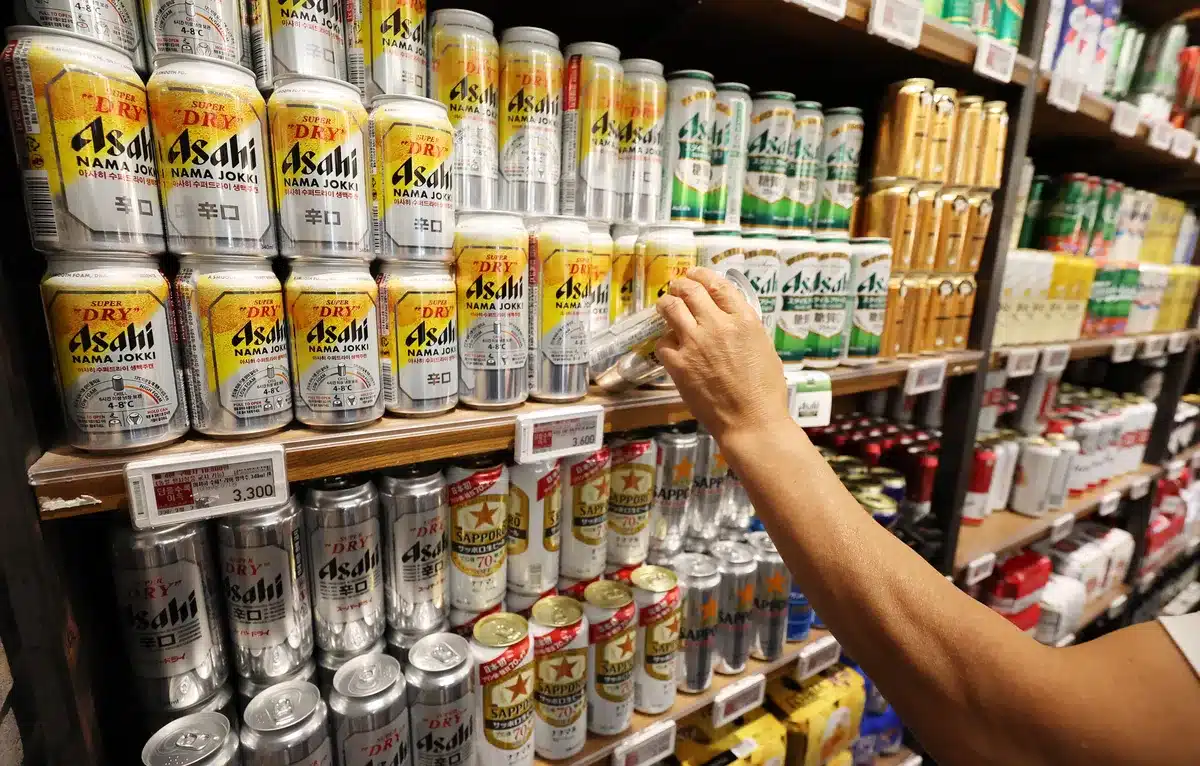
Despite lingering sentiments from a past boycott movement, imports of Japanese beer have reached an unprecedented milestone, surpassing 100,000 tons last year. This surge marks a significant rebound for Japanese beer in the South Korean market.
Record Import Volume Achieved
According to the Ministry of Food and Drug Safety’s recently released ‘2026 Import Food Inspection Yearbook,’ South Korea imported a total of 100,322 tons of Japanese beer in the previous year. This figure represents the first time annual imports have exceeded the 100,000-ton mark.
Overall beer imports last year amounted to 240,000 tons. Japanese beer accounted for a substantial portion, making up approximately 41.7% of all imported beer, equivalent to about 4 out of every 10 cans.
Historical Trends and Boycott Impact
Japanese beer imports had been on a steady upward trajectory, growing from 12,369 tons in 2011 to 86,566 tons by 2018, establishing itself as a dominant product in the imported beer market.
However, the landscape shifted dramatically in 2019 following a trade dispute between South Korea and Japan. This led to the resurgence of the ‘No Japan’ boycott movement, which significantly impacted Japanese beer sales. Consequently, import volumes plummeted, falling below 10,000 tons annually in 2020 and 2021.
Resurgence and Recovery
Following the decline of the boycott movement and an improvement in bilateral relations, Japanese beer imports began to recover. After a rebound in 2022, imports continued to climb, reaching 71,446 tons in 2023 and 82,229 tons in 2024, culminating in the record-breaking figure last year.
Key Importing Regions and Brands
Fukuoka Prefecture in Japan emerged as the largest source of imported Japanese beer into South Korea, accounting for 53,596 tons, which is more than half of the total Japanese beer imports. This region is home to major Japanese beer brands like Asahi and Kirin.
Other significant contributing prefectures include Oita (18,504 tons), where Sapporo and Kirin breweries are located, and Aichi (11,225 tons).
Shifting Import Landscape
In contrast, imports of European Union (EU) beer, which benefited from the ‘No Japan’ boycott, have seen a considerable decrease. Last year, beer imports from 27 EU countries totaled 63,161 tons, representing 26.3% of the total imports. This is a stark reduction from the 197,938 tons imported in 2019, a mere one-third of the previous volume.
Meanwhile, imports of American beer experienced a notable increase, rising by approximately 40% to 30,776 tons from 22,000 tons in the previous year.
The data indicates a dynamic shift in the imported beer market, with Japanese brands regaining significant ground after a period of political and economic tension.
