

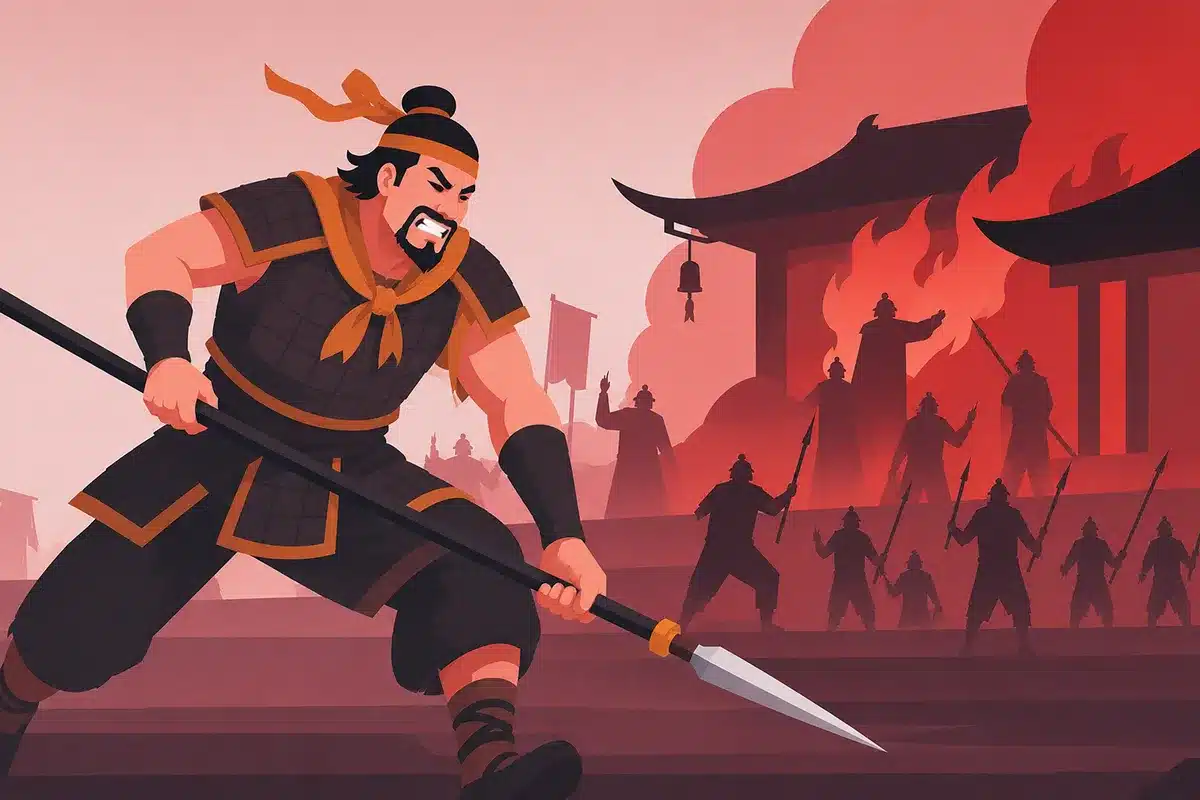
The narrative recounts a perilous journey undertaken by Cao Song, the father of the prominent warlord Cao Cao, during a tumultuous period. Cao Song, a scholar of renown, was dispatched to Langya Commandery. He had been living in seclusion, having fled to Langya to escape unrest. Upon receiving a letter from his son, Cao Song, along with his younger brother Cao De and approximately 40 followers, gathered over a hundred servants. They divided into groups and set out towards Jirum-gil, seeking a safe route.
An Unexpected Encounter and a Generous Host
During their travels, the group passed through Xuzhou. The governor of Xuzhou, Tao Qian, known for his virtuous and gentle nature, had long wished to establish a connection with Cao Cao but had never had the opportunity. Hearing that Cao Song, Cao Cao’s father, was passing through his territory, Tao Qian eagerly came out to greet him. He showed profound respect, offering elaborate ceremonies and hosting a grand banquet that lasted for two days. The hospitality was extensive, demonstrating Tao Qian’s deep admiration.
A Guard’s Treachery and a Devastating Ambush
As Cao Song and his entourage prepared to depart Xuzhou, Tao Qian personally escorted them far beyond the city walls. To ensure their safety, he appointed the Commandant, Zhang Kai, to lead 500 soldiers and personally escort Cao Song, emphasizing the importance of their protection. Cao Song, accompanied by his attendants, left Xuzhou and proceeded towards the regions of Huaxian and Bixian.
Despite it being early autumn, a torrential downpour began. Amidst the heavy rain, a dilapidated temple came into view. Seeking shelter from the storm, the group decided to stay for the night. The monks welcomed them, and they entered the Dharma hall. Cao Song arranged accommodations for his attendants and ordered Zhang Kai to encamp the soldiers on either side of the temple. Many soldiers, their clothes and armor soaked, shivered in the rain.
Zhang Kai, seeing the miserable state of his men, quietly gathered his subordinates. He spoke of their previous surrender to the Yellow Turbans, which had yielded little benefit, and then pointed to the considerable wealth carried by Cao Song’s party. He proposed a plan: “If you wish to become rich, it is not difficult. Tonight, we will launch a surprise attack, kill Cao Song and his entire family, seize their treasures, and then flee into the deep mountains to hide. What do you say?” The soldiers enthusiastically agreed to the treacherous scheme.
The Attack and the Aftermath
That night, the relentless rain and wind made sleep impossible for Cao Song, who remained awake. Suddenly, loud shouts erupted from the surroundings. Cao De, Cao Song’s brother, drew his sword and rushed outside, only to be fatally wounded by a spear thrust through a window. Cao Song, in shock, grabbed a single attendant and frantically tried to escape over a wall, heading towards the south. However, the plump attendant stumbled, preventing a swift escape. Cao Song and the attendant hid in a latrine, but they were discovered by the bandits.
Meanwhile, Ying Shao, the official responsible for Cao Song’s safety, managed to escape the massacre, though he was severely injured. Zhang Kai and his men murdered Cao Song and his entire family, plundered all their possessions, set fire to the temple, and fled with the 500 soldiers towards Huainan.
Historical Reflection
This tragic event, marked by betrayal and immense loss, was later immortalized in a poem, reflecting on the cyclical nature of justice and retribution:
- Cao Cao, the ambitious hero, is renowned throughout the ages,
- He once annihilated the entire family of Lu Bu.
- Now, his whole household has met death at the hands of others,
- Heaven’s justice cycles, and retribution is never amiss.
The poem highlights the perceived irony of Cao Cao’s family suffering a similar fate to those he had previously wronged, suggesting a cosmic balance at play. The narrative serves as a stark reminder of the brutality and treachery that characterized the era, where even familial ties and official protection offered little security against greed and ambition.
