

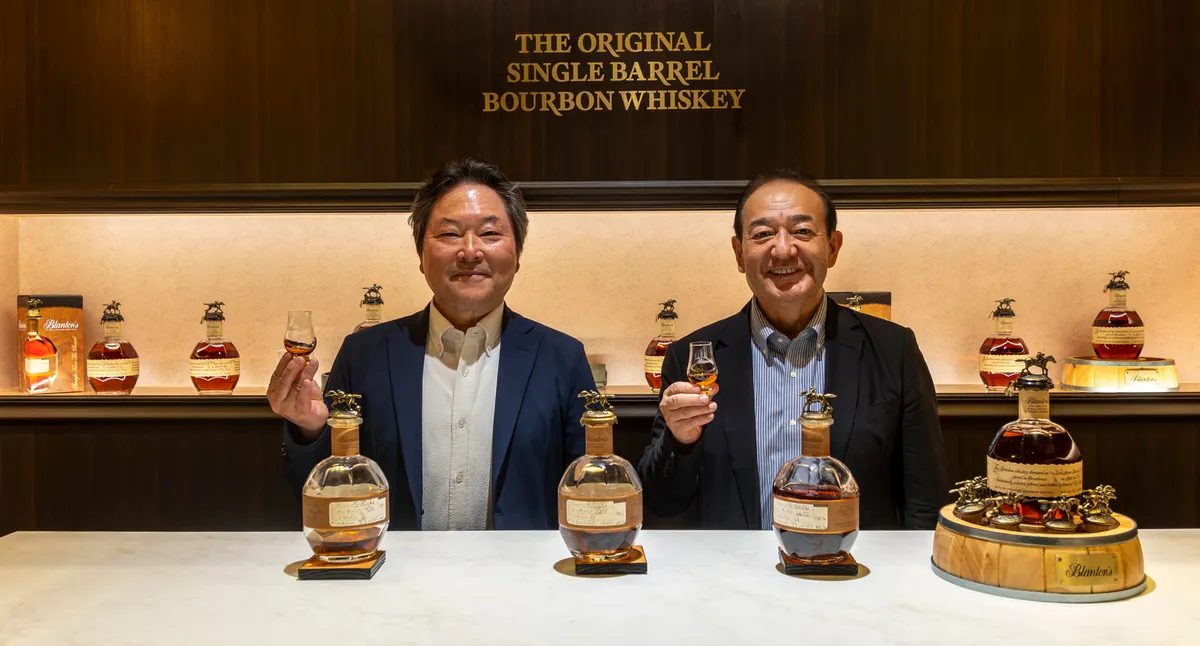
Blanton’s bourbon is instantly recognizable, not just for its distinctive bottle topped with a collectible horse and jockey stopper, but for its unique production philosophy. Often mistaken for a decorative item, this premium bourbon holds a special place in the spirits world as the first commercially produced single barrel bourbon. Its distinctive packaging and reputation for quality have made it a sought-after brand, but its true uniqueness lies in a stringent quality control process: no single person decides what constitutes ‘Blanton’s taste.’ Instead, a panel of approximately ten individuals, including experts, accountants, office staff, and gift shop employees, collectively taste and approve each barrel. Only when every member agrees that a particular barrel meets the Blanton’s standard can it be bottled and sold under the brand name. If even one person deems it unsuitable, the barrel is rejected.
The Genesis of a Single Barrel Icon
The story of Blanton’s begins with Albert B. Blanton, who joined the O.F.C. Distillery (now Buffalo Trace Distillery) in 1897 as an apprentice. By 1921, he had risen to the position of president. Blanton had a personal tradition: for special guests, he would personally select a favorite oak barrel from the aging warehouse and bottle its contents as a unique gift. This wasn’t a commercial product; it was a personal gesture of appreciation for his most valued guests. This intimate practice laid the groundwork for what would become a revolutionary concept in bourbon production.
In 1984, Elmer T. Lee, then Master Distiller, transformed Blanton’s personal tradition into a commercial product. At a time when blending whiskey from multiple barrels to achieve a consistent flavor profile was the industry norm, Lee introduced a bourbon bottled from a single oak barrel. This marked the birth of Blanton’s, a brand that would come to define the premium single barrel category.
Takara Group’s Acquisition and Global Strategy
Today, the Blanton’s brand is owned by the Japanese company Takara Group. Interestingly, Takara was not the initial importer of Blanton’s into Japan. While the American bourbon market was experiencing a downturn, Japan’s premium bourbon market was steadily growing. Takara began distributing Blanton’s in Japan in 1989, and after two years of market assessment, acquired the brand itself. A curious aspect of this acquisition is that Takara did not purchase the distillery assets. Instead, they acquired the brand name and the rights to its international market, while the production facilities remained in the United States.
This strategic decision allowed Takara to focus on brand building and international sales, while collaborating with a U.S. partner, Sazerac, for production. The company’s leadership explained that directly managing a U.S. distillery, including its production, labor, legal compliance, and distribution, would have been impractical for a Japanese firm. The success of Buffalo Trace today validates their decision, with no regrets expressed about not owning the distillery.
Why Takara Was Chosen
The previous owners approached Takara for acquisition because the two companies had already been collaborating in Japan for about two years, with Takara’s market share steadily increasing. This established relationship fostered trust, and Takara was seen as a suitable steward for Blanton’s legacy. It was deemed more appropriate for a company with an existing working relationship to continue the brand’s journey rather than transferring it to an unrelated entity.
Navigating Internal Debates
The acquisition of Blanton’s was not without internal debate within Takara. The company’s core business traditionally focused on everyday alcoholic beverages like sake and shochu. Introducing a high-priced imported whiskey into their portfolio sparked discussions about its strategic fit. However, Blanton’s was recognized as a premium brand that could fill a gap in Takara’s existing product range, offering access to a new market segment and enhancing the company’s overall offerings.
The Unwavering Commitment to Quality
The ultimate arbiter of Blanton’s quality remains the Master Distiller and tasting panel at the distillery in the United States. This practice predates Takara’s ownership. The decision of what qualifies as a Blanton’s barrel is not made by Japanese personnel imposing new standards, but by adhering strictly to the criteria established by Elmer T. Lee in 1984. The evaluators’ nationality is irrelevant; the focus is on whether the barrel meets Lee’s original benchmarks.
The tasting panel comprises about ten individuals, a mix of experts and non-experts, including accountants and gift shop employees. Their unanimous approval is required for a barrel to be designated as Blanton’s. This rigorous process ensures that each bottle represents the consistent quality and character that the brand is known for. Unlike blended whiskies, which can adjust flavor by mixing different barrels, Blanton’s single barrel nature means each barrel must stand on its own. This meticulous selection process naturally limits production volume.
Contrary to rumors, Blanton’s sold in Japan are not aged longer than those sold elsewhere. The fundamental aging process and quality standards are identical globally. The brand does not intentionally produce aged-specific or vintage products. Instead, the focus is on bottling each barrel at its absolute peak flavor, regardless of its age. A barrel might reach its prime at six, seven, or eight years, and that specific moment is what defines its readiness for bottling as Blanton’s. A ten-year-old barrel could be bottled if it meets the criteria, just as a six-year-old barrel can be if it achieves the same quality standard. The number of years is secondary to the achieved flavor profile.
Warehouse H: A Unique Aging Environment
The aging warehouse, known as Warehouse H, was built by Albert B. Blanton himself shortly after the end of Prohibition in 1934. It is unique as the only warehouse at the distillery constructed with a metal roof, allowing for more direct temperature fluctuations from Kentucky’s significant seasonal changes. These temperature shifts cause the bourbon within the oak barrels to repeatedly expand and contract, influencing the aging process. Even within the same warehouse, the location of a barrel can affect its temperature and aging speed, leading to distinct characteristics in each individual barrel.
Evolving the Brand: Gold and SFTB
While Blanton’s does not currently plan to release products based on specific aging periods or vintages, the brand continues to evolve. The Japanese market, in particular, has driven the development of new expressions. Blanton’s Gold and Blanton’s Straight From The Barrel (SFTB) were introduced in response to requests for products that offered a step up from the original, showcasing the single barrel’s character more directly. After discussions with Sazerac’s Master Distillers, Blanton’s Gold was bottled at a higher proof, with water added to achieve a specific alcohol content. SFTB, on the other hand, is bottled at cask strength, meaning no water is added, and the whiskey is bottled directly from the barrel as is. The variation in proof and flavor profiles between different SFTB barrels is considered part of its inherent value.
Blanton’s Gold represents a premium tier with a higher proof than the original. SFTB takes this further, offering an unfiltered, undiluted experience directly from the barrel, allowing consumers to experience the most direct expression of the single barrel’s unique qualities. These expressions have become highly favored among Blanton’s enthusiasts worldwide.
The Potential for a Korean Blanton’s
The possibility of a Blanton’s expression specifically for the Korean market is not out of the question. While no concrete plans exist, if sufficient demand arises from the Korean market and the proposed concept aligns with Blanton’s quality and identity, it could be considered. The development of Gold and SFTB originated from market demand, suggesting that unique regional expressions are feasible.
Conclusion: A Legacy of Uncompromising Standards
From its origins as the world’s first commercially available single barrel bourbon, Blanton’s has grown into a global premium brand. Yet, its selection process remains remarkably analog: a small group of about ten individuals, a mix of professionals and staff, hold the fate of each barrel. If even one person disapproves, that barrel cannot bear the Blanton’s name. The brand is owned by a Japanese company, the whiskey is produced in the U.S., and new product ideas often stem from collaborative discussions between the two nations. However, the final decision on what truly constitutes Blanton’s rests on the original principles set forth by Elmer T. Lee in 1984. This unwavering adherence to quality, established over 40 years ago, is arguably the key to Blanton’s enduring success and appeal.
