

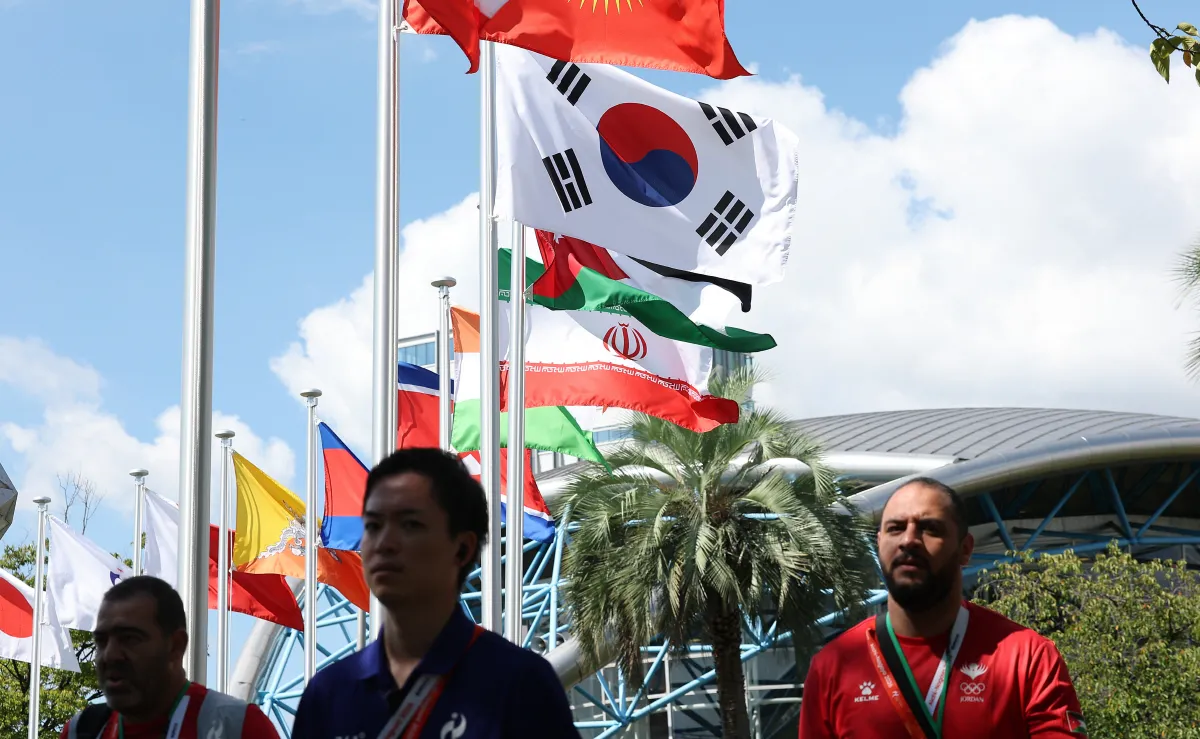
A significant error occurred during an Asian Games hockey match when the national anthem of North Korea was mistakenly played instead of South Korea’s. The incident took place on June 18th at the Green Stadium in Kakogawa, Japan, during a preliminary round match in Group A of the men’s hockey tournament for the 2026 Aichi-Nagoya Asian Games, featuring South Korea and Bangladesh.
Typically, before sporting events like hockey, football, or basketball, the national anthems of both competing teams are played with the athletes standing at attention. In this instance, the stadium announcer had indicated that South Korea’s national anthem would be played. However, to the surprise of attendees and participants, the anthem that sounded over the speakers was that of North Korea.
The stadium announcer acknowledged the mistake, stating, “We played the wrong national anthem.” This marks the second major incident involving national symbols at the Asian Games following a previous controversy regarding the South Korean flag.
The match proceeded without the South Korean anthem being played. The South Korean athletes were in position on the field, ready to pay respects during their anthem, but the error meant this moment was omitted. Following the error, the Korean Sport & Olympic Committee (KSOC) has collected evidence, including video footage, to confirm the playing of the North Korean anthem. A spokesperson for the KSOC stated that they are preparing an official protest to the organizing committee.
Previous National Symbol Controversy at the Games
This incident follows closely on the heels of another national symbol issue that occurred just the day before. On June 17th, the South Korean delegation arrived in Nagoya for the competition. However, the national flag, the Taegeukgi, was reportedly prohibited from being carried into the airport by members of the delegation. According to the KSOC, their proposal to carry only the flag, without the traditional pole, was rejected by airport authorities citing their own regulations.
This decision led to considerable dissatisfaction among the athletes and officials. Despite strong objections lodged by KSOC representatives, local police reportedly did not yield. The exact reasons for the flag’s prohibition were not clearly communicated.
Historically, South Korean sports delegations have always entered the opening ceremonies of the Olympics and Asian Games carrying the Taegeukgi, with the exception of the Tokyo Olympics in 2020 due to COVID-19 protocols. Even during the 2023 Hangzhou Asian Games, the South Korean delegation carried their flag without any objections from Chinese authorities.
Recap of the Hockey Match
Despite the off-field controversies, the South Korean athletes managed to focus on the game, securing a decisive 5-0 victory over Bangladesh. The team made a strong start, with Bae Seong-min scoring the opening goal in the second quarter. Oh Se-yong quickly followed with a powerful shot to double the lead to 2-0.
In the final moments of the second quarter, Lee Kang-san added a third goal by redirecting a pass. South Korea, competing in Group A alongside strong teams like India, Japan, and Indonesia, has begun the tournament positively with this win, earning three points.
The South Korean team is scheduled to play its second match against Indonesia on June 22nd at the same venue.
Broader Context of International Sporting Events
The incidents at the Aichi-Nagoya Asian Games highlight the critical importance of meticulous planning and execution in international sporting events, particularly concerning national symbols and anthems. These elements are deeply tied to national pride and identity, and errors can cause significant diplomatic and emotional distress.
The previous controversy involving the misidentification of South Korea as North Korea during the opening ceremony of the Paris Olympics in 2024 also underscores a pattern of concern. At that time, the Ministry of Culture, Sports and Tourism expressed its regret to the International Olympic Committee (IOC) and requested measures to prevent recurrence. Jang Mi-ran, the then-Vice Minister, even sought a meeting with then-IOC President Thomas Bach and conveyed strong objections through the Ministry of Foreign Affairs.
The IOC subsequently issued an apology via social media for the “mistake” during the introduction of the South Korean delegation at the Paris Olympics opening ceremony. These repeated occurrences suggest a need for enhanced verification processes and cultural sensitivity training for event organizers and stadium staff involved in international competitions.
The KSOC’s decision to lodge a formal protest is a standard procedure in such situations, aiming to ensure accountability and prevent future mishaps. The focus now shifts to how the organizing committee will address these grievances and what measures will be implemented to safeguard the integrity and respect due to all participating nations throughout the remainder of the Asian Games.
The successful performance of the South Korean hockey team, despite these distractions, demonstrates their resilience and commitment to their sport. Their focus remains on achieving success in the tournament, with the next match against Indonesia being a key step in their campaign.
