

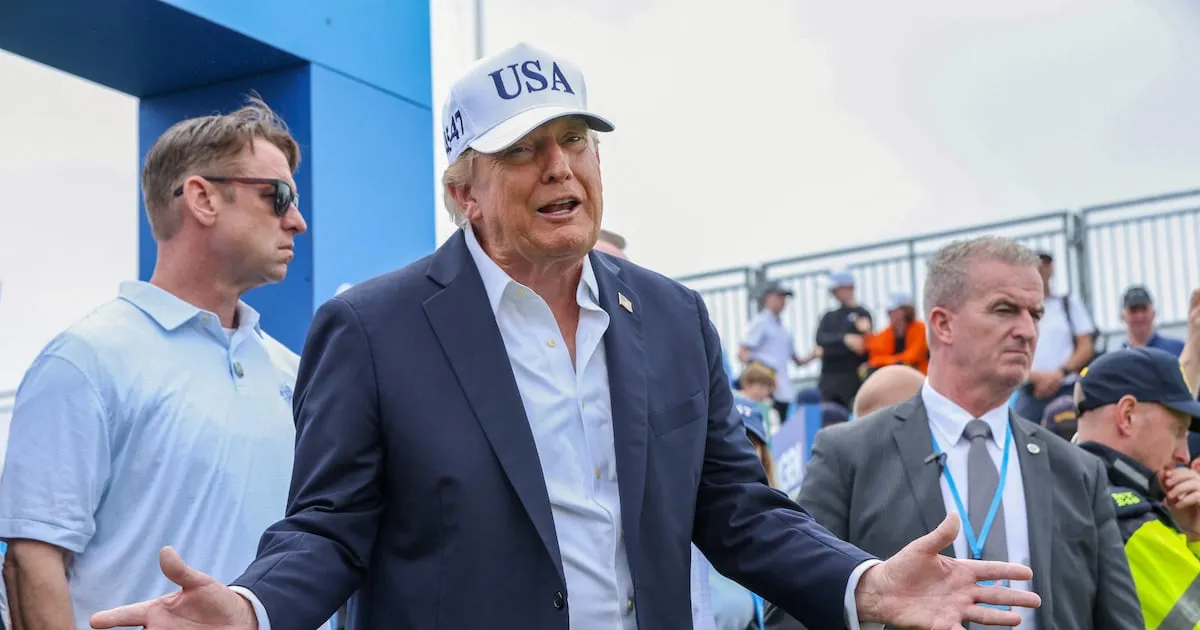
During his visit to Ireland, U.S. President Donald Trump made remarks suggesting support for the unification of Ireland, a statement that has stirred discussion in both Ireland and the United Kingdom. For two consecutive days, President Trump voiced opinions that Northern Ireland should separate from the UK and join the Republic of Ireland. He also touched upon the sensitive issue of Scottish independence, indicating that he would address it at a later time.
Trump’s Stance on Irish Unification
On June 13th, while attending the Irish Open golf tournament at his own golf course in South Dublin, President Trump told reporters that he believes unifying Northern Ireland with the Republic of Ireland would be a natural progression. “You have Northern Ireland, and you have Ireland, and to me, it sounds like it’s pretty simple that they’re going to be joined together,” he stated. This comment followed a similar sentiment expressed the previous day in Dublin, where he had previously indicated his support for Northern Ireland leaving the UK to unite with Ireland.
The U.S. has historically maintained a neutral official stance on the status of Northern Ireland. President Trump’s remarks deviate from this established diplomatic protocol, leading to varied interpretations and reactions across the UK and Ireland. The issue of Northern Ireland’s constitutional status is a complex and politically charged matter for both nations involved.
Remarks on Scottish Independence
President Trump also addressed questions regarding Scotland’s independence. When asked about the matter, he suggested he would postpone a discussion on it. “I was asked about Scotland, and I’m not going to talk about that now. I’ll save that for later,” he remarked. This statement implies that while the issue is on his radar, he does not intend to engage with it further at this moment.
Scotland’s independence is another deeply sensitive topic for the United Kingdom. Although a referendum in 2014 resulted in a majority voting against independence, the debate has resurfaced with renewed vigor following Brexit. This has created ongoing tensions between the Scottish government and the central government in the UK. The United Kingdom is comprised of four constituent countries: England, Scotland, Wales, and Northern Ireland.
Context of Trump’s Visit and Statements
President Trump’s comments on Irish unification were first made on June 12th, the first day of his visit to Ireland, shortly after a meeting with Irish Prime Minister Leo Varadkar. At that time, he suggested that Northern Ireland separating from the UK would be a “wonderful thing.” He reiterated similar views during a speech at the U.S. Ambassador’s residence in Phoenix Park, Dublin.
The political landscape surrounding Northern Ireland is particularly intricate. The region has a history marked by conflict, and its current status as part of the UK is a legacy of historical events. The Good Friday Agreement, a significant peace accord signed in 1998, played a crucial role in de-escalating tensions and establishing a framework for power-sharing in Northern Ireland. A key aspect of the agreement involves respecting the democratic wishes of the people of Northern Ireland regarding their constitutional future.
The economic and social implications of unification are also subjects of ongoing debate within Ireland. Proponents argue that unification could lead to greater economic synergy and a more cohesive national identity. Conversely, concerns exist regarding the potential economic costs, the integration of different legal and administrative systems, and the impact on existing peace processes. The political parties in Northern Ireland hold diverse views on the matter, reflecting the complex societal divisions that persist.
Broader Implications and Reactions
President Trump’s direct statements on Irish unification, departing from the traditional U.S. policy of neutrality, have drawn significant attention. While some may view his remarks as a personal opinion, others see them as potentially influencing future diplomatic discussions. The U.S. has historically played a role as a facilitator in the Northern Ireland peace process, and any perceived shift in its stance could have considerable ramifications.
In Scotland, the independence movement continues to advocate for a second referendum. The Scottish National Party (SNP), currently in power in Scotland, has consistently pushed for another vote, arguing that Scotland’s future should be determined by its own people, especially in light of the UK’s departure from the European Union. Brexit has become a central argument for many advocating for Scottish independence, as Scotland voted overwhelmingly to remain in the EU.
The UK government, under Prime Minister Boris Johnson at the time, has maintained a firm stance against granting permission for another independence referendum, asserting that the 2014 vote settled the matter for a generation. However, political dynamics can shift, and the ongoing debate highlights the persistent constitutional questions facing the United Kingdom.
Conclusion
President Donald Trump’s comments during his visit to Ireland have brought renewed attention to the long-standing issues of Irish unification and Scottish independence. By expressing support for a united Ireland and deferring discussion on Scotland’s future, he has engaged with topics that are central to the political identity and future trajectory of the United Kingdom and the island of Ireland. The reactions to his statements underscore the sensitivity and complexity of these constitutional questions, which continue to shape the political discourse in the region.
