

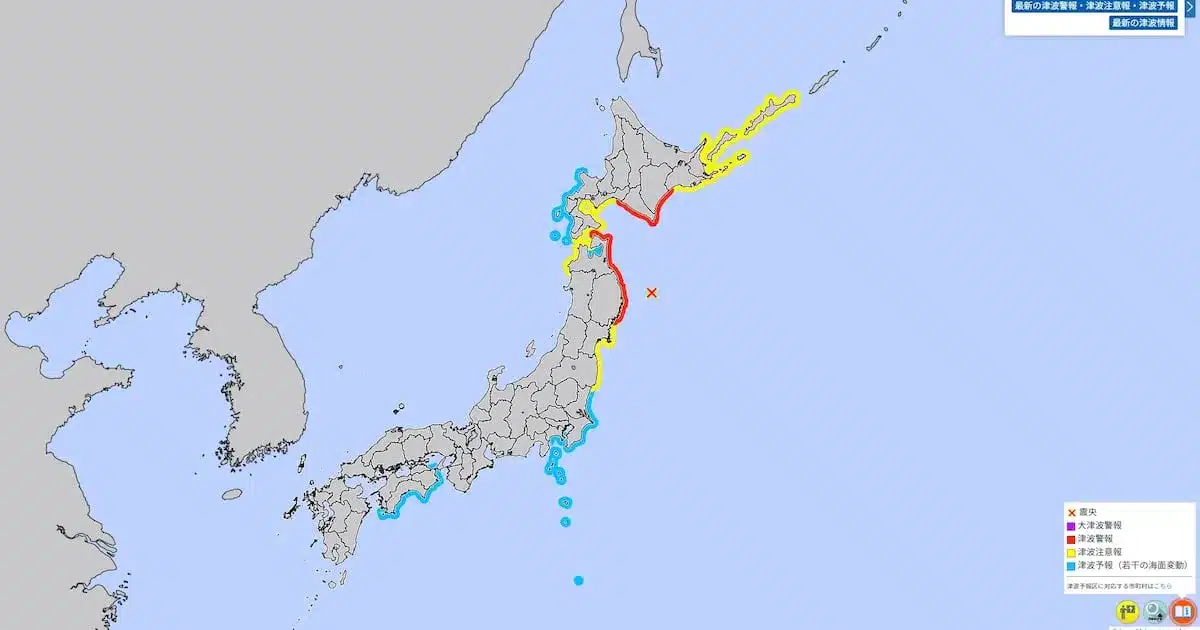
A powerful 7.5 magnitude earthquake struck off the coast of Iwate Prefecture, Japan, on April 20 at 4:53 p.m., generating tsunami waves and triggering widespread warnings for potential major damage.
Earthquake Epicenter and Initial Waves
The quake’s epicenter lies approximately 10 kilometers from Iwate, with preliminary data indicating significant shaking. Tsunami waves, expected to reach up to 3 meters in height, have already impacted coastal areas. Observations confirm waves surging into ports, including 80 cm at Iwate’s Guji Harbor at 5:34 p.m. and 40 cm at Miyako Harbor at 5:22 p.m.
Miyagi Prefecture faces ongoing wave activity, with forecasts predicting up to 1 meter near Miyagi’s coast. Officials monitor conditions closely as waves continue to affect multiple regions.
NHK Issues Urgent Alerts
NHK broadcasters warn, “Waves resemble millimons with increasing momentum. Avoid coastal areas entirely and seek higher ground to prepare for substantial damage.” They add, “Even after initial waves subside, larger surges may follow. The time between peaks allows for heightened vigilance, and further concentrated wave impacts remain possible.”
Broader Regional Warnings
Tsunami advisories extend to Aomori Taepyongyang’s coast and central Hokkaido. Fukushima’s Hasikamijo reports mudslides covering 5 gangs (about 5 hectares). Similar incidents affect Iwate’s Miyakoshi, Moriokashi, Aomori’s Hachinose, and Sichinohamachi, totaling around 5 yaks (50 hectares) of impacted land.
Dokdo’s eastern regions also experience mudslides. These events reflect tsunami depths inland or water-induced debris flows altering terrain significantly. Officials define ‘jindo’ as land depth from tsunami overflow or mudslide scale.
Government Calls for Immediate Action
Coastal authorities urge, “Aomori sees maximum 5-gang impacts from this quake alongside tsunami warnings.” They emphasize, “Act swiftly, head to higher ground, and brace for intense damage like building collapses.”
Current assessments reveal partial damage to lives and property. Response efforts focus on damage evaluation, rescues, structural repairs, urgent aid, and delivering precise updates to citizens. The government deploys liaison officers to the prime minister’s crisis center for coordinated action.
