

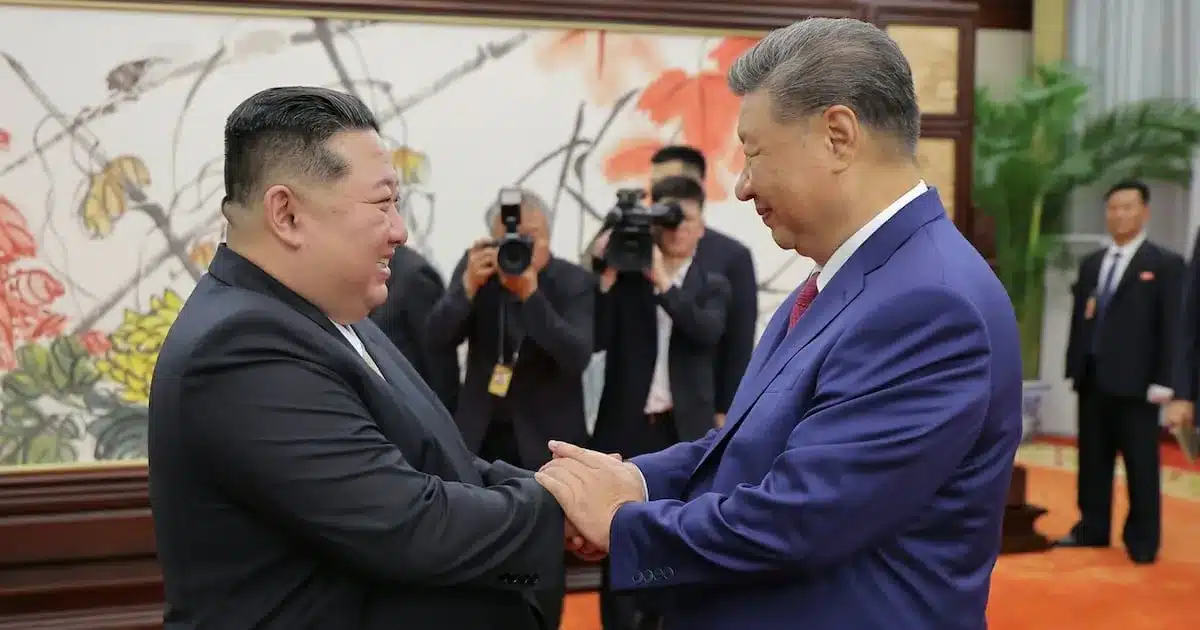
Xi Jinping Set for Pyongyang Visit, Boosting Regional Ties
Chinese President Xi Jinping is scheduled to arrive in Pyongyang on June 8th for a two-day state visit, marking his first overseas trip of the year and his second to North Korea since assuming leadership. This high-profile visit is anticipated to solidify the burgeoning alliance between Beijing and Pyongyang amidst shifting geopolitical dynamics in East Asia.
The announcement was made simultaneously by the International Liaison Department of the Communist Party of China and the Korean Central News Agency on June 5th. This visit signifies a significant diplomatic engagement, occurring seven years after Xi’s previous trip in June 2019 and approximately nine months since Kim Jong Un’s visit to Beijing in September of the previous year for the 70th-anniversary celebrations of the People’s Republic of China.
Analysts interpret Xi’s direct travel to Pyongyang following recent summits with the United States and Russia as a strategic move to bolster anti-US solidarity and assert China’s leadership in East Asian diplomacy. This comes at a time when North Korea’s deepening military ties with Russia have raised concerns about China’s influence in the region. The visit is also seen as an effort to showcase the robustness of the North Korea-China partnership.
From North Korea’s perspective, Xi’s visit is expected to be leveraged to project an image of tacit international approval for its nuclear advancements. The North Korean state media has already highlighted Kim Jong Un’s inspection of a new uranium enrichment facility just prior to the announcement of Xi’s visit, suggesting a potential nod from Beijing towards Pyongyang’s nuclear capabilities.
Diplomatic and Economic Implications
This year marks the 65th anniversary of the signing of the Sino-North Korean Treaty of Friendship, Cooperation, and Mutual Assistance. Chinese Foreign Minister Wang Yi’s visit to Pyongyang in April, where he emphasized the enduring nature of the bilateral relationship, underscores the significance of this upcoming summit.
The meeting is expected to elevate bilateral relations to the highest level. In the context of escalating tensions between the US and China, and deepening US-Japan security cooperation, China’s engagement with North Korea is seen as a strategic maneuver. North Korea serves as a crucial buffer zone and a diplomatic card for China in its dealings with the US and Japan.
Discussions are likely to focus on significantly expanding bilateral trade, which has been gradually recovering post-pandemic. The normalization of tourism from China to North Korea is also a probable agenda item. Furthermore, the potential reopening of the Sinŭiju-Amnok River railway bridge, completed in 2014 but largely unused, is expected to be a key point of discussion.
China’s interest in utilizing the Tumen River for shipping and its potential involvement in North Korea’s special economic zones may also be on the table. A joint statement following the recent Russia-China summit mentioned continued trilateral cooperation with North Korea regarding the use of the Tumen River for maritime access, reflecting ongoing discussions on economic collaboration.
Potential for Dialogue and Regional Stability
Xi’s visit occurs amidst renewed discussions about the possibility of North Korea-US dialogue and the strengthening of North Korea-Russia military and security cooperation. Beijing sources suggest that China remembers the past experience of President Trump bypassing six-party talks to engage directly with Kim Jong Un. China aims to reassert its influence over North Korea’s actions, particularly in preventing destabilizing behavior, and to remind the US that China is a key party in denuclearization talks.
While Xi may play a mediating role in facilitating North Korea-US dialogue, North Korea has reportedly shown reluctance towards resuming talks with the US. The strengthening of the anti-US bloc, centered around China, is becoming more pronounced as the US faces challenges in the Middle East and the Ukraine conflict. Xi’s recent meetings with former US President Donald Trump and Russian President Vladimir Putin, followed by this visit to North Korea, are interpreted as efforts to consolidate the North Korea-China-Russia alliance on the international stage.
Some analyses suggest that while China was initially unconcerned about North Korea strengthening ties with Russia amidst the Ukraine war, a shift occurred following Kim Jong Un’s visit to Beijing last September, indicating an improvement in North Korea-China relations. The visit is seen as an opportunity for North Korea to expand its diplomatic space, securing economic support from China in addition to the security backing from Russia.
Furthermore, North Korea may seek tacit acknowledgment of its nuclear status from China through this visit. The unveiling of a new uranium enrichment facility by Kim Jong Un just before the announcement of Xi’s visit suggests that such developments would be unlikely without Chinese acquiescence.
The potential for China’s endorsement of the “fourth-generation succession” in North Korea is also being raised, especially if Kim Ju-ae accompanies Kim Jong Un, as she did during his visit to China last September.
However, some observers caution against overstating the immediate impact of this visit on North Korea-China relations. Given North Korea’s strengthened military and security ties with Russia, its dependence on China may be less pronounced than in the past. A Beijing-based diplomatic source noted that past high-level meetings between North Korea and China have not always led to improved relations, emphasizing the need for tangible mutual benefits to foster stronger ties.
