

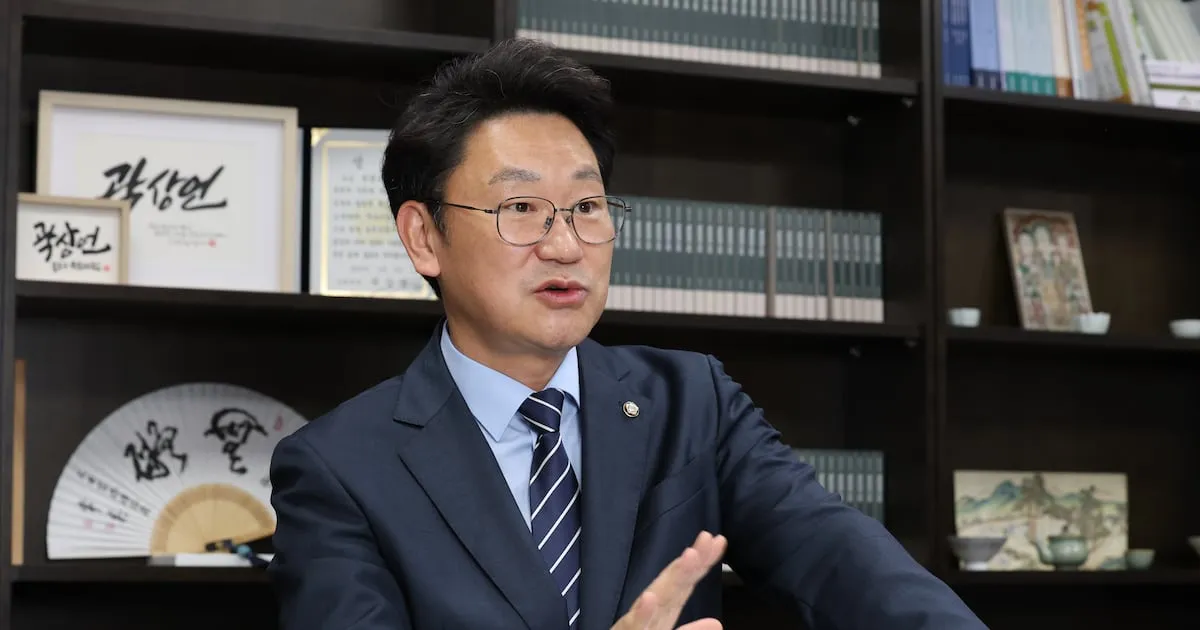
A significant debate has emerged following the National Assembly’s passage of amendments to the Criminal Procedure Act, which aim to abolish the prosecution’s investigative authority. Kwak Sang-eon, the sole member of the Democratic Party to oppose the bill, has strongly refuted claims that the late President Roh Moo-hyun advocated for the complete removal of the prosecution’s investigative powers. Kwak argues that linking the legislative action to Roh’s legacy misrepresents the former president’s actual stance and intentions.
Kwak Sang-eon’s Stance on the Amendments
Kwak Sang-eon, granddaughter of former President Roh Moo-hyun, voiced her dissent by casting a dissenting vote during the plenary session on the 31st of last month. In a Facebook post titled “Abolishing Investigative Powers, President Roh Moo-hyun’s Choice,” she explained her decision. Kwak stated that she could not support the bill because she foresaw the public’s suffering and heard their laments, making it impossible for her to vote otherwise.
She emphasized the historical significance of the vote, marking the first time since the Criminal Procedure Act’s enactment in 1954 that the prosecution’s investigative authority would be abolished in South Korea. Kwak criticized ruling party figures who, following the bill’s passage, have invoked the late president’s political philosophy and even his death to legitimize the reform.
Contrasting Interpretations of Roh Moo-hyun’s Legacy
Prominent figures within the Democratic Party have publicly linked the legislative changes to Roh Moo-hyun’s vision. For instance, Jung Cheong-rae, a candidate for the party leadership, declared the day of the vote as a “historic day” that begins the principle of separating investigation and indictment, a long-held public aspiration, and a day that brings Roh Moo-hyun to mind. Jung further asserted that curbing the prosecution’s unchecked power and separating investigative and indictment functions was Roh Moo-hyun’s unfulfilled dream and a mission of the era. He added that dismantling the concentrated power of the prosecution would be the completion of the “Roh Moo-hyun spirit.”
Former President Moon Jae-in also commented, characterizing prosecutorial reform as a long-standing project that began with the Roh Moo-hyun administration and progressed incrementally. He expressed his profound relief and gratitude that the reforms, which his predecessors could not fully achieve, were finally being completed.
Kwak’s Detailed Rebuttal of the Official Narrative
Kwak Sang-eon directly challenged these interpretations, asserting that the claims made by ruling party officials do not align with President Roh Moo-hyun’s actual wishes or political principles. She reiterated that Roh Moo-hyun never pursued the complete abolition of the prosecution’s investigative powers during his presidency.
According to Kwak, Roh Moo-hyun’s approach to adjusting investigative powers involved specific limitations. For certain civil and crime victim protection matters, he proposed a system where the prosecution would retain control, but with oversight and supplementary investigation powers held by the police. This was in contrast to the current bill, which completely removes the prosecution’s investigative authority.
Kwak cited a speech by Roh Moo-hyun on the 62nd Police Day in October 2007, where he reportedly rejected the police’s demand for exclusive investigative authority. At that time, Roh Moo-hyun did not support granting the police sole power to conclude investigations independently. Instead, he believed in a system where prosecutorial powers would be checked and balanced, but crucially, he also recognized the need to prevent the police from monopolizing investigative authority.
“State power must be divided among institutions and mutually checked,” Kwak emphasized. “Monopolistic state power inevitably harbors the potential for abuse.”
Accusations of Political Exploitation
Kwak Sang-eon accused ruling party figures of distorting Roh Moo-hyun’s words and presenting them as his own, and misrepresenting his political stance as a factual political pursuit. She alleged that these actions were aimed at serving their own political interests and deceiving the public.
“Do not distort President Roh Moo-hyun’s intentions or his politics for your own political gain,” Kwak urged. “Do not consume his death as a symbolic means to legitimize your political claims.” She further criticized the narrative that Roh Moo-hyun died tragically during a prosecution investigation, arguing that this trivializes his passing and is used for political mobilization.
Kwak contended that using Roh Moo-hyun’s final choices as political tools for personal gain and turning his name into a mere taunt was unacceptable. She firmly stated that “revenge for Roh Moo-hyun cannot be Roh Moo-hyun’s politics,” and that distorting his words or seeking personal political benefit under his name was antithetical to his political philosophy. “Roh Moo-hyun would never have undermined state power for personal gain,” she asserted.
Internal Party Dissent and Concerns
Within the Democratic Party itself, concerns have been raised about potential loopholes in victim protection following the complete abolition of the prosecution’s supplementary investigation powers. Jung Min-cheol, head of the Democratic Party’s policy committee, acknowledged on his social media that many younger supporters, particularly those in their 20s and 30s, are expressing apprehension about the current government and the party’s actions.
Jung specifically pointed to cases of sexual violence, stalking, and digital sex crimes, suggesting that the prosecution’s supplementary investigative powers should be retained in such instances. He stated, “Prosecutorial reform is a means, not an end.” If consensus cannot be reached, he requested that President Lee Jae-myung review the bill through a veto.
Despite the bill’s passage, internal dissent within the Democratic Party persists regarding the complete removal of supplementary investigative powers and the associated issues of victim protection. This ongoing debate highlights the complexities and differing perspectives surrounding the significant reform of prosecutorial authority.
