

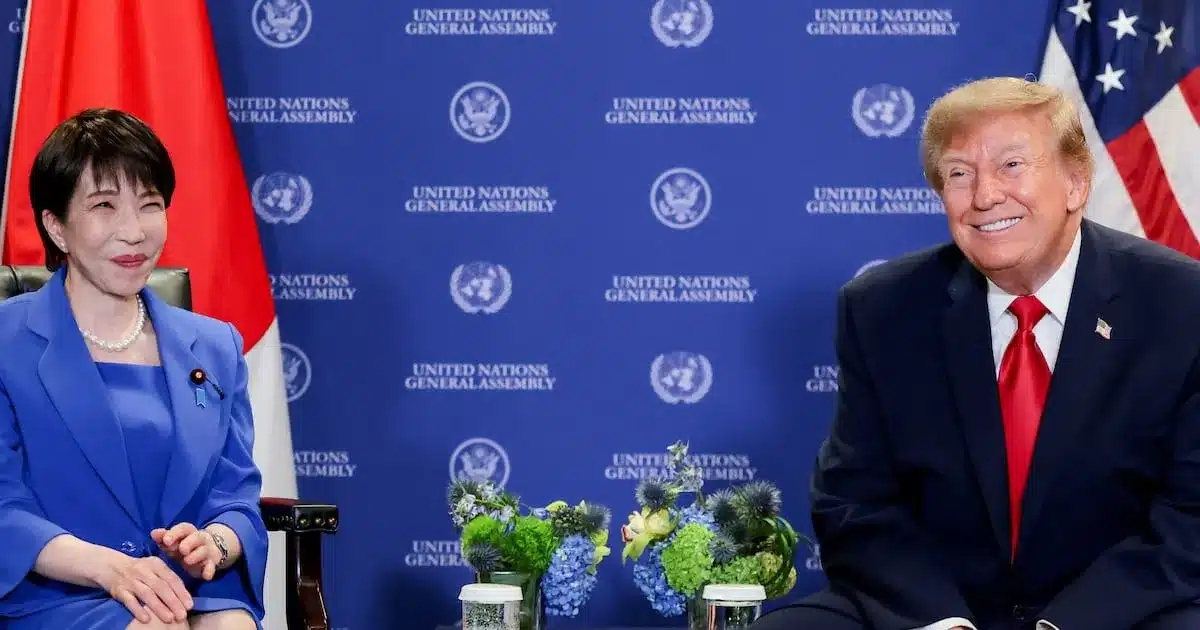
During a meeting at the United Nations Headquarters in New York, U.S. President Donald Trump and Japanese Minister of State Sanae Takaichi, who was visiting the United States, held a summit. This marked their third face-to-face meeting, following encounters in October 2025 and March 2026.
Takaichi, who had previously garnered attention from American media for her candid remarks and distinctive actions, continued to be a focal point during this meeting. Amidst President Trump’s ongoing public disagreements with the press following his directive to ban CNN from the White House, Takaichi, through an interpreter, initiated a notable exchange. She reportedly asked, “Will the press please leave us? We have much to discuss.”
This remark elicited laughter from those present, including U.S. Treasury Secretary Steven Mnuchin, Commerce Secretary Wilbur Ross, Senator Marco Rubio, White House Press Secretary Susie Wiles, and the U.S. Trade Representative James Green. President Trump, gesturing towards Takaichi, then addressed the press, humorously remarking, “Did you hear that?”
Minister Takaichi’s Bold Cabinet Reshuffle
Takaichi, who had recently appointed ten new ministers after taking office on the 17th, described her decision to replace ten out of eighteen cabinet members as a “bold decision.” However, she humorously noted that the ministers responsible for foreign affairs, finance, economic revitalization, and defense were intentionally retained. She explained this by stating they were “counterparts to my great self.”
Japan had previously committed to investing $550 million (approximately 750 billion won) in the U.S. during tariff negotiations last year, and some projects have already been announced. Ryosei Akazawa, the Minister of State for Economic Revitalization, is reported to have played a crucial role in this process.
Strategic Alignment Ahead of U.S.-China Summit
The meeting also served as a platform for the U.S. and Japan to coordinate their positions on security in the Indo-Pacific region, particularly in anticipation of the upcoming summit between President Trump and Chinese President Xi Jinping on the 24th.
In the context of China’s growing influence, Japan has been strengthening its security alliances with partner nations in the Indo-Pacific, such as the Philippines and Australia. Takaichi expressed her gratitude for President Trump’s strong commitment to the U.S.-Japan alliance, stating, “I am grateful for President Trump’s very strong commitment to the U.S.-Japan alliance.” She added, “I want to show the whole world how strong our alliance is.”
Background of U.S.-Japan Economic Relations
The economic relationship between the United States and Japan has been a significant aspect of their bilateral ties. Following trade discussions and negotiations, Japan pledged substantial investment in the U.S. This commitment was seen as a move to strengthen economic cooperation and address trade imbalances. The specific figure of $550 million was a key outcome of these discussions, signaling Japan’s intent to foster economic growth within the U.S. through direct investment.
The role of key figures like Ryosei Akazawa in facilitating these economic agreements highlights the importance of dedicated individuals in driving bilateral economic policy. His involvement in the negotiations underscores the detailed work required to build trust and reach mutually beneficial outcomes between the two nations.
Geopolitical Considerations in the Indo-Pacific
The Indo-Pacific region remains a critical area of focus for both the U.S. and Japan, given its strategic importance and the evolving geopolitical landscape. China’s increasing assertiveness in the region has prompted a concerted effort by like-minded countries to bolster security cooperation.
Japan’s proactive approach in forging stronger security partnerships with countries like the Philippines and Australia is a testament to its commitment to maintaining regional stability. These alliances are designed to create a network of cooperation that can effectively address shared security challenges and promote a free and open Indo-Pacific.
Minister Takaichi’s remarks about the strength of the U.S.-Japan alliance reflect a broader sentiment of solidarity and shared purpose. The alliance is not merely a military pact but a comprehensive partnership that encompasses economic, political, and security dimensions. The desire to demonstrate this strength to the global community suggests a strategic intent to project a united front against potential threats and to reassure allies in the region.
The meeting between President Trump and Minister Takaichi, therefore, was more than just a diplomatic encounter; it was a strategic dialogue aimed at reinforcing bilateral ties and coordinating efforts on critical international issues. The exchange, characterized by both seriousness and a touch of humor, underscored the dynamic nature of the relationship between the two nations and their shared commitment to regional and global security.
