

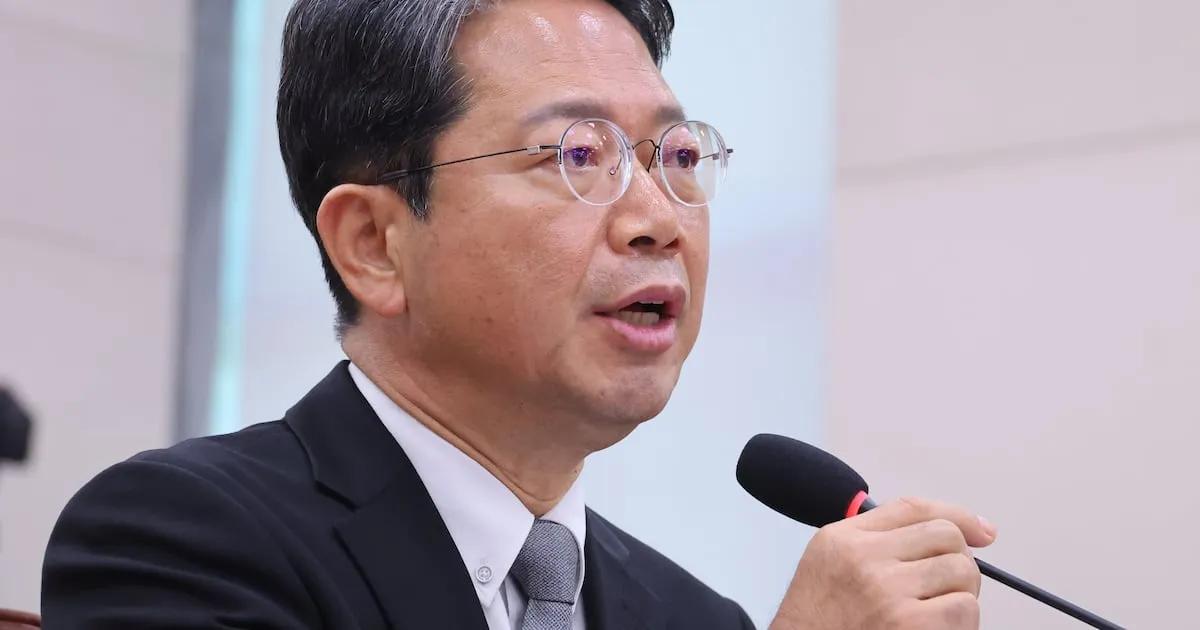
Justice Minister Kim Seung-won has stated his opposition to granting special prosecutors the authority to drop charges, particularly in cases related to presidential affairs. This stance was articulated during a recent press briefing, where Minister Kim addressed concerns about potential legislative changes that could empower investigative bodies in such sensitive matters.
Minister Kim’s Stance on Special Prosecutor Authority
During a session with the National Assembly’s Legislation and Judiciary Committee, Minister Kim Seung-won responded to a question posed by Park Hyung-soo, a Member of Parliament from the People Power Party. Park inquired whether Minister Kim would advise the President to exercise his right of veto if the opposition-led National Assembly were to pass a special prosecutor bill that included provisions for dropping charges. Minister Kim unequivocally stated, “If the Special Prosecutor Act is passed in that manner, my opinion is to oppose it.”
The controversy stems from a bill proposed by the Democratic Party. This party initiated the “Special Prosecutor Act for Fabricated Investigations” in April, following the Yoon Suk-yeol administration’s alleged involvement in investigative manipulation and false accusations. The proposed legislation includes a clause that would allow a special prosecutor to decide whether to maintain or drop charges in cases assigned to them.
Political circles have widely interpreted this move as an attempt to facilitate the dropping of charges in cases connected to President Lee Jae-myung. Minister Kim elaborated on his position, emphasizing his consistent opposition to incorporating such provisions into the Special Prosecutor Act from the outset. “I have opposed including a clause for dropping charges in the Special Prosecutor Act from the beginning,” he affirmed, adding, “There is no need to do this artificially.”
Background of the Proposed Legislation
The Democratic Party’s proposal for a “Special Prosecutor Act for Fabricated Investigations” aims to investigate allegations of investigative manipulation and false accusations during the previous administration. The core of the debate lies in the provision that grants the special prosecutor discretion over the continuation of charges. This specific clause has drawn significant attention and criticism from various political factions.
The party argues that such a mechanism is necessary to ensure thorough and impartial investigations into alleged misconduct. However, critics contend that empowering a special prosecutor to drop charges could lead to selective prosecution or the shielding of certain individuals from accountability, particularly given the political context surrounding President Lee Jae-myung’s related cases.
Minister Kim’s Previous Role and Current Position
It is noteworthy that Minister Kim Seung-won previously served as a co-representative for the Democratic Party’s internal committee focused on “The dropping of charges in President Lee Jae-myung’s cases and the advancement of state investigations.” This committee, known as the “Gongchwi-mo” (literally, “Dropping Charges Committee”), was established to pursue investigations and potentially drop charges in specific cases.
When questioned by Yoon Sang-hyun, a Member of Parliament from the People Power Party, about his current stance in light of his past role, Minister Kim clarified his current responsibilities and perspective as Justice Minister. “Dropping charges is not a power vested in the Minister of Justice,” he explained. “Nor do I intend to exercise general command authority through the Prosecutor General.” This statement underscores his commitment to adhering to established legal procedures and the separation of powers within the justice system.
Implications and Political Reactions
The Minister’s firm opposition signals a potential legislative battleground. The Democratic Party’s push for the special prosecutor bill, coupled with Minister Kim’s resistance, highlights the deep political divisions surrounding ongoing investigations and the perceived fairness of the justice system.
The debate over the special prosecutor’s authority to drop charges touches upon fundamental questions of prosecutorial discretion, the role of special investigations, and the potential for political influence in legal proceedings. Minister Kim’s position emphasizes a preference for maintaining the existing legal framework, where the authority to drop charges typically rests with the prosecution under established legal standards, rather than being vested in a special prosecutor through specific legislative amendments.
His remarks suggest that any attempt to pass legislation granting such broad powers to special prosecutors would likely face significant resistance from the Ministry of Justice and potentially lead to the President exercising his veto power, as indicated by Minister Kim’s willingness to recommend such an action.
Conclusion
Justice Minister Kim Seung-won’s clear declaration against granting special prosecutors the power to drop charges signifies a critical juncture in the legislative process. His stance, rooted in principles of established legal authority and a concern against artificial intervention, sets the stage for further political debate and potential conflict over the scope and powers of special investigative bodies in South Korea. The opposition party’s proposed bill, aimed at addressing alleged investigative manipulations, now faces a significant hurdle in the form of the Justice Minister’s firm opposition and the possibility of a presidential veto.
