

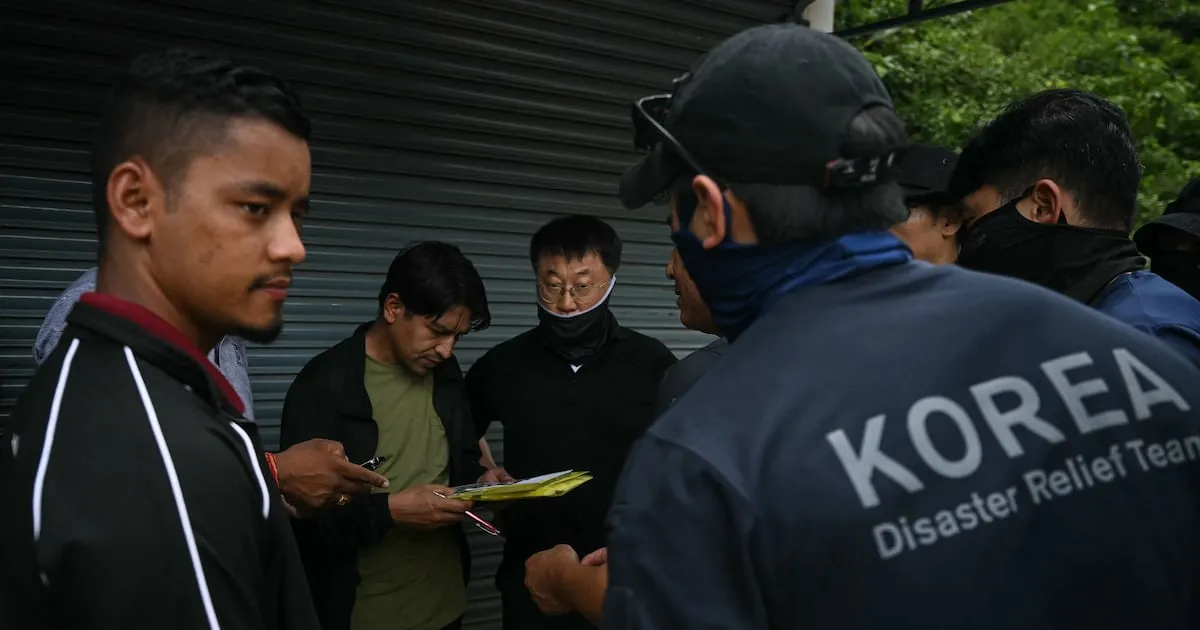
A joint South Korean and Nepalese rescue operation has successfully penetrated 400 meters into a tunnel at a hydropower construction site in Nepal where nine South Korean workers went missing during recent floods. Despite this significant advance, as of the morning of the 8th, the workers have not yet been located. Rescue teams are now shifting their focus to a ground search in the mountainous terrain believed to be where the South Koreans disappeared.
Rescue Efforts Intensify in Nepal Tunnel Disaster
The collaborative rescue effort involves the South Korean Disaster Relief Team (KDRT) and the Nepalese Army. According to situation reports from Nepal’s National Disaster Risk Reduction and Management Authority (NDRRMA), the joint teams gained access to the 400-meter mark within the tunnel at the Upper Trishuli-1 (UT-1) hydropower project site, located in Rasuwa district, central Nepal. This area has been the focus of intense search operations following the devastating floods.
Previously, on the 5th, the same rescue teams had successfully extracted a Chinese survivor, Lu Haitao, aged 49, from the 225-meter point of the same tunnel. Upon his rescue, Lu Haitao indicated that another individual had been present nearby, though his condition or whereabouts remained unknown. Following this lead, the KDRT, in coordination with the Nepalese Army, expanded the search operations centered around the location where Lu was found. However, these efforts have thus far failed to locate any of the missing South Korean workers.
Ground Search Authorized in Suspected Disappearance Zone
In a significant development, Nepalese authorities have now granted permission for a ground search in the vicinity of the UT-1 project, a change from their previous stance. The KDRT has confirmed that six of its members, accompanied by Nepalese Army personnel, will conduct the search in two key mountainous areas adjacent to the construction site: one to the west of the powerhouse and Yellow Bridge, and another to the east of the main camp. These teams are scheduled to be airlifted to the site and will then proceed with a meticulous ground inspection.
Given the challenging and rugged terrain, drones are also slated to be deployed to aid in the search and rescue mission. This authorization comes after an earlier proposal by the KDRT on the 4th for a ground search was denied by the Nepalese Army, citing safety concerns.
Assessing the Scale of the Hydropower Incident
Earlier reports from the Nepalese Army on the 7th suggested that approximately 121 individuals might be trapped in various tunnels at the hydropower facility. This figure contrasts with an initial estimate released by the NDRRMA shortly after the disaster, which indicated that as many as 900 people could have been inside the tunnels. Army officials clarified that the higher number represented the total workforce at the hydropower project, not necessarily those trapped within the tunnels at the time of the incident.
A military official expressed a commitment to continuing the search operations indefinitely, stating, “Unless the government decides to halt the operation, the search will continue. Our hope is that there are still survivors.”
Broader Impact of Nepal’s Floods
The floods in Nepal have resulted in a significant loss of life and widespread displacement. As of the latest figures, the Nepalese authorities have reported 1,356 deaths and 4,894 individuals injured across the country. When combined with figures from China, which reported 43 deaths and 519 missing from its side, the total death toll rises to 1,399, with 5,413 people injured.
The ongoing rescue operation at the hydropower site underscores the perilous conditions faced by rescue teams and the desperate hope for survivors amidst the devastation caused by the recent extreme weather events in Nepal.
