

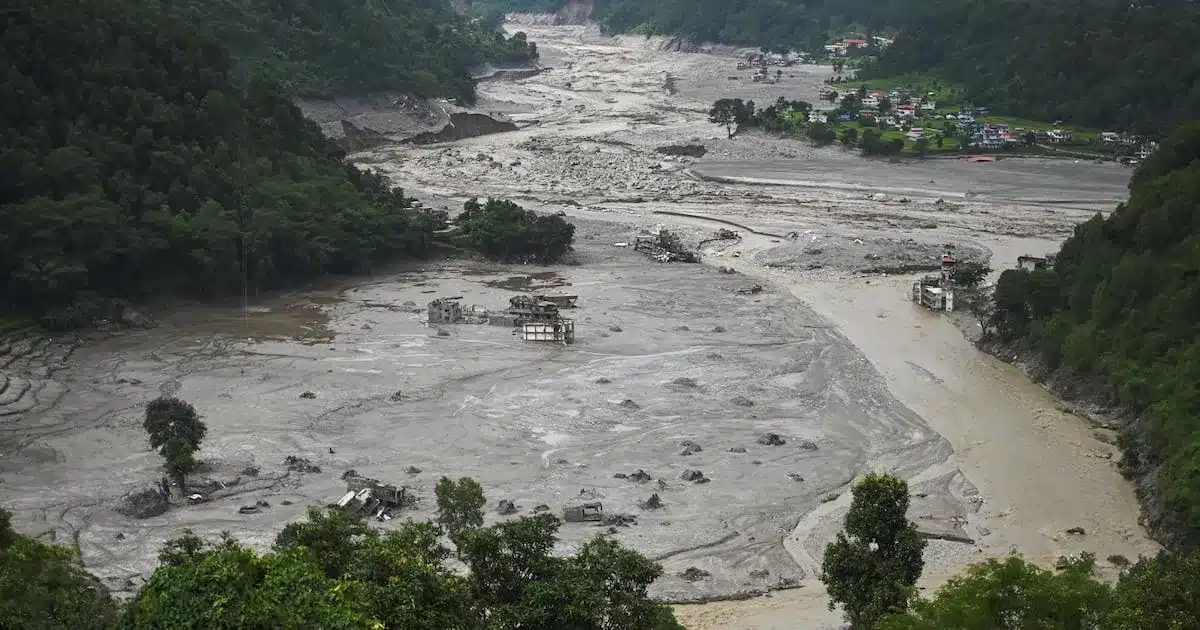
Nepal has officially declared the recent devastating floods a climate change-induced disaster and is demanding compensation from major global greenhouse gas emitting nations. Prime Minister Pushpa Kamal Dahal, widely known as Prachanda, stated on social media that it is time for the international community to address the climate-related calamities Nepal is experiencing.
Nepal’s Plea for Climate Justice
The Nepalese government has formally submitted a petition to the international community seeking reparations for climate change-related damages. Speaking to local media, Nepal’s Foreign Minister Narayan Prakash Saud emphasized the nation’s minimal contribution to global emissions while bearing the brunt of a crisis it did not create. “Nepal’s greenhouse gas emissions are negligible, yet we are bearing the ultimate cost of a global crisis we did not instigate,” Saud stated.
The recent deluge, described by officials as a ‘Himalayan tsunami,’ was directly attributed to the rapid melting of glaciers and subsequent glacial lake outburst floods (GLOFs). Minister Saud explained that the accelerated melting of Himalayan glaciers, a direct consequence of global warming, is causing these catastrophic events. He asserted that major greenhouse gas emitters, specifically naming China, the United States, and India as the top three global polluters, have a historical responsibility to compensate vulnerable nations like Nepal.
Historical Responsibility and Moral Obligation
Minister Saud framed the demand not as a matter of charity but as a legal and moral obligation. “This is not a question of self-interest, but of legal and ethical responsibility,” he declared, vowing to pursue the issue with “absolute firmness and clarity.” He warned that the disappearance of Himalayan glaciers poses a severe and potentially permanent threat to the water security of over two billion people in South Asia who rely on rivers like the Ganges and the Trishuli. “We are raising this issue not just for Nepal, but for the survival of civilization across South Asia,” he added.
The Melting Himalayas: A Looming Crisis
The scientific community has been sounding alarms about the rapid retreat of Himalayan glaciers for years. Glaciologist Dr. Arvindra Karki from Tribhuvan University in Kathmandu, speaking to The New York Times, noted that glaciers are melting at an alarming rate, with some losing approximately one meter in thickness annually. “It’s not just Mount Everest; the entire Himalayan range is melting,” Karki warned, highlighting the vast scale of the problem.
These melting glaciers are a critical source of freshwater for major river systems across the continent. The implications of their rapid disappearance extend far beyond Nepal, impacting agriculture, water availability, and the livelihoods of millions. The floods are just one manifestation of this larger climate crisis, which also includes increased risks of landslides, droughts, and unpredictable weather patterns.
Nepal’s Vulnerability and the Call for Action
Nepal, situated in the Himalayas, is exceptionally vulnerable to the impacts of climate change. Despite contributing minimally to global greenhouse gas emissions, the nation faces disproportionate consequences, including extreme weather events, glacial melt, and threats to its biodiversity and natural resources. The government’s call for compensation is rooted in the principle of climate justice, arguing that those who have benefited most from industrialization, often at the expense of the environment, should assist those suffering the most severe impacts.
The international community is increasingly being urged to recognize the differentiated responsibilities and capabilities of nations in addressing climate change. While developed nations have historically been the largest emitters, rapidly developing economies also play a significant role. Nepal’s proactive stance underscores the urgent need for global cooperation and financial mechanisms to support climate adaptation and mitigation efforts in vulnerable countries. The demand for compensation from major emitters like China, the US, and India reflects a growing assertiveness from developing nations seeking to hold major polluters accountable for the climate crisis and its devastating consequences.
Looking Ahead: Global Implications
The Nepalese government’s initiative is likely to spark further debate on international climate finance and loss and damage mechanisms. As climate change impacts intensify globally, more vulnerable nations may follow Nepal’s lead in demanding accountability from major emitters. The future of the Himalayan glaciers, vital water towers for Asia, remains a critical concern, and addressing the root causes of climate change through significant emissions reductions by all major economies is paramount to averting further catastrophe.
