

The narrative recounts a pivotal moment where Liu Bei, a descendant of the Han imperial family, is urged to take on the governorship of Xu Province. This event is framed within the context of a larger conflict, highlighting Liu Bei’s character and strategic acumen.
The Plea for Aid and Liu Bei’s Initial Hesitation
The story begins with Gongsun Zan, a warlord, questioning Liu Bei’s willingness to intervene in the affairs of Xu Province. Gongsun Zan points out that Liu Bei has no personal enmity with the current powers in Xu and questions the necessity of undertaking such a difficult task. Liu Bei, however, explains that he has already made a commitment and cannot abandon his word. This demonstrates Liu Bei’s strong sense of loyalty and adherence to his promises, even when faced with considerable personal risk.
Gongsun Zan, impressed by Liu Bei’s resolve, offers to lend him 2,000 cavalry troops. Liu Bei, in turn, requests that Zhao Yun, a trusted warrior, accompany him. Gongsun Zan grants this request. Subsequently, Liu Bei sets out for Xu Province with Guan Yu, Zhang Fei, and 3,000 elite troops, with Zhao Yun and his 2,000 men following behind.
Arrival in Xu Province and Strategic Preparations
Upon arriving in Xu Province, Liu Bei and his contingent meet with Tao Qian, the acting governor. The narrative suggests that Liu Bei’s arrival was prompted by a request from the northern forces, indicating a broader political landscape at play. News also circulates that Jin Yuanlong, who had previously gone to Qing Province, has returned and is preparing to send reinforcements, adding a layer of complexity to the situation.
Tao Qian, relieved by the prospect of reinforcements, displays a more relaxed demeanor. The forces of Gongsun Zan and Liu Bei approach Xu Province from different routes. However, the formidable reputation of Cao Cao’s army, which is also present, causes them to halt at a distance, establishing camps on the outskirts of the city. The troops are hesitant to advance directly due to the perceived strength and reputation of Cao Cao’s forces.
Observing the approach of Cao Cao’s army, Liu Bei divides his own troops. Despite this tactical division, he refrains from initiating an immediate attack, opting instead to carefully assess the situation. The narrative implies a strategic pause, allowing for further intelligence gathering and planning.
Meeting with Gongsun Zan and the Plan to Engage
Later, Liu Bei’s reinforcements arrive in Xu Province and meet with Gongsun Zan, who is encamped outside the city. Gongsun Zan acknowledges the daunting presence of Cao Cao’s army and the strategic challenge it poses. He advises caution, suggesting that any offensive action should be carefully considered after thoroughly assessing the enemy’s movements and intentions.
Liu Bei expresses concern about the dwindling food supplies, noting that a prolonged siege would exacerbate the shortage. To address this, he proposes a plan: He will order Yun Chang and Zhao Yun to lead 4,000 troops to assist in the siege, while he and Zhang Fei will infiltrate Cao Cao’s camp to meet with Tao Qian. Their objective is to discuss the critical issue of food supply and to strategize on future actions.
Gongsun Zan is pleased with this proposal. He joins forces with the troops led by Zhan He, devising a joint strategy for the siege. Yun Chang and Zhao Yun are tasked with appearing only when the situation becomes critical, ready to provide support. On this day, Liu Bei and Zhang Fei lead 1,000 soldiers towards Cao Cao’s camp.
The Confrontation and Liu Bei’s Entry into the City
As they approach, a loud commotion erupts from within the enemy camp. Cavalry and infantry pour out like a tidal wave. The vanguard of this sortie is led by Wu Dun. He halts his advance and shouts, demanding to know who dares to approach their position. Zhang Fei, recognizing Wu Dun, immediately charges forward without hesitation. The two leaders engage in a fierce duel, their horses clashing as they exchange blows.
Meanwhile, Liu Bei rallies his soldiers, brandishing his double swords and urging them to advance. Faced with this determined assault, Wu Dun and his forces retreat in fear. Zhang Fei pursues them relentlessly, driving them back towards the gates of Xu Province city.
From atop the city walls, Tao Qian observes the unfolding events. He spots a red banner bearing the inscription ‘Pingyuan Liu Xuande’ (平原劉玄德) in large white letters. Recognizing Liu Bei’s banner, Tao Qian breathes a sigh of relief and immediately orders the city gates to be opened.
Liu Bei enters the city and is warmly welcomed by Tao Qian. They proceed together to the main hall, where they perform the customary rites of greeting. A banquet is held, and Tao Qian entertains Liu Bei generously. The soldiers are also provided with ample food and drink, ensuring their comfort and morale.
Tao Qian’s Offer and Liu Bei’s Humble Refusal
Tao Qian, having heard much about Liu Bei but now meeting him in person, is deeply impressed by his noble character and eloquent speech. He perceives Liu Bei as a capable and virtuous individual, perfectly suited to govern. Recognizing the instability and the imminent danger to the imperial throne, Tao Qian decides to offer Liu Bei the position of governor.
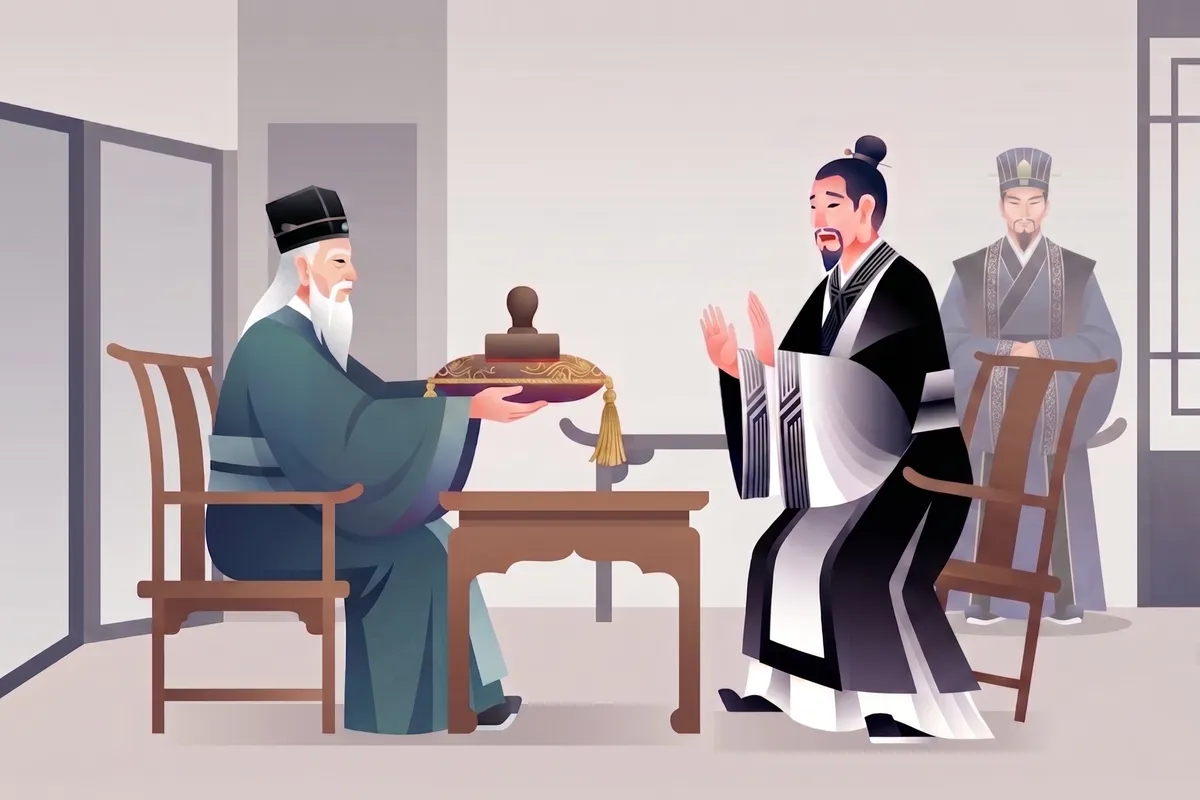
He summons Mi Zhu and instructs him to bring the official seal. Upon receiving the impressive seal, Liu Bei is taken aback. He questions Tao Qian’s intentions, asking why he would bestow such an honor upon him.
Tao Qian explains that the recent turmoil has shaken the foundations of the state, and the emperor’s authority is in peril. He believes that Liu Bei, as a loyal subject and a capable leader, is the most suitable candidate to preserve the empire. Tao Qian humbly states, “This old man is old and incompetent. I sincerely wish for you to take my place and govern the land of Xu. Please do not refuse! I will immediately write a memorial to the court to resign my position.”
Liu Bei is astonished by this offer. He rises from his seat and bows twice, expressing his deep respect. He humbly replies, “I, Liu Bei, although a descendant of the imperial family, have made few contributions to the nation and lack virtue. The position of governor of Pingyuan is already more than I deserve. The reason I have come here today is solely to assist you in defending the realm, not for any personal gain. If I were to accept your offer of the land of Xu, I fear I would be seen as coveting your territory. If I harbored such selfish ambitions, Heaven would surely not forgive me!”
A Diplomatic Stalemate and a New Strategy
Tao Qian insists that his offer is genuine. Despite repeated refusals from Liu Bei, he remains steadfast in his desire to pass the governorship to him. At this point, Mi Zhu intervenes, suggesting that the immediate priority is to address the pressing threat of the enemy army at their doorstep. He proposes that strategizing on how to repel the invaders should take precedence over the discussion of the governorship.
Liu Bei agrees with Mi Zhu’s assessment. He suggests that he will first send a letter to Cao Cao, urging him to cease hostilities and seek peace. If Cao Cao refuses, then they can consider launching an offensive. Following this, Liu Bei dispatches orders to his own camps, instructing his soldiers to remain in their positions and rest. He then sends a messenger to Cao Cao’s camp with a letter proposing a peaceful resolution.
The narrative concludes with this diplomatic overture, setting the stage for further developments in the conflict over Xu Province. The focus remains on Liu Bei’s principled stance and his commitment to acting with integrity, even in the face of significant political opportunity.
(To be continued)
