

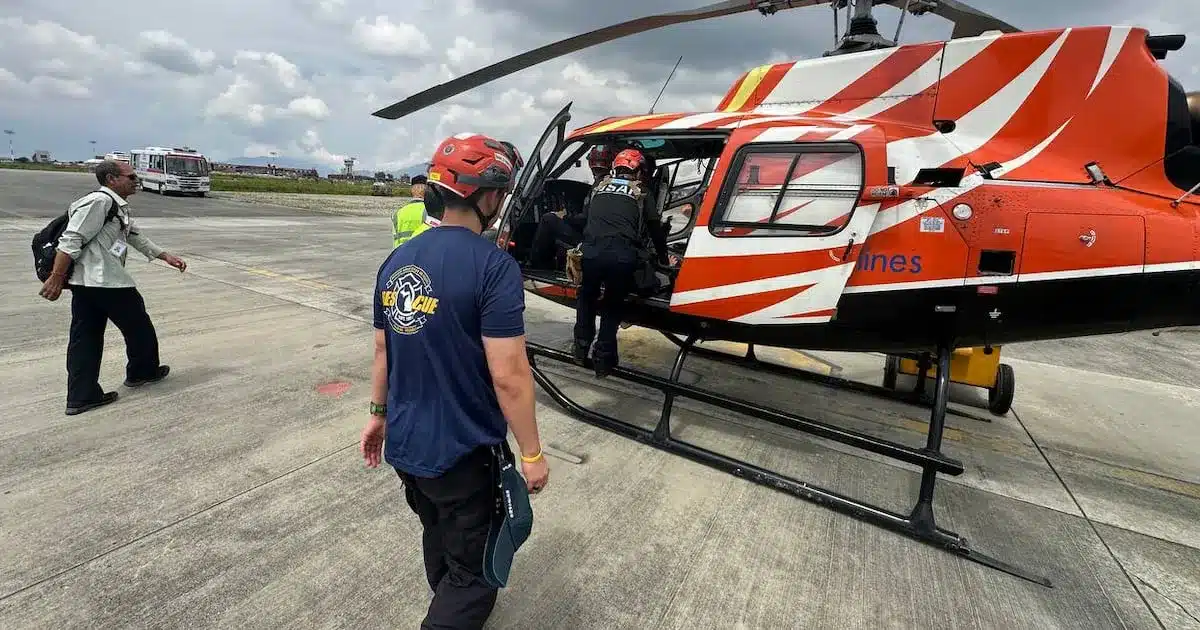
South Korean authorities are intensifying search efforts for nine of their citizens missing in the devastating floods and landslides that have struck Nepal. On July 30th, a joint operation involving two helicopters was launched to scour the affected regions, aiming to locate the missing individuals amidst the widespread destruction.
Intensified Search Operations Underway
A rapid response team dispatched by the South Korean government, equipped with one helicopter, is collaborating with a second helicopter provided by Doosan Heavy Industries & Construction. This joint aerial operation is crucial for covering vast and often inaccessible areas. However, the flight plans are subject to approval by Nepalese military authorities, who are leading the overall search and rescue operations. The challenging weather conditions and the rugged terrain of Nepal significantly impact the feasibility and timing of these flights.
If conditions permit, the primary focus of the helicopter search will be the ‘Weir Dam’ area. This region is significant as it is believed to be where some of the missing South Koreans were working. Families of the missing have also urged authorities to prioritize this location in the search efforts.
Previous Attempts and Challenges
A similar search operation was planned for the Weir Dam area on July 29th but had to be aborted due to adverse weather and hazardous geological conditions. The Ministry of Foreign Affairs confirmed that if flights are authorized on July 30th, this area will be the top priority.
On the previous day, a single South Korean government helicopter managed two sorties, conducting aerial reconnaissance of the disaster zone. While Nepalese military helicopters were also in operation, the South Korean helicopter was reportedly the only civilian aircraft to receive landing permission at that time. The South Korean helicopter, however, was unable to land in the affected areas and conducted its search from the air, performing visual sweeps of the ground. Footage captured during these flights is being re-analyzed to identify any potential clues.
A spokesperson from the Ministry of Foreign Affairs indicated that the expanded search operations on July 30th are a direct result of the previous day’s reconnaissance. “Based on the two search sorties yesterday, additional searches are expected to be conducted,” the spokesperson stated, adding that “the scope of the search will also widen.”
Broader Rescue Efforts and Technological Support
Beyond helicopter surveillance, the South Korean government is employing various methods to aid in the search for the missing. The second rapid response team, deployed on July 29th, brought with them drones for search operations. However, the deployment of these drones is also contingent on approval from Nepalese authorities and will be considered separately from the helicopter missions, taking into account the on-ground situation.
South Korea has provided Nepalese officials with crucial data, including coordinates and maps, indicating the suspected locations of the missing South Korean nationals. The Nepalese army is actively engaged in ground searches for the missing individuals in these areas.
During the South Korean rapid response team’s helicopter reconnaissance on July 29th, a Nepalese military helicopter was observed landing at the scene. Officials confirmed that the Nepalese helicopter was dispatched with the intention of searching for the missing South Koreans, though no survivors were found.
Terrain and Operational Constraints
The search area is characterized by steep, mountainous terrain with dense forests, making helicopter landings extremely difficult and dangerous. Furthermore, Nepalese authorities have imposed general restrictions on the operation of foreign and private helicopters, which has also limited the scope of South Korean government and corporate-led search activities.
Regarding the possibility of the missing individuals being inside a hydropower plant tunnel, which is a focus of the Nepalese authorities’ rescue efforts, the South Korean government believes this is unlikely. The tunnel is not a known workplace for South Koreans, nor is it within walking distance of their reported work sites. Therefore, the likelihood of them seeking shelter there during the floods is considered low.
Context of the Disaster
The new South Korean Ambassador to Nepal, Park Jae-gyeong, who was appointed on July 28th, is scheduled to arrive in the country on July 31st. His arrival coincides with the ongoing crisis and the intensified search efforts.
According to Nepal’s National Disaster Risk Reduction and Management Authority, the severe floods and landslides in the Bagmati Province of central Nepal have resulted in at least 734 deaths as of the latest reports. A total of 2,498 people are reported missing, including 589 foreign nationals. Including casualties from the Tibet Autonomous Region of China, the total death toll rises to at least 750, with 3,044 people missing. In the Tibet Autonomous Region alone, 16 people have died and 546 are missing, with 261 of the missing being foreign nationals.
