

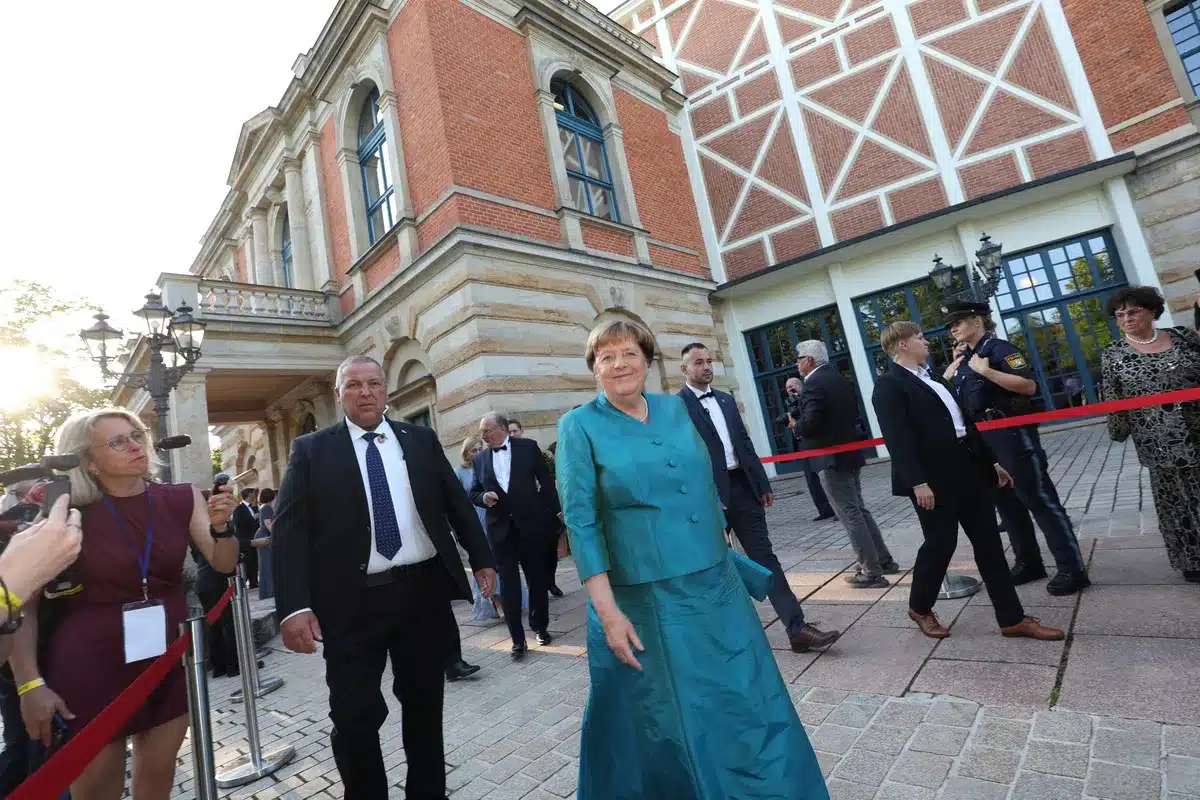
Former German Chancellor Angela Merkel was a notable attendee at a recent performance of Richard Wagner’s epic opera cycle, ‘Der Ring des Nibelungen’ (The Ring of the Nibelung), at the Bayreuth Festival. The marathon performance, spanning four operas, captivated audiences for over 20 hours, including intermissions. Merkel, a known admirer of Wagner’s work, was seated in the first row for the second performance of the ‘Walküre’ (The Valkyrie) installment.
A Dedicated Wagnerian Audience Member
The Bayreuth Festival, renowned for its unique staging and dedicated audience, presents Wagner’s ‘Ring’ cycle in a format that requires significant commitment. The cycle consists of four operas: ‘Das Rheingold’ (The Rhinegold), ‘Die Walküre’ (The Valkyrie), ‘Siegfried’, and ‘Götterdämmerung’ (Twilight of the Gods). Performances are structured with long intermissions, allowing audiences to rest and reflect. The seating arrangement at Bayreuth is also distinctive; with no central aisles, latecomers must disturb the entire row to reach their seats, and those in the middle seats are the last to leave.
Merkel’s presence, while discreet, did not go unnoticed. Despite her international stature as a political figure and her past recognition with the European Civic Prize, she was treated as just another audience member. This understated reception is characteristic of the Bayreuth Festival, where the focus is on the artistic experience. Merkel’s connection to the festival dates back over 30 years, to 1991, when she first attended at the invitation of her husband, Joachim Sauer. Sauer, a distinguished chemist, has often been described as more reserved than his wife, famously not attending her inauguration as Chancellor.
The couple’s public appearances together are rare, often coinciding with the festival’s opening ceremonies, earning them the nickname ‘Opera Ghosts’ due to their infrequent public sightings. Earlier in the festival, Merkel had attended the opening night performance featuring Beethoven’s Ninth Symphony, accompanied by Sauer. However, for the ‘Ring’ cycle performance, Sauer was not visibly present.
Merkel’s Perspective on ‘The Ring’
Merkel has spoken about her deep appreciation for Wagner’s ‘Ring’ cycle, viewing it not merely as an opera but as a profound exploration of human nature and political dynamics. In a 2022 podcast appearance on SWR, she remarked that the opera’s recurring patterns offer insights into the complexities of human society, from personal relationships to political structures. She emphasized that politics should be approached with a focus on reconciliation rather than retribution, suggesting that a cycle of revenge or retribution can be detrimental to political discourse.
Her attendance underscores her long-standing engagement with the work, which she perceives as a rich text for understanding societal patterns. This perspective aligns with the festival’s innovative staging, which often incorporates historical performance images and modern technology, including AI-generated visuals, to enhance the audience’s experience. These visual elements, projected onto a semi-transparent screen, aim to complement the music and singing, creating a dynamic and evolving stage environment for each performance.
A Spectacle of Sound and Vision
The Bayreuth Festival’s 150th-anniversary production of ‘The Ring’ cycle featured a demanding casting strategy, with some principal singers undertaking multiple roles across the four operas. Tenor Klaus Florian Vogt was particularly lauded for his stamina and vocal prowess, performing leading roles in ‘Das Rheingold’, ‘Die Walküre’, ‘Siegfried’, and ‘Götterdämmerung’. His ability to sustain powerful and clear performances throughout the lengthy arias was a highlight for many.
The festival’s commitment to showcasing exceptional talent was evident in the casting of other prominent singers, including Michael Volle as Wotan, Camilla Nylund as Brünnhilde, and Mika Kares in bass roles such as Fasolt and Hagen. These artists delivered powerful interpretations, contributing to the overall grandeur of the production.
The sheer length of the ‘Ring’ cycle is a significant undertaking for both performers and audience. Each of the four operas has a substantial running time: ‘Das Rheingold’ approximately 2 hours and 25 minutes; ‘Die Walküre’ about 5 hours and 40 minutes; ‘Siegfried’ around 5 hours and 55 minutes; and ‘Götterdämmerung’ the longest, at approximately 6 hours and 30 minutes. With two one-hour intermissions for each opera, the total duration for the entire cycle, as experienced at Bayreuth, extends to over 20 hours.
A Shared Experience for Dedicated Fans
The Bayreuth Festival attracts a devoted international following, with many attendees making annual pilgrimages to witness Wagner’s masterpieces. This year’s festival was no exception, with enthusiasts traveling from around the globe. Among the audience members were individuals who have followed the festival for years, sharing their experiences and insights.
Notable attendees included Yoo Jeong-woo, president of the Korea Wagner Society, who provided commentary on the historical staging and the unique aspects of the current production. Lee Wang-joon, director of Myungji Hospital, a self-proclaimed ‘Wagnerian,’ has attended the ‘Ring’ cycle multiple times, completing the full cycle 12 times across various renowned opera houses worldwide. He praised the festival’s experimental use of AI in its staging, acknowledging the innovative approach to a classic work.
Im Jae-in, director of Bundang Seoul National University Hospital, secured tickets for the 150th-anniversary production, highlighting the difficulty of obtaining them due to the requirement of purchasing the entire four-opera cycle package. For many, attending the ‘Ring’ cycle is a deeply rewarding, albeit challenging, experience, fostering a sense of community among those who share a passion for Wagner’s monumental operatic achievements.
The shared experience of enduring the long performances, discussing the nuances of the music and staging during intermissions, and celebrating the artistic triumphs extended beyond the opera house. Many attendees gathered in local restaurants after the performances to continue their discussions late into the night, forging bonds over their shared appreciation for Wagner’s enduring legacy.
Conclusion: More Than Just an Opera
Angela Merkel’s attendance at the Bayreuth Festival’s ‘Ring’ cycle underscores the enduring power and cultural significance of Wagner’s magnum opus. The marathon performances, demanding as they are, offer a unique and immersive experience that draws dedicated audiences from around the world. The festival’s innovative approach, blending tradition with cutting-edge technology like AI, ensures that Wagner’s works continue to resonate with contemporary audiences, offering profound insights into human nature, mythology, and the complexities of the human condition.
