

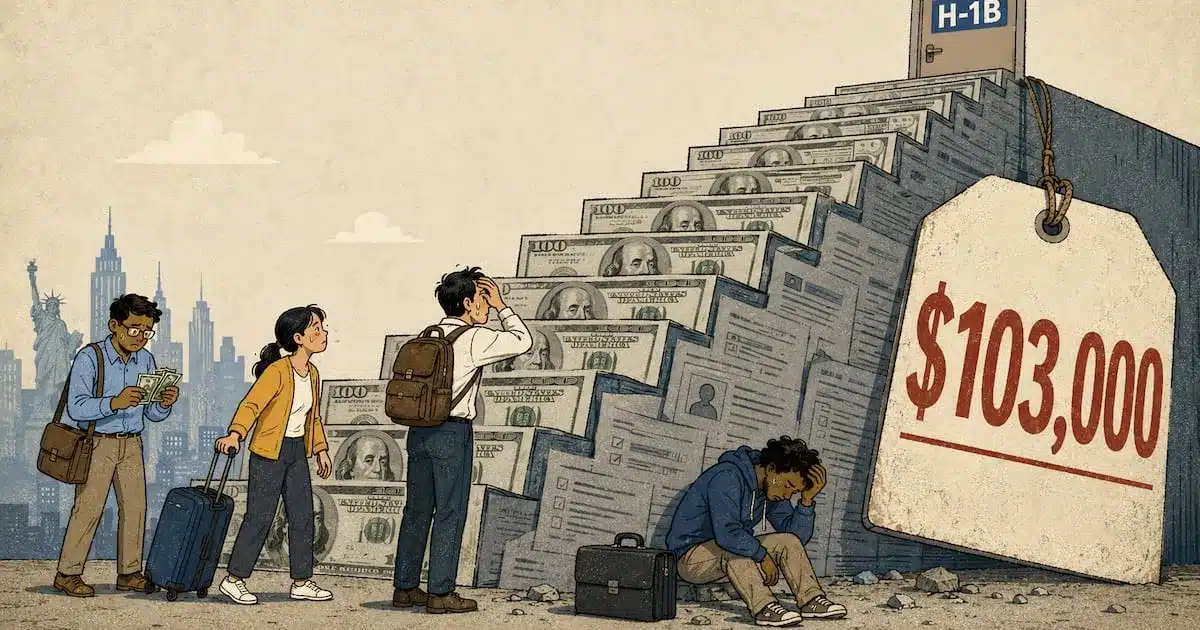
The U.S. Department of Homeland Security (DHS) has proposed a new regulation that would impose significant fees on new H-1B visa applications, potentially costing over $100,000 per applicant. This move is expected to create substantial hurdles for highly skilled professionals, including many from South Korea, seeking employment in the United States.
New Fee Structure for H-1B Visas
The proposed rule, published in the Federal Register, outlines a fee of $103,265 for new H-1B visa applicants. This initiative aims to formalize a fee increase initially suggested by the Trump administration in September of the previous year. While the earlier directive primarily targeted applicants applying from outside the U.S., the new regulation extends this substantial fee to individuals already within the United States who have graduated from American universities and are preparing for employment.
However, certain categories of applicants are slated for exemption from these fees. These include individuals employed by universities as professors, those working for non-profit research institutions, and support staff at hospitals located in rural areas. The H-1B visa is specifically designed for professionals in Science, Technology, Engineering, and Mathematics (STEM) fields. The annual cap for H-1B visas is set at 85,000, with selections typically made through a lottery system.
Impact on South Korean Professionals
Data from the U.S. Department of Homeland Security for the fiscal year 2024 indicates that India and China are the leading countries of origin for H-1B visa recipients, accounting for 71% and 11.7% respectively. South Korea ranks fifth, representing 1% of the total recipients. Based on these statistics, it is estimated that approximately 2,000 South Korean nationals secure these visas annually to work in the U.S.
The proposed fee increase, however, could significantly diminish employment opportunities for these skilled Korean workers. Given that even major tech companies reportedly find it burdensome to cover additional costs exceeding 100 million Korean won (approximately $75,000 USD) per new hire, the new fee structure presents a formidable financial barrier. Reports suggest that the number of H-1B applications has already seen a decline following the initial fee increase proposal last year.
Broader Immigration Policy Context
This proposed fee hike is part of a broader immigration policy framework under the current administration, which emphasizes prioritizing American jobs. Former Vice President Mike Pence expressed support for the fee proposal, stating on social media platform X, “If American businesses need workers, they should hire and train Americans.” A spokesperson for U.S. Citizenship and Immigration Services (USCIS), Jack Harris, explained that the proposed fees are intended to “recoup the costs borne by taxpayers for the adjudication and support of immigration programs.”
The government plans to allocate the projected annual revenue from H-1B fees, estimated at $8.8 billion (approximately $12 trillion Korean won), to the budget of agencies like Immigration and Customs Enforcement (ICE).
Industry and Legal Repercussions
The business community, particularly those reliant on attracting highly skilled foreign talent, has voiced strong opposition to the proposed changes. Neil Bradley, Executive Vice President of the U.S. Chamber of Commerce, criticized the move, warning that it would “create immense cost barriers for startups and small to medium-sized businesses.”
Beyond the H-1B visa, the administration is also considering imposing high fees on the Optional Practical Training (OPT) program, which allows international students to work in the U.S. after graduation. This, coupled with the H-1B changes, could further restrict pathways for foreign talent.
Jerome Powell, a representative from the think tank Center for American Progress, pointed out to The Washington Post that large corporations might be unwilling to pay such fees for their H-1B sponsored employees. Legal challenges are also anticipated. In June, the U.S. District Court for Massachusetts ruled that the President lacks the authority to impose fees on H-1B petitions, deeming the previous attempt unlawful.
Conclusion
The proposed substantial increase in H-1B visa fees represents a significant policy shift with potentially far-reaching consequences for international professionals seeking to work in the United States, particularly those in STEM fields. While the government aims to cover operational costs and prioritize domestic employment, industry leaders and potential applicants express concerns about the economic impact and accessibility of these vital work visas.
