

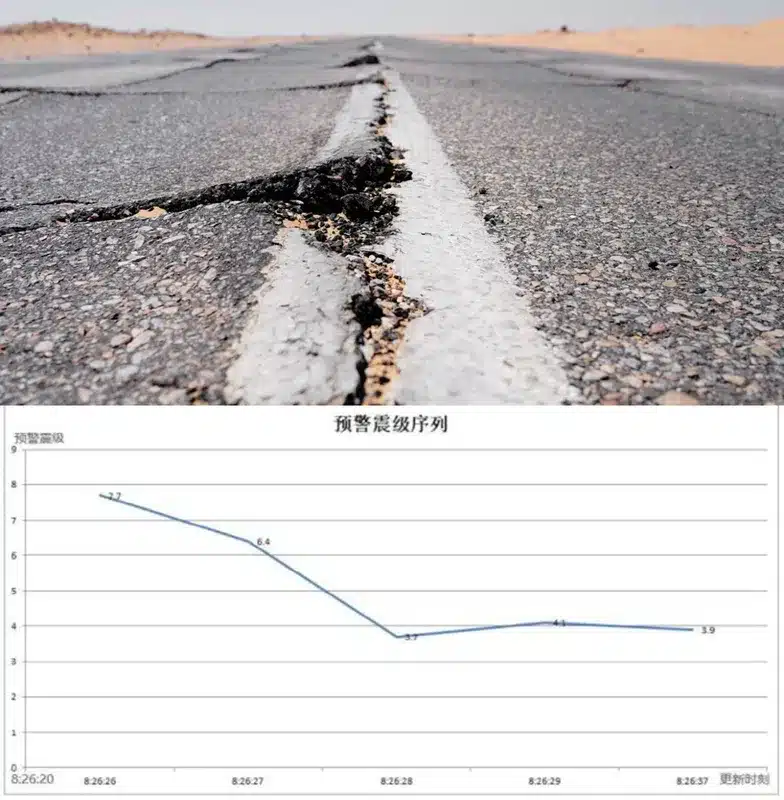
An earthquake early warning system in China’s Sichuan province issued a drastically inaccurate magnitude reading following a 4.7 magnitude tremor, reporting it as a 7.7 magnitude event. The error, which significantly overestimated the earthquake’s size by 3.0 magnitude points, has been officially acknowledged by the operating research institute as the largest discrepancy in 15 years. This incident has sparked public concern and prompted an apology from the responsible scientific body.
Details of the Sichuan Earthquake and Warning Discrepancy
The earthquake occurred on the 24th at approximately 8:26 AM local time, with its epicenter located in Channing County, Yibin City, Sichuan Province. The actual seismic event registered a magnitude of 4.7, with its hypocenter at a depth of 5 kilometers, situated at 28.33 degrees North latitude and 104.98 degrees East longitude. Shortly after the tremor, residents in some areas received alerts on their mobile devices indicating a magnitude of 7.7. This substantial overestimation caused considerable anxiety among the populace.
The erroneous alert was transmitted through the early warning system managed by the Chengdu University of Technology’s Institute of Geochemistry. Initial data released by the institute revealed that the first magnitude calculation, generated just 5 seconds after the earthquake began, was 7.7. This figure was subsequently revised: 6.4 magnitude after 6 seconds, 3.7 after 7 seconds, and 4.1 after 8 seconds. Within 16 seconds, the magnitude stabilized at 3.9, and official confirmation later established the actual magnitude at 4.7.
Institute’s Explanation and Apology
In response to the widespread concern, the Institute of Geochemistry issued a formal apology on its website. The institute explained that the nature of earthquake early warning systems involves automatic data processing immediately after a seismic event, often before the full extent of the earthquake is known. This process can inherently lead to certain degrees of error in magnitude and location estimations.
However, the institute acknowledged that the initial 7.7 magnitude reading far exceeded the normal range of expected deviation. This significant overestimation was confirmed as the most substantial error recorded since the early warning system was made available to the public in September 2011, marking a 15-year period of operation. The institute stated that the first magnitude calculation was indeed significantly higher than the actual event.
Commitment to Improvement and Future Measures
The research institute has pledged to conduct a swift and thorough investigation into the precise causes of this significant error. Furthermore, they have committed to implementing technological improvements and enhancing the overall quality of their early warning services to prevent similar incidents from occurring in the future. Users of the service have been offered an apology for the distress caused by the inaccurate alert.
Understanding Earthquake Early Warning Systems
Earthquake early warning (EEW) systems are designed to detect an earthquake shortly after it begins and provide a warning to surrounding areas before the strong shaking arrives. These systems rely on detecting seismic waves, specifically the faster, less damaging P-waves, to estimate the earthquake’s location and magnitude. The warning is then transmitted through various channels, including mobile alerts, radio, and television broadcasts.
The accuracy of these systems is crucial, as even slight miscalculations can lead to public confusion or undue alarm. The time available for a warning can range from a few seconds to over a minute, depending on the distance from the epicenter. The goal is to provide enough time for people to take protective actions, such as dropping, covering, and holding on, or for automated systems to shut down critical infrastructure like trains or gas lines.
Challenges in EEW include:
- Rapid Data Processing: Systems must analyze seismic data in near real-time, which can be computationally intensive and prone to initial inaccuracies.
- Magnitude Estimation: Accurately determining the magnitude of an earthquake in its very early stages is complex and often requires multiple updates as more data becomes available.
- False Alarms: While rare, the potential for false alarms or significant overestimations, as seen in this Sichuan case, can erode public trust.
- Network Density: The effectiveness of EEW systems depends on a dense network of seismic sensors to quickly detect and triangulate earthquake sources.
Context of Seismic Activity in Sichuan
Sichuan province is located in a seismically active region of China, situated near the boundary of the Indian and Eurasian tectonic plates. This geological setting makes the area prone to earthquakes. The region has experienced several significant seismic events in the past, including the devastating magnitude 7.9 Wenchuan earthquake in 2008, which caused widespread destruction and a high number of casualties. Due to this seismic history, the development and reliability of earthquake early warning systems are of paramount importance to the local population and authorities.
The incident underscores the ongoing challenges in refining seismic monitoring and early warning technologies. While these systems offer a vital layer of safety, continuous improvement and transparent communication regarding their limitations and potential errors are essential for maintaining public confidence and ensuring their effectiveness in mitigating earthquake risks.
