

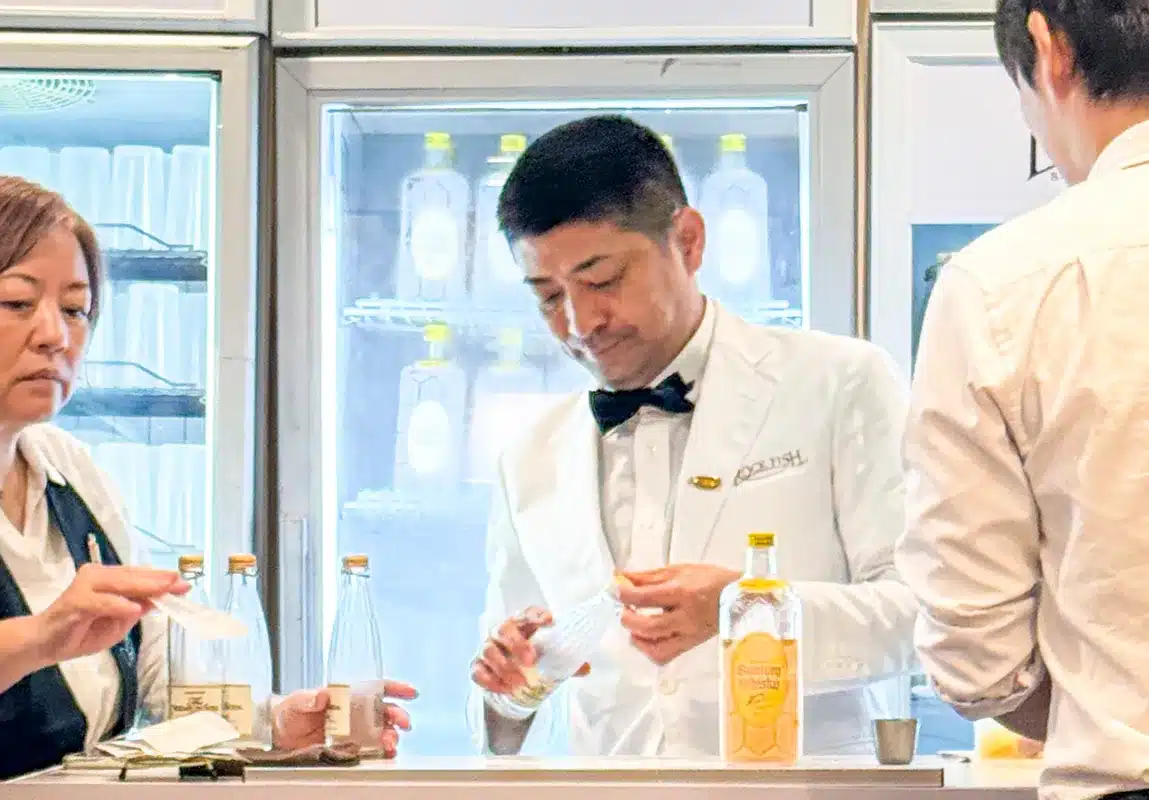
A unique approach to preparing and enjoying the classic highball cocktail is gaining attention, challenging the conventional wisdom of adding ice. This method, championed by Japanese bartender Maguchi Kazunari, focuses on maintaining the drink’s intended flavor profile from the first sip to the last, by eliminating ice altogether. Instead, all ingredients are pre-chilled to extreme temperatures, a technique he calls “pre-chilling.”
The Traditional Highball vs. Maguchi’s Innovation
The standard highball, a popular drink often made with Japanese whisky and soda water, typically relies on ice to achieve its refreshing chill. While ice effectively cools the drink and maintains that coolness for a period, it inevitably melts. As the ice melts, it dilutes the whisky and soda, altering the carefully balanced ratio of spirits to carbonation. This dilution means the taste of the highball changes significantly as it sits, often becoming weaker and less vibrant.
Maguchi Kazunari, who operates the bar ROCK FISH in Tokyo’s Ginza district, observed this phenomenon and sought a solution. His method, developed over years of experience, involves chilling the whisky, the soda water, and even the serving glass to sub-zero temperatures before mixing. This “pre-chilling” ensures that the drink starts at the desired cold temperature without the immediate need for ice to cool it down.
The “Pre-Chilling” Process
The preparation at ROCK FISH is remarkably straightforward once the ingredients are chilled. For instance, a specific recipe might call for 60ml of Suntory Kakubin whisky and 190ml of soda water. The whisky is poured into a frosted glass, followed by the cold soda water. A twist of lemon peel is then added for aroma. Crucially, no ice is used at any stage. This meticulous attention to temperature and ratio is key to Maguchi’s philosophy.
The initial experience of an ice-free highball can be surprising. Without the visual cue of ice, one might question its ability to satisfy. However, the crispness of the carbonation remains sharp, and the whisky’s flavor is distinct and potent. The absence of melting ice means the ratio of whisky to soda water remains constant throughout the drinking process. This consistency is what Maguchi emphasizes as the primary advantage.
Origins of the Ice-Free Highball
Maguchi’s technique is not entirely his own invention but rather an evolution of a style originating from Osaka. He learned the fundamentals at a long-standing bar called Samboa in Osaka during his university days. Samboa, a respected establishment in Japanese bar culture, has a history of serving highballs made with chilled ingredients—whisky, soda, and glass—instead of ice. This method was recognized for its unique characteristic of preventing dilution.
Maguchi adopted this foundational technique and refined it at ROCK FISH. He opened the bar in Kichijoji, Osaka, in 2000, later relocating it to Ginza, Tokyo, in 2002. The ice-free highball became a signature offering, contributing to ROCK FISH’s reputation, particularly as the popularity of highballs surged in Japan. The bar’s adherence to this method, even before the recent highball boom, cemented its status as a notable establishment.
The Debate: Ice vs. No Ice
While Maguchi’s method offers distinct advantages in flavor consistency, it’s not universally superior. The dilution caused by melting ice in a traditional highball isn’t always a negative. The addition of water can mellow the harshness of strong alcohol, allowing the whisky’s aroma and flavor to open up and become smoother. Furthermore, ice allows the drinker to savor the drink slowly, keeping it cold for an extended period.
Maguchi’s approach sacrifices this prolonged chill and gradual mellowing. Instead, he prioritizes a taste that remains unchanged by dilution. The result is a more direct and intense experience of the whisky and carbonation. However, this also means the drink warms up faster, and the carbonation dissipates more quickly without the insulating effect of ice.
The “Three-Cup” Recommendation
The rapid consumption necessitated by the ice-free method leads to Maguchi’s distinctive recommendation: “Drink it in three cups.” This isn’t merely a suggestion but an acknowledgment of the drink’s nature. Without ice acting as a buffer, the highball’s temperature rises and carbonation fades more quickly. The implication is that the drink is best enjoyed rapidly, before its optimal state is lost.
This rapid drinking pace can lead to quicker intoxication, a factor that might be appealing to some patrons and beneficial for bar turnover. However, Maguchi insists his primary motivation is not to accelerate sales but to preserve the integrity of the highball’s flavor from the first sip to the last. His method achieves this by meticulously controlling temperature and ratios, foregoing ice in favor of pre-chilled components.
Conclusion: A Matter of Preference
The choice between a traditional, ice-laden highball and an ice-free version ultimately comes down to personal preference. The traditional method offers a slower, evolving drinking experience, where dilution can enhance smoothness. Maguchi’s ice-free highball provides a consistent, intense flavor profile that emphasizes the purity of the whisky and the sharpness of the carbonation. Both methods have their merits, reflecting different philosophies on how best to appreciate this beloved cocktail. Maguchi’s innovation, however, offers a compelling argument for prioritizing unwavering flavor over prolonged chill, challenging drinkers to consider speed as an ingredient.
